
Last updated April 2026
Criminal Charges for Driving Without Valid Authority in Fort Lauderdale & South Florida
Driver’s license offenses are among the most commonly prosecuted criminal traffic cases in Florida. What begins as a simple traffic stop can quickly turn into a misdemeanor arrest — or even a felony — depending on your record and the status of your driving privileges.
If you have been charged in Fort Lauderdale, Broward County, Miami-Dade, Palm Beach County, or anywhere in South Florida, understanding how Florida law treats license-based offenses is critical.
Unlike civil traffic infractions, these cases are handled in criminal court and can affect your freedom, record, and long-term ability to drive.
For an overview of how these cases fit within Florida’s broader criminal traffic system, see our guide to Criminal Traffic Offenses in Florida.
⚖️ What Counts as a Driver’s License Offense?
Driver’s license offenses generally involve operating a motor vehicle without lawful authority. These cases often arise from:
-
Administrative suspensions
-
Prior criminal traffic convictions
-
Habitual Traffic Offender designations
-
Failure to pay fines or child support
-
DUI-related suspensions
-
Insurance lapses
-
Driving outside hardship restrictions
Penalties may include:
-
Jail or probation
-
Mandatory court appearances
-
Extended license revocation
-
Permanent criminal record
-
Escalation to felony charges
For an overview of how these cases fit within Florida’s broader criminal traffic system, see our Criminal Traffic Offenses in Fort Lauderdale and South Florida guide.
🧠 How Driver’s License Charges Are Actually Filed in South Florida
In many cases, driver’s license offenses are not based on intentional wrongdoing — they arise from administrative issues that escalate during a traffic stop.
In Broward County and across South Florida, we frequently see charges filed when:
- A driver is unaware of a recent suspension
- Court records or DHSMV databases have not updated
- A prior citation or notice was never received
- Multiple minor issues accumulate into a Habitual Traffic Offender (HTO) designation
These cases are often charged quickly at the arrest stage — but the outcome depends on what the State can actually prove.
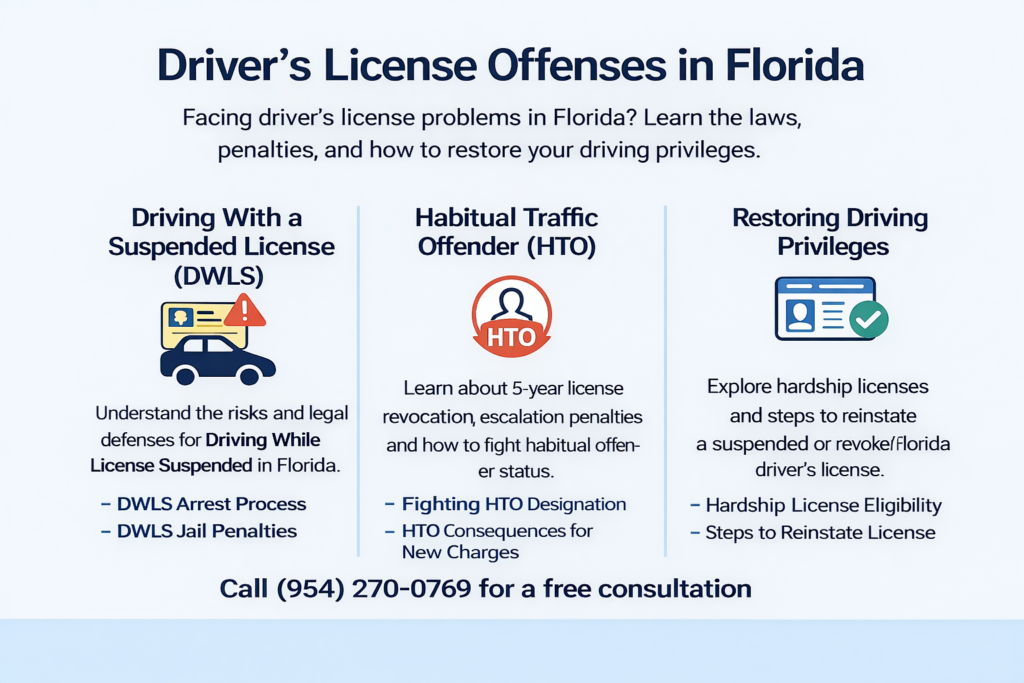
🚔 Driving With a Suspended License (DWLS)
Driving With a Suspended License (DWLS) is prosecuted under Fla. Stat. § 322.34 and is one of the most frequently charged criminal traffic offenses in Florida.
The severity depends on prior convictions and whether the State can prove you knew your license was suspended.
⚖️ What the State Must Prove vs. What They Often Actually Have
Many license-based charges — especially DWLS — depend on proof of knowledge.
But in practice, prosecutors often rely on:
- Mailing records rather than proof of actual notice
- Prior citations without clear acknowledgment
- DHSMV database entries that may be incomplete or outdated
This gap between the legal requirement and the available evidence is where many cases are successfully reduced or dismissed.
Related DWLS Guides:
DWLS cases often hinge on notice, knowledge, and the accuracy of DHSMV records.
🚗 No Valid Driver’s License (NVDL)
Driving without ever having obtained a valid Florida driver’s license is prosecuted differently from DWLS.
Unlike DWLS, these cases do not involve suspension — they involve driving without lawful licensing authority at all.
See our guide to No Valid Driver’s License in Florida.
🚦 Restricted & Hardship License Violations
Many drivers receive restricted driving privileges after suspension. These hardship licenses typically limit driving to:
-
Work
-
School
-
Religious services
-
Medical appointments
Violating these restrictions can result in new criminal charges.
Related Hardship and Restricted Driver’s License Guides:
🧾 Real-World Example: When a License Case Doesn’t Hold Up
In one South Florida case, a driver was charged with Driving With a Suspended License after a routine traffic stop.
The State relied on a database return showing the license as suspended. However, further review revealed:
- The suspension notice had been mailed to an outdated address
- The driver had resolved the underlying issue days earlier
- The DHSMV system had not yet updated
Because the State could not prove the driver had actual knowledge of the suspension, the charge was reduced to a non-criminal infraction.
Situations like this are common — and they often depend on details not visible in the initial arrest report.
⚠️ Habitual Traffic Offender (HTO)
Florida designates certain drivers as Habitual Traffic Offenders under Fla. Stat. § 322.264. An HTO designation triggers a five-year license revocation.
If you are charged with DWLS while designated as an HTO, the offense can escalate significantly.
Related HTO Guides:
HTO status dramatically increases exposure and often changes the defense strategy.
🔄 Restoring Your Driving Privileges
Driver’s license cases involve two separate systems:
1️⃣ Criminal Court
2️⃣ Florida Department of Highway Safety and Motor Vehicles (DHSMV)
Even if your criminal charge is reduced, administrative consequences may remain.
Steps toward restoration often include:
-
Paying reinstatement fees
-
Resolving underlying suspensions
-
Completing required courses
-
Petitioning for hardship privileges
Learn more in How to Reinstate a Suspended License in Florida.
⚠️ Common Mistakes That Make License Cases Worse
Many drivers unintentionally increase their exposure after being charged.
Common mistakes include:
- Ignoring the suspension and continuing to drive
- Failing to check or correct DHSMV records early
- Pleading to DWLS without understanding HTO consequences
- Waiting too long to address reinstatement or hardship eligibility
Early action often determines whether a case remains a misdemeanor — or escalates into a felony-level issue.
🛡️ How We Defend Driver’s License Offenses
Effective defense often involves:
-
Challenging proof of knowledge
-
Reviewing DHSMV notice records
-
Identifying clerical or administrative errors
-
Negotiating diversion or withhold of adjudication
-
Preventing felony escalation
-
Coordinating hardship eligibility
Because repeat license offenses can snowball into Habitual Traffic Offender status, early intervention is critical.
🌎 Immigration & Professional License Risks
Driver’s license convictions may:
-
Impact CDL eligibility
-
Affect immigration status
-
Interfere with professional licensing
-
Increase insurance premiums
Avoiding a formal conviction can protect long-term consequences.
In many cases, the most important issue is not whether the license was suspended — but whether the State can prove the driver knew it.
📍 Driver’s License Offense Defense in Fort Lauderdale & South Florida
If you are facing DWLS, NVDL, HTO, or hardship violations, the consequences can extend far beyond a simple traffic stop.
Michael White, P.A. provides strategic criminal defense representation for license-based traffic offenses throughout Fort Lauderdale and South Florida.
📞 Call (954) 270-0769 for a confidential consultation.
Protect your license.
Protect your record.
Protect your future.
💬 Frequently Asked Questions – Driver’s License Offenses in Florida
Is driving with a suspended license a criminal offense in Florida?
Yes. Driving With a Suspended License (DWLS) is a criminal charge under Florida law and is prosecuted in criminal court. Penalties depend on prior history and whether the State can prove knowledge of the suspension. Learn more in Driving With a Suspended License in Florida.
Does the State have to prove I knew my license was suspended?
In most criminal DWLS cases, the prosecution must prove that you had knowledge of the suspension. This often involves DHSMV notice records or prior citations. See how this element is challenged in How Florida Proves You Knew Your License Was Suspended.
How many DWLS convictions before jail becomes likely?
Repeat DWLS offenses increase jail exposure and may lead to enhanced penalties depending on your record. For a breakdown of how courts treat repeat offenses, see Can You Go to Jail for DWLS in Florida?.
What is a Habitual Traffic Offender (HTO) in Florida?
A Habitual Traffic Offender designation occurs when a driver accumulates qualifying convictions within a specified timeframe. HTO status results in a mandatory five-year license revocation and significantly increases the severity of future charges. Learn more in Habitual Traffic Offender in Florida.
Can I get a hardship license after my license is suspended?
In many cases, drivers may be eligible for restricted driving privileges for work or business purposes. Eligibility depends on the type of suspension and prior record. Learn more in Hardship License in Florida.
What happens if I violate the terms of a hardship or restricted license?
Driving outside the permitted scope of a restricted license can result in new criminal charges and additional suspension. These violations are prosecuted separately from the original suspension. See Restricted License Violations in Florida for more information.
Can driver’s license offenses be sealed or expunged?
Some license-related offenses may qualify for sealing if adjudication is withheld and other statutory requirements are met. Eligibility depends on the specific charge and outcome. Learn more in Sealing and Expungement in Florida.