
Last updated April 2026
In Florida, simply driving with a suspended license is not automatically a crime.
To convict someone of Driving With a Suspended License (DWLS) under Fla. Stat. § 322.34, the State must prove something very specific:
👉 That you knew your license was suspended, revoked, or canceled.
That “knowledge” element is often the central battleground in DWLS cases.
For a broader overview of license-based criminal charges, see our guide to Driver’s License Offenses in Florida.
This page focuses only on how prosecutors attempt to prove knowledge — and how those claims are challenged in court.
For a full explanation of the DWLS charge and penalties, see our guide to Driving With a Suspended License in Florida.
⚖️ The Legal Standard: “With Knowledge”
Under § 322.34(2), criminal DWLS requires proof that:
-
You were driving a motor vehicle, and
-
You knew your driving privilege was suspended.
If the State cannot prove knowledge, the charge may be reduced to a civil infraction under § 322.34(1).
That difference determines whether the case is:
-
A criminal misdemeanor
-
Or a non-criminal traffic citation
The entire case often turns on that distinction.
If you’ve already been charged, see what the process looks like in What Happens After a DWLS Arrest in Florida.
🧾 How Prosecutors Try to Prove Knowledge
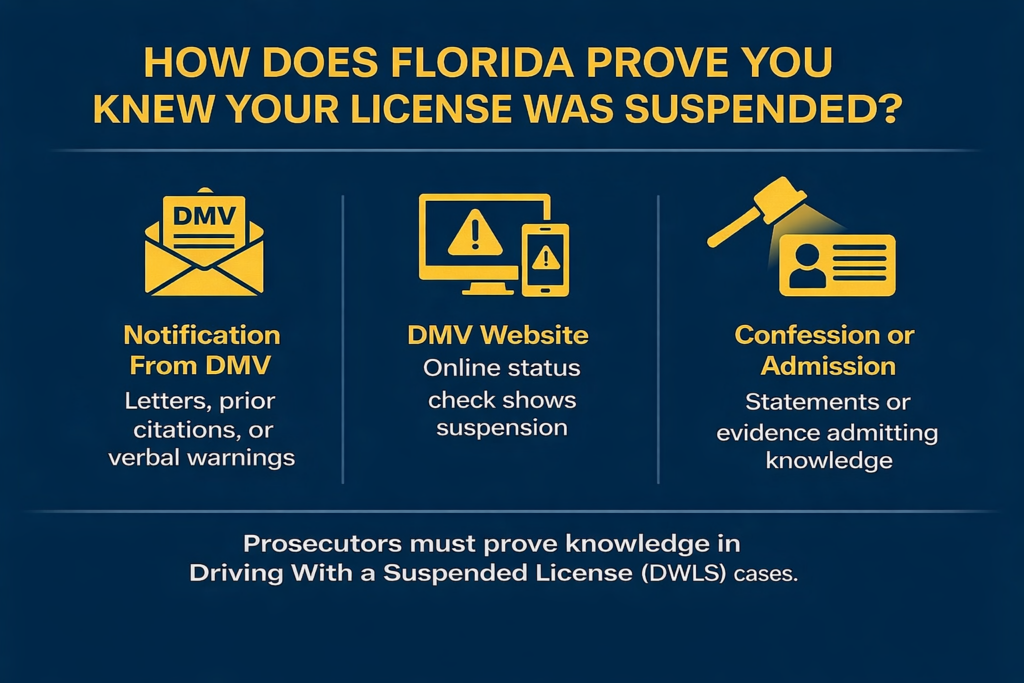
Florida prosecutors typically rely on several types of evidence.
📬 1️⃣ Notice from the DHSMV
The most common method is proof that the Florida Department of Highway Safety and Motor Vehicles (DHSMV) mailed a suspension notice to your last known address.
The State may introduce:
-
DMV mailing records
-
Certified driving record
-
Suspension history printouts
However, mailing does not automatically equal actual knowledge.
If the address was outdated or incorrect, knowledge becomes disputable.
🚓 2️⃣ Prior Traffic Citations
Prosecutors often argue knowledge based on prior interactions, such as:
-
A previous DWLS citation
-
A written warning
-
A court appearance related to suspension
-
A judge’s statement during sentencing
If you were previously told in open court that your license was suspended, the State will rely heavily on that record.
🖥️ 3️⃣ Electronic or Online Status Checks
In some cases, the State argues that drivers:
-
Checked their status online
-
Received electronic notification
-
Signed documents acknowledging suspension
But prosecutors must still prove that the defendant personally accessed or understood the information.
🗣️ 4️⃣ Admissions or Statements
Statements made during a traffic stop can be used to argue knowledge.
For example:
-
“Yeah, I know it’s suspended.”
-
“I just haven’t fixed it yet.”
-
“I’m working on getting it back.”
Even casual remarks can be used as evidence of knowledge.
This is why speaking carefully during traffic stops matters.
🚨 When Knowledge Is Harder to Prove
There are many real-world scenarios where knowledge is legitimately disputed:
-
Mail sent to an old address
-
Administrative suspension without clear notice
-
Confusion between suspension and expiration
-
Third-party handling of paperwork
-
Clerical errors in DMV records
-
Recent reinstatement not yet updated in the system — see How to Reinstate a Suspended License in Florida.
In these situations, the prosecution’s case can weaken significantly.
🛡️ Challenging Knowledge in DWLS Cases
Effective defenses often focus on undermining the State’s proof.
Common defense strategies include:
✔ Address Discrepancies
If the DMV mailed notice to an outdated address, proof of receipt may be weak.
✔ No Direct Notice
If the defendant never signed or acknowledged a suspension document, knowledge may be contested.
✔ Administrative Error
DMV databases are not infallible. Clerical errors can occur.
✔ Misclassification
Sometimes drivers are charged under the “with knowledge” subsection when facts only support a civil infraction.
✔ No Proof Beyond a Certified Record
A certified driving record alone may not establish actual knowledge.
In many cases, successfully challenging knowledge results in a reduction from criminal DWLS to a civil violation. That distinction can also affect incarceration risk — see Can You Go to Jail for DWLS in Florida?.
🔄 Why Knowledge Matters for Repeat Offenses
Knowledge is especially important in repeat cases.
Prior convictions may:
-
Increase sentencing exposure
-
Contribute to Habitual Traffic Offender (HTO) designation
-
Elevate a case to felony level
👉 Learn more about Habitual Traffic Offender (HTO) consequences in Florida.
Because knowledge is an element of criminal DWLS, proving or disproving it can dramatically change the case outcome.
🧠 The Bottom Line
Florida cannot convict you of criminal DWLS without proving knowledge.
That proof typically comes from:
-
DMV notice
-
Prior citations or court appearances
-
Admissions
-
Documentary records
But knowledge is often more complicated than it appears on paper.
Early legal review can determine whether the State can actually meet its burden — or whether the charge should be reduced or dismissed.
👨⚖️ Fort Lauderdale DWLS Defense Lawyer
If you are facing a DWLS charge in Fort Lauderdale or South Florida, the knowledge element may be the most important issue in your case.
As a former prosecutor, Michael White understands how knowledge is proven — and how it is challenged.
📞 Call (954) 270-0769 or schedule a confidential consultation today.
Protect your license.
Protect your record.
Protect your future.