
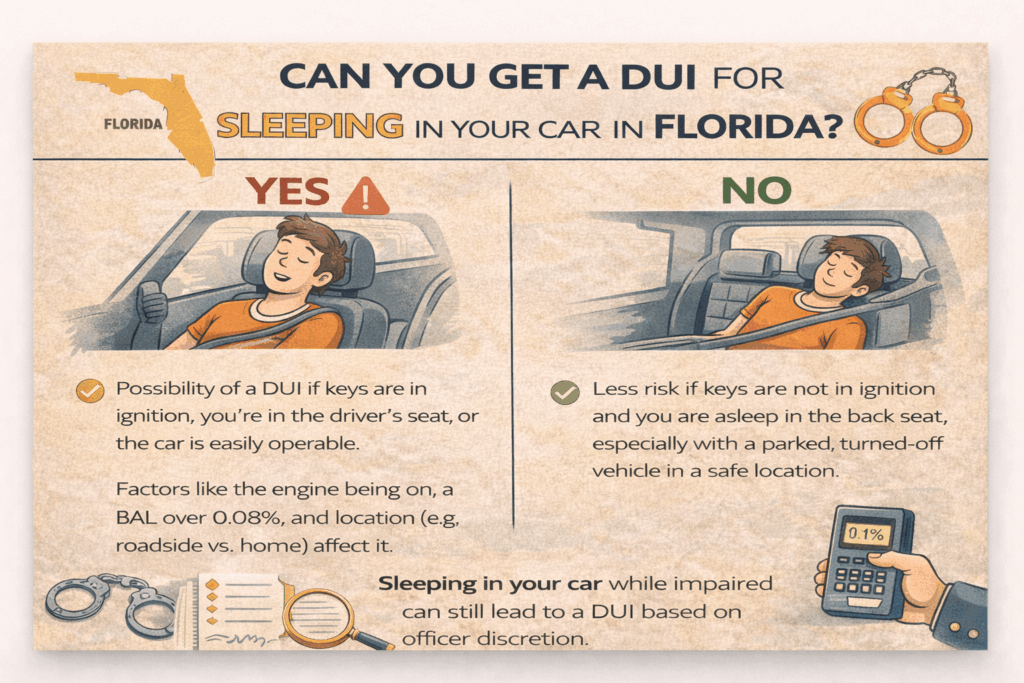
Last updated March 2026
Many people assume that if they’re not driving, they can’t be arrested for DUI. In Florida, that assumption is often wrong.
Across Fort Lauderdale and Broward County, DUI arrests frequently happen when someone is sleeping in a parked car—sometimes after doing what they thought was the responsible thing: pulling over, waiting for a ride, or trying to “sleep it off.”
Under Florida law, you do not have to be driving to be charged with DUI.
To understand how Florida law defines control in parked-car DUI cases, see our guide to Actual Physical Control in Florida DUI Cases.
⚖️ Florida DUI Law Does Not Require Driving
Florida’s DUI statute does not require proof that a vehicle was moving. A person may be arrested for DUI if the State claims they were:
impaired by alcohol or drugs, and
in actual physical control of a vehicle.
This is why sleeping-in-the-car cases are so common—and so aggressively charged.
In many of these situations, the strongest defense strategy is not arguing intent, but challenging and suppressing the DUI evidence used to justify the arrest.
🚘 What “Actual Physical Control” Means in Florida
“Actual physical control” is not defined by a single factor. Instead, courts look at whether the person had the present ability to operate the vehicle, even if they never intended to drive.
Key factors officers and prosecutors rely on include:
Where you were located inside the car
Whether the keys were accessible
Whether the engine was running or warm
Whether the vehicle was operable
Where the car was parked
Sleeping alone does not automatically equal control—but these surrounding facts often drive the arrest decision.
🗝️ The Role of Keys and Engine Status
One of the most common issues in sleeping-in-car DUI cases is key access.
Police may argue control if:
the keys were in your hand or pocket,
the keys were in the ignition,
the engine was running for heat or air conditioning.
Defense arguments become stronger when:
the keys were stored away from the driver’s seat,
the engine was off, which we break down further in our guide to DUI Charges When the Engine is Off in Florida.
the car was disabled or out of gas.
Small factual differences matter enormously in these cases.
🅿️ Where the Car Was Parked Matters
Location often plays a major role in whether DUI charges hold up.
Sleeping in your car:
in a private driveway,
behind a gated community,
in a parking lot after hours,
or while waiting for a tow or rideshare, including scenarios involving waiting for a tow or rideshare during a DUI investigation
can weaken the State’s argument that you posed a risk to the public.
These details often intersect with the broader doctrine of actual physical control, which courts analyze case-by-case rather than by bright-line rules.
🧪 Testing Delays and Sleeping-in-Car DUI Arrests
Many sleeping-in-car arrests begin as welfare checks, not traffic stops. That creates timing problems for the State.
Common issues include:
long delays before sobriety testing,
alcohol absorption while the person was asleep,
officers relying heavily on subjective observations,
breath or blood tests conducted well after any alleged driving.
🚨 Why These Cases Are Often Defensible
Sleeping-in-the-car DUI cases often rest on assumptions rather than proof.
Common defense angles include:
lack of probable cause to escalate a welfare check,
weak evidence of actual physical control,
unlawful or extended detention,
unreliable testing after long delays,
bodycam footage that contradicts officer reports.
In many cases, the most effective approach is filing a motion to suppress evidence obtained during the encounter.
📌 What to Do If You Were Arrested While Sleeping in Your Car
If you were arrested for DUI while sleeping in your vehicle, the case is not automatic—and it is not hopeless.
These cases often turn on:
facts that officers overlooked,
procedural mistakes,
and whether the evidence can be legally excluded.
Understanding how Florida courts evaluate sleeping-in-car arrests is critical to protecting your license, your record, and your future.
For a broader overview of the DUI process and what happens next, see our guide on Florida DUI cases from arrest through resolution.
✅ Key Takeaways
You can be charged with DUI in Florida without driving
Sleeping in your car does not automatically protect you
Actual physical control depends on surrounding facts
Many sleeping-in-car DUI cases are defensible
Suppressing evidence is often the strongest strategy
❓ Frequently Asked Questions About Sleeping in Your Car and DUI in Florida
Can you really get a DUI in Florida without driving?
Yes. Florida law does not require proof that you were driving. A DUI charge can be based on whether police believe you were in actual physical control of a vehicle while impaired.
Is it illegal to sleep in your car if you’ve been drinking?
Sleeping in your car is not automatically illegal. However, if police believe you had the ability to operate the vehicle—based on factors like key access, engine status, or where you were parked—they may still make a DUI arrest.
Does it matter where the keys were located?
Yes. Key location is one of the most important factors in sleeping-in-the-car DUI cases. Keys in the ignition, your hand, or your pocket can support a claim of control, while keys stored away from the driver’s seat may weaken the State’s case.
What if the engine was off the entire time?
An engine being off helps the defense, but it does not automatically prevent a DUI charge. Officers may still argue control if the vehicle was operable and the keys were accessible.
Can police turn a welfare check into a DUI arrest?
Yes. Many sleeping-in-the-car DUIs begin as welfare checks. Whether officers were legally justified in escalating that encounter into a DUI investigation is often a key defense issue.
Does sleeping in a parking lot or private property make a difference?
It can. Being on private property, in a gated area, or somewhere with limited public access may weaken the argument that you posed a danger to the public—an important consideration in DUI cases.
What if I was waiting for a ride or tow truck?
Waiting for a tow, rideshare, or ride home can support a defense that you had no intent to drive. While intent alone does not control the case, it can undermine the State’s theory when combined with other facts.
Are breath or blood tests less reliable in these cases?
Often, yes. Sleeping-in-the-car arrests frequently involve delays before testing, which can raise issues such as rising BAC, alcohol absorption, or unreliable observations.
Are sleeping-in-the-car DUI cases defensible?
Very often. These cases frequently involve questionable probable cause, weak evidence of control, testing delays, or procedural errors that can support suppression or dismissal.