
Last updated March 2026
Yes, it is possible.
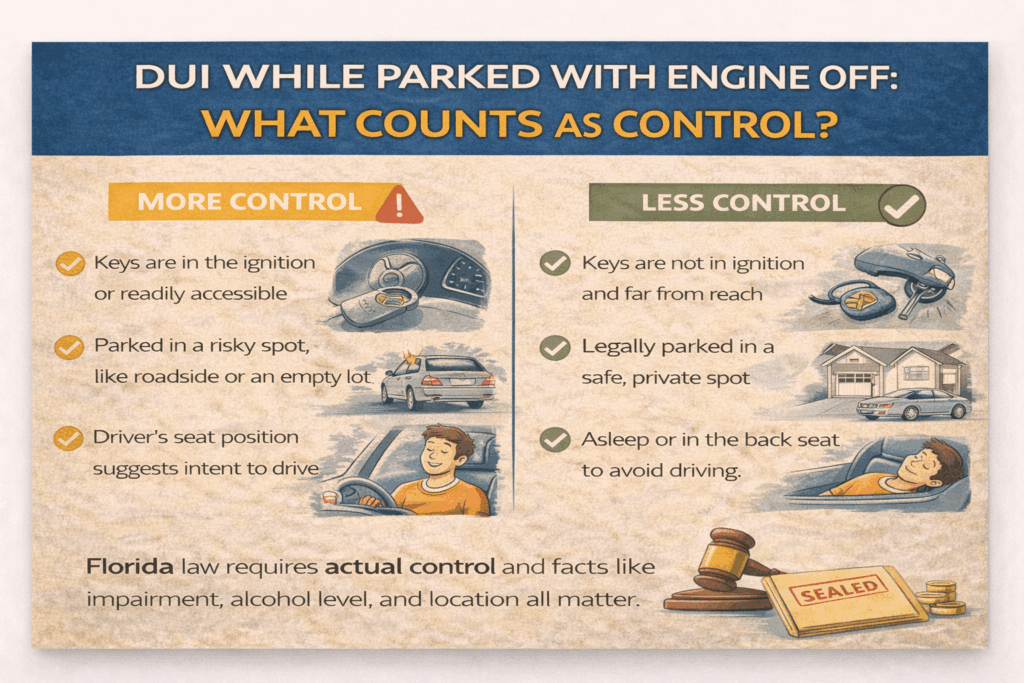
Florida DUI cases can be based on actual physical control, not just driving. To understand how Florida law defines control in parked-vehicle cases, see our guide to Actual Physical Control in Florida DUI Cases. Officers often claim “control” when they believe a person had the ability to operate the vehicle, even if they were sitting still and the engine was not running.
That said, “engine off” facts often create strong defense angles because they tend to weaken the State’s argument that the person posed an immediate risk.
In many engine-off cases, the strongest defenses often focus on whether police lawfully escalated the encounter and whether the State can rely on the evidence it gathered.
🚘 What “Actual Physical Control” Means in Engine-Off Cases
Actual physical control is a fact-specific issue. Courts look at whether the State can argue you had the present ability to start and operate the car.
The engine being off helps — but it is not automatically a defense.
Officers will typically focus on:
where you were seated,
where the keys were located,
whether the vehicle was operable,
and why police approached you in the first place.
🗝️ Key Location Matters More Than Engine Status
In parked-car DUI cases, key access is often the biggest battleground.
Prosecutors tend to argue control when:
keys were in your hand or pocket,
keys were within reach (console, cup holder),
keys were in the ignition (even if not turned),
the car could easily be started.
Defense arguments often get stronger when:
keys were stored away from the driver’s seat,
keys were not in the ignition,
the person was in the passenger seat or back seat,
there is no evidence the person intended or attempted to start the car.
🔧 “Operability” Can Be the Hidden Issue
Even if keys are nearby, the State still has to convince the court the vehicle was realistically operable.
Engine-off cases can raise real operability questions, such as:
dead battery,
mechanical problems,
no fuel,
the car being blocked in,
the person not having a valid key (or key fob issues).
If the vehicle could not reasonably be driven, “control” becomes harder to prove.
🅿️ Where You Were Parked Can Change the Entire Case
Parking location influences how prosecutors frame risk to the public.
Being parked:
in a private driveway,
on private property,
in a gated community,
or somewhere the public does not have access including situations involving waiting for a tow or rideshare during a DUI investigation
can weaken the argument that you created danger to others.
Location also ties into whether officers had lawful grounds to approach you and escalate a welfare check into a DUI investigation. We explore these issues further in cases involving DUI arrests in parking lots and drive-thru settings.
🚨 How These Encounters Start (And Why It Matters)
Many engine-off DUIs begin as:
a welfare check,
a suspicious vehicle call,
a parking lot patrol encounter,
or an officer “checking” someone who appears asleep.
These situations frequently overlap with cases involving sleeping in your car during a DUI investigation.
The legality of the escalation matters. A lawful welfare check does not automatically justify a full DUI investigation, prolonged detention, or testing unless the officer develops legal grounds to do so.
Bodycam footage often becomes critical in showing what was actually said, observed, and done.
🧪 Testing Problems Are Common in Parked, Engine-Off Arrests
Because the car is not moving, these cases often involve time gaps.
That creates testing and timing issues like:
delay before sobriety exercises,
delay before breath or blood testing,
alcohol absorption while the person was sitting or resting,
subjective “impairment” claims without driving behavior.
These details can undermine the reliability of the State’s evidence.
✅ Key Takeaways: Engine Off Does Not Automatically Protect You
You can be charged with DUI in Florida even if the engine was off
Actual physical control is based on facts like keys, seat position, and operability
Private property and welfare-check encounters create defense opportunities
Many cases are defensible through suppression and evidentiary challenges
❓ Frequently Asked Questions
Can I get a DUI if I’m parked with the engine off in Florida?
Yes. Police may still claim you were in actual physical control if they believe you could have started and driven the vehicle.
Are keys in my pocket enough for a DUI arrest?
They can be. Officers often use key access to claim control, especially if you were in the driver’s seat and the car was operable.
What if I was sleeping but the engine was off?
Sleeping may reduce risk, but the State may still argue control depending on key location, where you were seated, and vehicle operability.
Does it help if I was in a private parking lot or driveway?
It can. Location may affect both the “risk to the public” narrative and the legality of police escalating the encounter into a DUI investigation.
Are these cases defensible?
Often, yes. Many engine-off cases have weak proof of actual physical control or involve legal issues with the stop, detention, or testing.