
Last updated March 2026
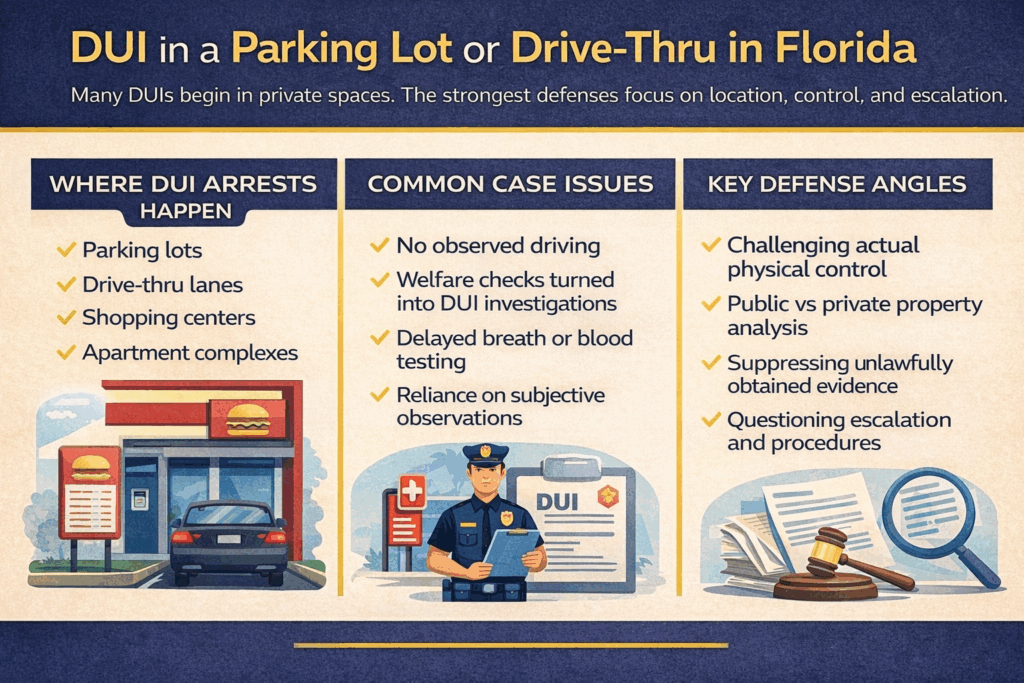
Many DUI arrests in Florida don’t happen on public roads. They happen in parking lots, shopping centers, apartment complexes, or drive-thru lanes—often when a driver believes they are on private property and not subject to DUI laws.
That belief can be dangerous.
Florida DUI law does not require that a vehicle be stopped on a public roadway. What matters is whether the State can claim impairment and actual physical control of a vehicle.
To understand how Florida law defines control in these situations, see our guide to Actual Physical Control in Florida DUI cases.
⚖️ Can You Get a DUI in a Parking Lot or Drive-Thru?
Yes. Florida courts have consistently held that DUI charges can arise in parking lots and drive-thru lanes, even though they are not traditional roadways.
Police often argue that these areas are:
open to the public,
connected to public roads,
or places where impaired driving can still pose a risk.
That said, location matters, and parking-lot DUI cases often expose weaknesses in the State’s proof.
🚘 Public vs. Private Property: Why It Matters
Not all parking lots are treated the same.
Courts often consider:
whether the area was open to the public,
whether access was restricted or gated,
whether the business was open or closed,
whether signage limited entry.
A gated apartment complex, closed business lot, or restricted private property can weaken the State’s claim that the driver posed a danger to the public.
🍔 DUI Arrests in Drive-Thru Lanes
Drive-thru DUI arrests are surprisingly common.
They often begin when:
a driver is stopped in line,
employees call police due to perceived impairment,
or officers observe a vehicle idling for an extended period.
Because the vehicle is often stationary, drive-thru cases frequently raise actual physical control questions rather than traditional driving evidence.
🗝️ Keys, Engine Status, and Vehicle Position
In parking-lot and drive-thru cases, officers rely heavily on circumstantial facts, including:
whether the engine was running — an issue we explore further in DUI charges when the engine is off in Florida
whether the vehicle was in gear,
where the driver was seated,
where the keys were located.
Small factual details can dramatically affect whether the State can prove control.
🚔 How These Encounters Begin (And Why It Matters)
Many parking-lot DUI cases begin as:
welfare checks, including situations involving sleeping in your car during a DUI investigation
suspicious-vehicle calls,
or business-initiated complaints.
These cases may also involve drivers who were waiting for a tow or rideshare during a DUI investigation.
A lawful initial encounter does not automatically justify:
field sobriety exercises,
or chemical testing.
Whether officers had legal grounds to escalate the encounter is often a central defense issue.
🧪 Testing Problems in Parking-Lot DUI Cases
Because these cases often involve delayed observation, testing issues are common.
Problems frequently include:
no observed driving behavior,
reliance on subjective impairment indicators,
delayed breath or blood testing,
alcohol absorption after the vehicle stopped.
✅ Key Takeaways
You can be charged with DUI in a parking lot or drive-thru in Florida
Public access and property status matter
Actual physical control is often the State’s theory
Testing delays and lack of driving evidence are common
Many cases are defensible through suppression
❓ Frequently Asked Questions
Can you get a DUI on private property in Florida?
Sometimes. If the area is open to the public or connected to public roads, police may still make a DUI arrest. Truly private or restricted property can weaken the State’s case.
Does sitting in a drive-thru count as driving?
Not necessarily. Drive-thru cases often hinge on whether the driver was in actual physical control rather than whether the vehicle was moving.
What if my car wasn’t moving in the parking lot?
Lack of movement helps the defense, but officers may still claim control based on keys, engine status, or seating position.
Are parking-lot DUI cases defensible?
Very often. These cases frequently involve weak evidence of control, questionable escalation, or unreliable testing.