
Last updated March 2026
⚖️ Understanding Florida DUI Law — Before Strategy Comes Into Play
Florida DUI law defines when a person can be charged, what conduct qualifies, and how cases are evaluated — but it does not determine the outcome of a case by itself.
A DUI charge is not limited to alcohol, does not always require observed driving, and can trigger consequences before a case ever reaches court.
This page explains the legal framework of DUI in Florida — including how the law defines impairment, testing, and driving — before any defense strategy is applied.
For a complete overview of DUI charges, defense strategy, and how cases are handled in South Florida, see our guide to Fort Lauderdale DUI Lawyer.
📜 How Florida Defines DUI
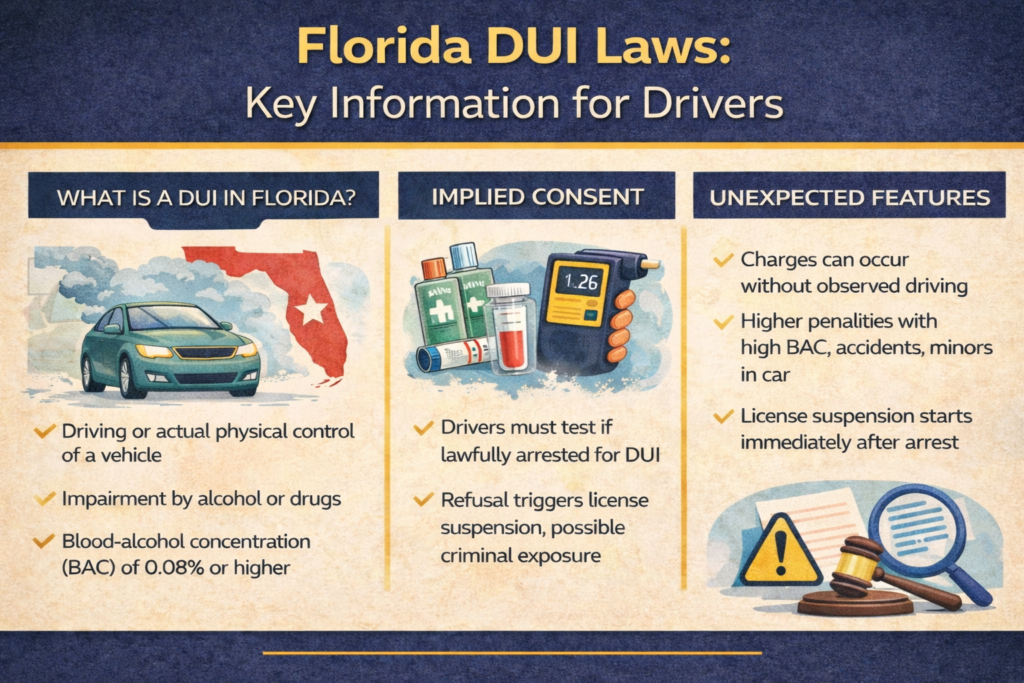
Under Florida law, a person may be charged with DUI if they are:
- driving, or
- in actual physical control of a vehicle
while either:
- impaired by alcohol, drugs, or a chemical substance, or
- having a blood-alcohol concentration (BAC) of 0.08% or higher
Importantly, Florida law does not require observed driving.
A person may be arrested even if the vehicle is parked, depending on the circumstances.
🚗 “Actual Physical Control” Under Florida DUI Law
Florida’s DUI statute allows charges even when a vehicle is not moving.
Courts evaluate “actual physical control” based on:
- the person’s position in or near the vehicle
- access to the keys
- whether the vehicle was operable
- surrounding circumstances
This broad definition explains why DUI arrests can occur in parking lots, private property, or stationary vehicles.
For a deeper analysis of how this doctrine is applied, see DUI Actual Physical Control in Florida.
🧪 Implied Consent and Chemical Testing
Florida enforces an implied consent law.
By driving in the state, motorists are deemed to have consented to lawful breath, blood, or urine testing following a DUI arrest.
Key principles include:
- refusal carries separate consequences
- license suspension may occur before conviction
- testing procedures must follow strict rules
Chemical testing plays a central role in DUI prosecutions.
For a full breakdown of testing procedures and legal challenges, see Florida DUI Testing.
🚔 DUI Stops and Investigations Under Florida Law
Before any arrest occurs, law enforcement must comply with legal standards governing stops and investigations.
These include:
- reasonable suspicion for a traffic stop
- lawful detention procedures
- proper escalation to a DUI investigation
If these standards are not met, the case may be challenged.
For a detailed explanation of how DUI stops are evaluated, see DUI Traffic Stops & Investigations in Florida.
⚖️ Suppression and Legal Challenges
Florida DUI law does not operate in isolation.
How evidence is obtained — including stops, searches, and testing — can determine whether that evidence is admissible in court.
Legal challenges often focus on:
- unlawful stops
- improper detention
- illegal searches
- flawed testing procedures
These issues are addressed through suppression arguments.
For a deeper look at how DUI evidence is challenged, see Suppressing DUI Evidence in Florida.
🚗 Administrative License Law and the 10-Day Rule
Florida DUI law includes both criminal and administrative components.
After an arrest, drivers typically have 10 days to act before license consequences take effect.
This process is handled separately from criminal court and follows its own rules.
For a full explanation of how license suspension works, see Florida DUI License Suspension & the 10-Day Rule.
⚖️ Penalties Under Florida DUI Law
Florida DUI law includes escalating penalties based on:
- prior offenses
- BAC level
- presence of injury or property damage
- other aggravating factors
These penalties may include fines, probation, license consequences, and possible incarceration.
For a full breakdown of penalties, see Florida DUI Penalties.
🧠 DUI Law vs. DUI Case Outcomes
Understanding the law is only the first step.
A DUI case is ultimately shaped by:
- how the law applies to the facts
- how evidence is obtained and challenged
- how the case is handled procedurally
For a step-by-step breakdown of how DUI cases are defended, see DUI Process & Defense Strategy in Florida.
⚠️ DUI Law Affects More Than Court Outcomes
Florida DUI law impacts more than criminal charges.
It can affect:
- your ability to drive
- your employment
- your professional licensing
- your long-term record
For a deeper look at these real-world impacts, see What Happens After a DUI in Florida? Consequences That Affect Your Life.
📍 Charged With DUI in Florida?
Understanding Florida DUI law is the starting point.
What matters next is how the law is applied to your case — and how your defense is structured from the beginning.
❓ Frequently Asked Questions About Florida DUI Law
Can I be charged with DUI if I wasn’t driving?
Yes. Florida law allows DUI charges based on actual physical control, even if the vehicle was not moving.
Does DUI only apply to alcohol?
No. Florida DUI law applies to alcohol, drugs, prescription medications, or any combination that allegedly impairs normal faculties.
Is a first DUI always a felony in Florida?
No. Most first DUIs are misdemeanors, but charges can become felonies depending on prior history, injuries, or other aggravating factors.
Will my license be suspended after a DUI arrest?
Possibly. License suspension is handled separately from the criminal case and can begin shortly after arrest unless challenged.
Can DUI charges be dismissed under Florida law?
Yes. DUI cases are dismissed or reduced when the State cannot meet its burden of proof or when evidence is excluded.