
Last updated April 2026
In most cases, people charged with a crime in Florida have a legal right to pretrial release or bail. However, for certain serious charges—especially those punishable by life in prison or death—you may be held in jail without bail until trial.
Pretrial detention decisions are made during the earliest stage of a criminal case — typically at first appearance. To understand how arrest, booking, and initial hearings unfold in Florida, see how arrests and first appearance work in Florida criminal cases.
If you’re worried about whether you or a loved one could be denied bail, it’s critical to speak with a Florida criminal defense attorney immediately.
⚖️ When Can the Court Deny Bail?
Under Florida law, everyone is entitled to pretrial release unless:
- The person is charged with a capital offense or a life-punishable felony,
- AND the evidence against them meets a strict standard called “proof evident, presumption great.”
These decisions are typically addressed during the Florida bond hearing process, where the judge evaluates whether release is appropriate.
This is an exceptionally high evidentiary standard that requires the State to present clear and convincing proof that the accused committed the charged offense.
If these criteria are met, the court may deny bail and keep the defendant in custody until trial.
In Broward County, judges often look beyond the charge itself and focus on factors such as the strength of the evidence, prior record, and community ties. Even in serious cases, these factors can influence whether a defendant is held without bond or granted release under strict conditions.
🔴 Capital Offenses
A capital offense is a crime punishable by the death penalty. Examples include:
- First-degree murder
- Terrorism
- Treason
- Espionage
Because of the severity of these charges and the high risk of flight, courts frequently deny bail entirely in these cases.
🔒 First-Degree Felonies Punishable by Life
Not all first-degree felonies are capital offenses, but some still carry life imprisonment as a possible sentence. These include:
- Rape / Sexual battery
- Kidnapping
- Armed carjacking
- Arson of an occupied dwelling
- Armed burglary of a home with occupants inside
In these situations, if the prosecution can establish proof evident, presumption great, the judge has the legal authority to deny pretrial release.
🔐 What Happens If You’re Denied Bail?
If you are denied bail, you will remain in jail before trial in Florida, which could take months —or longer—depending on the complexity of the case and court scheduling.
In many cases, the outcome of early bond hearings can shape the entire trajectory of a case—affecting negotiation leverage, timing, and how prosecutors approach resolution.
But not all is lost. A defense attorney can:
- Challenge whether the evidence meets the high threshold
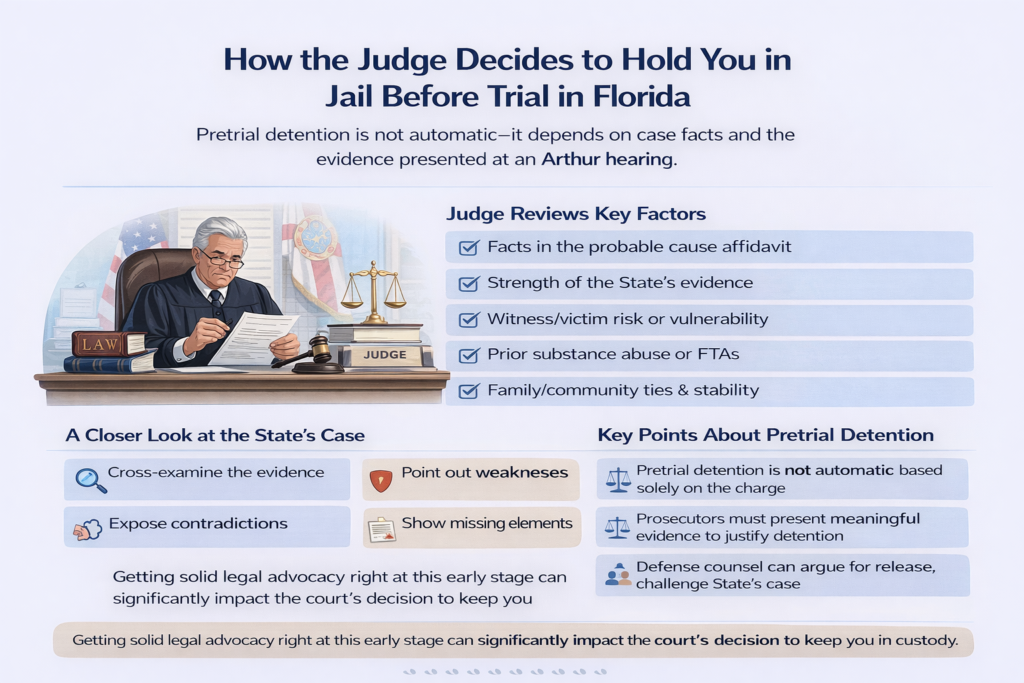
- Request a Arthur Hearing to present arguments for release
- Push for pretrial detention reconsideration as facts develop
In other cases, defendants may still be able to pursue release through alternative methods, including how to get bailed out in Florida when eligible.
Early legal challenges at this stage can also influence how the case is evaluated moving forward—sometimes creating opportunities where criminal charges can be dropped before trial in Florida, or where defendants may later be considered to qualify for diversion programs in Florida depending on the charge and record.
👨⚖️ Facing Jail Before Trial? Call Michael White, P.A.
If you’re worried about being held in jail before trial, don’t wait. Attorney Michael White is a former prosecutor who understands how Florida courts evaluate bail and pretrial detention.
At Michael White, P.A., we fight to:
- Challenge improper detainment
- Push for release on bond
- Prepare strong defenses from day one
📞 Call (954) 270-0769 or schedule a confidential consultation online
❓ Frequently Asked Questions
1. Can I be held in jail without bail in Florida?
Yes. If you’re charged with a capital offense or a life-punishable felony, and the evidence meets the high legal standard of proof evident, presumption great, the court can deny bail and hold you until trial.
2. What does “proof evident, presumption great” mean?
It’s a legal standard higher than “beyond a reasonable doubt.” It means the evidence is so strong that the court presumes guilt with near certainty—a threshold used only for serious charges.
3. What are examples of crimes that can lead to pretrial detention in Florida?
Crimes such as first-degree murder, rape, kidnapping, armed burglary, and terrorism may result in being held in jail before trial if the court finds the evidence overwhelming.
4. Is there a hearing to argue for pretrial release in serious cases?
Yes. Your defense attorney can request an Arthur Hearing, where the court reviews the evidence and determines whether pretrial detention is justified or if bail should be granted.
5. Can a lawyer help me avoid jail before trial?
Absolutely. A defense lawyer can challenge the strength of the State’s evidence, argue for bail or conditional release, and present mitigating circumstances to keep you out of custody.