
Last updated April 2026
If you’ve been charged with a crime in Florida, one of the most important questions is whether your case can be dismissed before trial.
The answer is yes — in certain circumstances.
Charges are dropped before trial more often than many people realize, but dismissal typically results from legal strategy, procedural defects, or evidentiary weaknesses — not luck.
For a broader look at how Florida cases resolve—including diversion, sentencing, and record outcomes—see our guideto Florida sentencing and case outcomes.
🎥 Watch: How Criminal Charges Get Dropped Before Trial in Florida
Yes, criminal charges can be dismissed before trial — but most dismissals happen because of identifiable legal weaknesses.
In this video, I explain:
• When prosecutors drop cases
• How weak evidence can lead to dismissal
• The role of suppression motions
• How diversion programs can resolve charges early
Early defense strategy often determines whether a case moves forward — or falls apart.
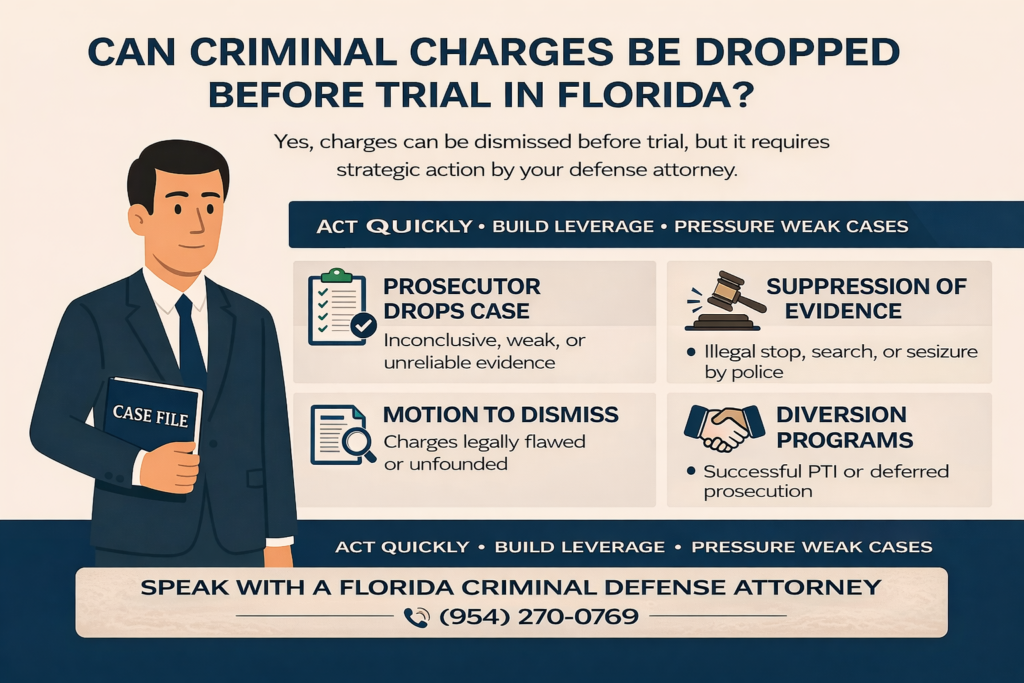
⚖️ How Are Charges Dropped?
Charges may be dismissed in several ways:
1️⃣ Prosecutor Declines to Proceed
If the State determines there is insufficient evidence to prove the case beyond a reasonable doubt, prosecutors may file a dismissal.
This may occur when:
• Witnesses are unavailable
• Evidence is weak
• Law enforcement credibility is compromised
• Victims recant or refuse cooperation
2️⃣ Motion to Dismiss
A defense attorney may file a motion to dismiss when:
• The facts alleged do not constitute a crime
• There is no material factual dispute
• The charging document is legally defective
If granted, the case ends without trial.
3️⃣ Suppression of Evidence
If evidence was obtained unlawfully — through an illegal stop, search, or seizure — a motion to suppress may eliminate key proof.
Without sufficient evidence, prosecutors may be forced to dismiss the case.
In practice, suppression motions often drive dismissal negotiations—even when they are not ultimately granted—because they expose weaknesses in how the case was investigated.
4️⃣ Completion of Diversion
Some cases are dismissed after successful completion of programs available to defendants who qualify for diversion programs in Florida, including:
• Pretrial Intervention (PTI)
• Deferred Prosecution Agreements
• County-level diversion programs
Diversion-based dismissals occur before trial and avoid conviction entirely.
📊 When Are Dismissals Most Likely?
In Broward County, many dismissals occur after early discovery review—particularly when body-worn camera footage contradicts initial police reports or when key witnesses fail to appear for deposition. These breakdowns often happen well before trial is ever scheduled.
Dismissals are more common when:
• The case relies heavily on one weak witness
• Law enforcement made procedural mistakes
• Discovery reveals contradictions
• Video evidence undermines allegations
• The alleged victim refuses to cooperate
Strong early investigation increases dismissal probability.
A person’s criminal history can also impact how aggressively a case is prosecuted—especially when prior convictions affect charging decisions and negotiation leverage.
🚫 What Does “Dropped” Actually Mean?
A dismissal before trial means:
• The prosecution ends the case
• No conviction is entered
• The defendant avoids trial
• The case may later qualify for sealing or expungement
Dismissal is different from an acquittal, which occurs after trial.
In some cases, avoiding a conviction through dismissal can be just as important as negotiating a plea—especially when compared to outcomes like adjudication withheld in Florida.
🎯 Why Early Strategy Matters
The timing of these decisions is tied closely to how a case moves through the system—see how the Florida criminal pretrial process works from arrest through resolution.
Charges are most vulnerable:
• Before arraignment hardens positions
• Before pretrial deadlines pass
• Before plea negotiations are finalized
Early legal intervention can:
• Preserve surveillance footage
• Secure favorable witness statements
• Identify constitutional violations
• Pressure weak cases
Delay often reduces leverage.
🛡️ Speak With a Florida Criminal Defense Attorney
If you’re facing charges, dismissal is possible — but it requires strategy.
Call (954) 270-0769 for a confidential consultation.
❓ Frequently Asked Questions
1. Can a case be dismissed before trial in Florida?
Yes. Charges can be dropped if there’s insufficient evidence, legal violations, or problems with witness testimony.
2. What’s the difference between dismissal and acquittal?
A dismissal happens before or during trial and ends the case without a conviction. An acquittal occurs after trial when a judge or jury finds the defendant not guilty.
3. Do I still need a lawyer if I’m innocent?
Absolutely. Innocent people are charged every day. A lawyer ensures your rights are protected and fights to get charges dismissed early.
4. What is a motion to dismiss in Florida criminal cases?
A motion to dismiss asks the judge to throw out the charges due to legal defects—such as lack of evidence or improper procedures.
5. How soon should I contact an attorney?
Immediately. Early legal representation gives you the best chance to build a strong defense and prevent the case from going to trial.