
Last updated April 2026
If you or a loved one has been arrested in Florida, the first 30 days of a criminal case are often the most critical.
From the moment of arrest through bond hearings, arraignment, and early negotiations, the decisions made during the pretrial stage can shape the outcome of the entire case.
Whether the charge involves DUI, drug possession, domestic violence, theft, or a serious felony, the procedural path is largely the same. Understanding how the Florida criminal process works can protect your freedom, your record, and your future.
For a complete overview of how criminal cases are handled in Broward County, visit our guide to Fort Lauderdale criminal defense strategy and case process.
At Michael White, P.A., we represent clients throughout Fort Lauderdale, Broward County, Miami-Dade, Palm Beach County, and South Florida at every stage of the arrest and pretrial process.
📞 Call (954) 270-0769 for a confidential consultation.
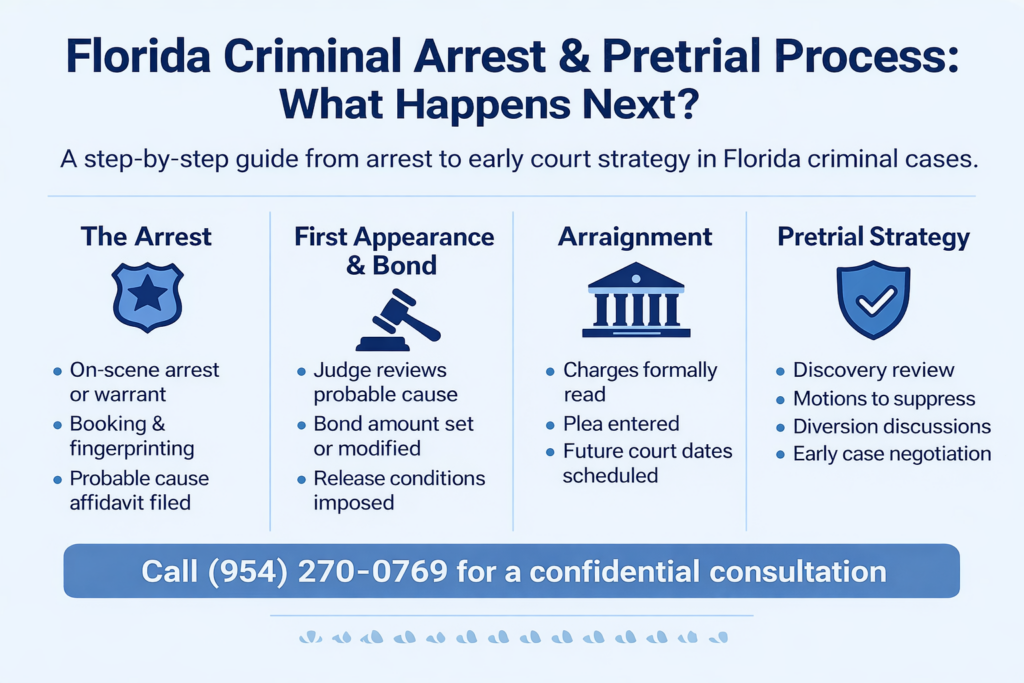
🚔 Step 1: The Arrest
An arrest in Florida may occur in several ways:
• On-scene arrest by law enforcement
• Arrest based on a warrant
• Surrender after a warrant is issued
• Notice to Appear (misdemeanor citation)
Depending on how the arrest occurs, the process may involve a probable cause affidavit, a notice to appear, or an active arrest warrant.
After an arrest, the individual is typically transported to the county jail, photographed, fingerprinted, and booked into the system.
For a detailed breakdown, see how arrests and first appearance work in Florida criminal cases.
📄 What Is a Probable Cause Affidavit?
Within hours of arrest, officers prepare a probable cause affidavit summarizing:
• The alleged facts
• Witness statements
• Evidence recovered
• Applicable criminal statutes
This document forms the foundation of the prosecution’s case — but it is not evidence itself. It is an officer’s summary and can be challenged.
Errors or inconsistencies in this document can create early opportunities where criminal charges can be dropped before trial in Florida.
🔓 Step 2: First Appearance & Bond
Within 24 hours of arrest, Florida law requires a first appearance hearing.
At this hearing, a judge determines:
• Whether probable cause exists
• Bond amount (if not already set)
• Pretrial release conditions
• No-contact orders
Bond can take several forms:
• Standard monetary bond
• Recognizance bond (ROR)
• Pretrial supervision
• Electronic monitoring
For a full explanation, see how bond and pretrial release work in Florida.
The outcome of this stage often determines whether a person remains in jail before trial or is released pending further proceedings.
🏛 Step 3: Arraignment
The arraignment is typically scheduled several weeks after arrest.
At arraignment:
• Charges are formally read
• A plea is entered (not guilty, guilty, or no contest)
• Future court dates are scheduled
In most cases, defendants plead not guilty to preserve all defenses.
See our breakdown of what happens at arraignment in Florida criminal cases.
If you fail to show at an arraignment, a warrant, or capias, will likely be issued for your arrest.
📆 Step 4: The Pretrial Phase
In Broward County, many cases are effectively shaped during this stage—often before trial becomes a realistic possibility. Early discovery review, witness depositions, and motion practice frequently determine whether a case is dismissed, diverted, or resolved through negotiation.
The pretrial phase is where cases are won or lost.
This stage includes:
• Discovery review
• Depositions
• Motion practice
• Suppression hearings
• Negotiations
• Diversion discussions
Many cases are resolved before trial — either through dismissal, reduction, diversion, or negotiated plea agreements.
At this stage, cases may begin moving toward resolution—including situations where criminal charges can be dropped before trial in Florida or where defendants may be evaluated for whether they qualify for diversion programs in Florida.
⚖️ What If You Violate Pretrial Release?
Violating pretrial conditions can lead to:
• Bond revocation
• Additional charges
• Jail without bond
If accused of violating pretrial release, immediate legal intervention is critical.
Violations can significantly impact negotiation leverage and may eliminate opportunities for diversion or early dismissal.
🌎 Special Situations
Some cases involve additional procedural issues:
• Extradition from another state
• Immigration detainers (ICE holds)
• Out-of-county warrants
• Federal target letters
Each requires a specific defense strategy.
🛡 Why Early Representation Matters
In many cases, the trajectory of a criminal case is determined before formal plea negotiations even begin, making early legal intervention one of the most important factors in the outcome.
Many people make the mistake of waiting until after arraignment to hire counsel.
But early intervention can:
• Argue for lower bond
• Prevent damaging statements
• Secure surveillance footage before deletion
• Influence charging decisions
• Explore diversion eligibility
The earlier strategy begins, the stronger the defense.
📍 Fort Lauderdale & Broward County Focus
While Florida criminal procedure is governed by statewide rules, local practices matter.
Bond customs, diversion availability, and prosecutorial policies vary between Broward, Miami-Dade, and Palm Beach counties.
As a former prosecutor in Broward County, Michael White understands how these early-stage decisions are made and how to position cases effectively.
📞 Speak With a Florida Criminal Defense Attorney Today
Early-stage decisions often determine whether a case moves toward dismissal, diversion, or sentencing exposure.
If you or someone you care about has been arrested or expects to be charged, do not wait.
The pretrial phase sets the trajectory for the entire case.
Call (954) 270-0769 or schedule a confidential consultation with Michael White, P.A., today.