
Last updated April 2026
If you’re heading to the DMV in Fort Lauderdale and suspect there’s a warrant for your arrest, you might feel a pit in your stomach—and with good reason.
Arrest warrants are part of the earliest stage of a criminal case. For a broader overview of how arrests, warrants, and first appearance hearings work in Florida, see how arrests, warrants, and first appearance work in Florida criminal cases.
The answer: Yes, it’s possible—but it depends. Let’s break it down.
🎥 Video: What Happens If You Go to the DMV With an Active Warrant?
Many people don’t realize that certain DMV transactions can expose unresolved warrants — especially failures to appear or suspended license issues.
In this video, I break down:
• When a DMV visit may trigger law enforcement notification
• The difference between felony and misdemeanor warrant risk
• Why voluntary surrender is often smarter than waiting
• How proactive legal strategy can prevent an embarrassing arrest
If you suspect a warrant exists, understanding the process before walking into the DMV can make a significant difference.
👮 Arrest Risk at the DMV: What You Should Know
The Florida Department of Highway Safety and Motor Vehicles (DHSMV) does not routinely conduct warrant checks for every visitor. However, there are scenarios where a DMV staff member may discover an active warrant—especially if you’re there to renew a license, update personal info, or resolve a suspension.
- If your warrant is for a serious or violent offense, such as aggravated battery, drug trafficking, or failure to appear for a felony case, law enforcement is far more likely to be contacted.
- For non-violent misdemeanors or older warrants, arrest at the DMV is less common, but not impossible.
The seriousness of the underlying charge, the age of the warrant, and whether it involves a failure to appear or probation violation all affect the likelihood of arrest at a DMV visit.
If the warrant originates from another jurisdiction, it may also involve how extradition to Florida works in criminal cases.
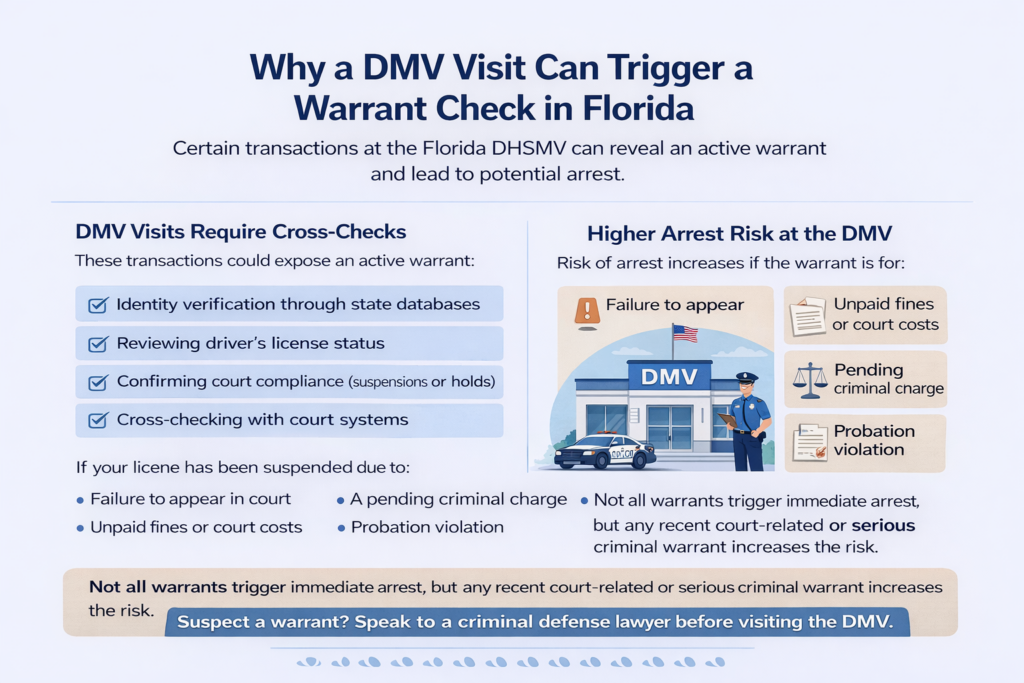
🔎 Why a DMV Visit Can Trigger a Warrant Check
In Broward County, many DMV-related warrant issues arise from failure-to-appear cases tied to traffic or misdemeanor charges. These cases are often resolved quickly once addressed—but can lead to immediate arrest if ignored.
While the Florida Department of Highway Safety and Motor Vehicles (DHSMV) does not automatically run warrant checks on every person who walks through the door, certain transactions may expose an active warrant.
A DMV visit typically requires:
• Identity verification through state databases
• Review of driver’s license status
• Confirmation of court compliance for suspensions or holds
• Cross-checking with court and clerk systems
If your license has been suspended due to:
• Failure to appear in court
• Unpaid fines or court costs
• A pending criminal charge
• A probation violation
those flags may appear during the reinstatement process.
In some situations, DMV personnel may contact law enforcement if an active warrant is confirmed—particularly if the warrant involves a felony, a recent failure to appear, or a serious offense.
However, practices vary by county and by the seriousness of the warrant. Not every active warrant results in immediate arrest at the DMV, but the risk increases when the warrant is recent, court-related, or tied to a higher-level charge.
Because warrants do not expire and remain active until resolved, addressing the issue proactively through counsel is often safer than discovering it during a routine visit.
If an arrest occurs, you may be taken into custody and held in jail before trial until a bond hearing or court appearance.
🚨 Warrants & Arrests at the DMV: Quick Facts
✅ Yes, you can be arrested at the DMV if a warrant is flagged
✅ Felony warrants = higher risk of arrest
✅ Minor or old warrants = less likely, but still possible
🚫 DMV doesn’t always check, but certain services (license reinstatement, suspensions) may trigger reviews
🚫 Waiting it out is risky — warrants don’t expire
✅ Step 1: Speak With a Fort Lauderdale Criminal Defense Attorney
At Michael White, P.A., I help clients in Fort Lauderdale and throughout South Florida resolve active warrants before they lead to public embarrassment or unnecessary jail time.
A criminal defense lawyer can:
- Check if your warrant is active
- Determine if it’s local, state, or federal
- File a motion to recall or quash the warrant
- Arrange a voluntary surrender (often resulting in reduced penalties or avoiding jail entirely) and begin addressing how bond and pretrial release work in Florida before you are taken into custody
- Negotiate bond or pre-trial release
📊Suspect you have a warrant? Schedule a Free Consultation today.
⚖️ Why Handle the Warrant Proactively?
In many cases, resolving a warrant before law enforcement contact allows for controlled surrender, better bond outcomes, and reduced time in custody.
Here’s what a proactive legal strategy can help you avoid:
- Being arrested in front of family, coworkers, or strangers
- Spending the weekend in jail while waiting to see a judge
- Losing the ability to drive, work, or travel freely
In some cases, addressing a warrant early may also create opportunities where criminal charges can be dropped before trial in Florida, depending on the underlying case.
📅 Schedule a Consultation Today
If you suspect an active warrant for your arrest, don’t wait for it to surface at the worst possible moment—like during a DMV visit.
📍 Contact Michael White, P.A. in Fort Lauderdale to get ahead of the problem:
📞 Call now: (954) 710-0925
💬 Schedule a confidential consultation
Let’s resolve your warrant and protect your freedom before it’s too late.
❓ Frequently Asked Questions
1. Can I really be arrested at the DMV in Florida if I have a warrant?
A: Yes. If DMV staff or their system flags an active warrant—especially for felonies or serious charges—they can notify law enforcement, and you may be arrested.
2. Will I be arrested at the DMV for a minor warrant or traffic offense?
A: It’s less common. Arrests at the DMV for non-violent misdemeanors or older traffic warrants are rare, but they still can happen. The seriousness of the warrant determines the risk.
3. Does the DMV in Florida check for warrants?
A: Not for every visitor. But certain services—like reinstating a suspended license or resolving a hold—may trigger a warrant review. That’s when an active warrant is more likely to be flagged.
4. What should I do if I think I have a warrant before going to the DMV?
A: Contact a criminal defense attorney before your visit. A lawyer can check if your warrant is active, help quash or recall it, and guide you through the process—often avoiding an arrest entirely.
5. Can a lawyer help me avoid being arrested for a warrant in Florida?
A: Yes. An attorney can file motions, coordinate voluntary surrender, or arrange bond/pre-trial release. This proactive approach often prevents an embarrassing public arrest and reduces time in custody.