
Last updated April 2026
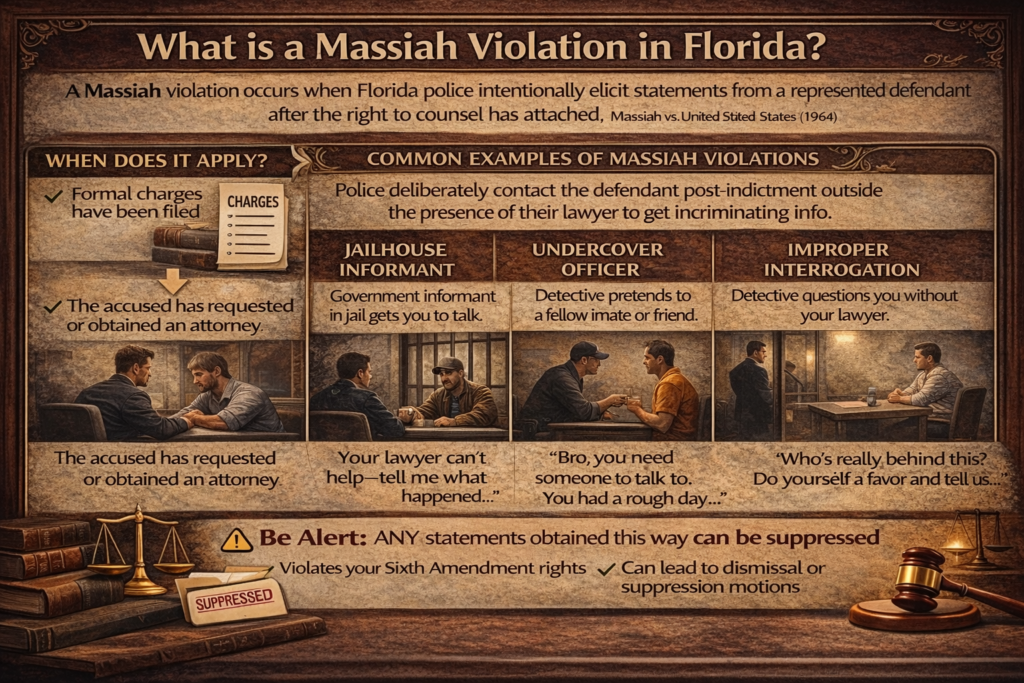
A Massiah violation occurs when police deliberately obtain statements from a defendant after the right to counsel has attached — without the presence of their lawyer.
These violations often happen outside traditional interrogations and can lead to suppression of powerful evidence.
For a broader overview of how this protection works, see our guide to right to counsel in Florida.
⚖️ The Rule: No Deliberate Elicitation After Charges
Once formal charges are filed, the Sixth Amendment prohibits law enforcement from deliberately eliciting statements about the charged offense without counsel present.
This rule applies even when:
- questioning is indirect
- officers are not asking formal questions
- the interaction appears casual
👉 Learn when this protection begins in when the right to counsel attaches in Florida
🧠 What “Deliberate Elicitation” Means
Deliberate elicitation is broader than interrogation.
It includes:
- direct questioning
- subtle prompts designed to get a response
- creating situations where a defendant is likely to talk
- using third parties to gather statements
Courts look at whether law enforcement intentionally created the opportunity to obtain incriminating information.
🚨 Common Examples of Massiah Violations
Massiah violations frequently arise in:
- jailhouse informant situations
- undercover officers posing as inmates
- recorded conversations in custody
- coordinated attempts to gather statements indirectly
In many cases, the defendant does not realize they are speaking to someone working with law enforcement.
🔎 Why These Cases Are Highly Fact-Specific
Massiah issues often turn on subtle details:
- who initiated the conversation
- whether law enforcement directed the interaction
- whether the defendant was induced to speak
- whether the statements related to the charged offense
Small factual differences can determine whether a violation occurred.
⚠️ When Statements May Still Be Used
Not every post-charge statement is automatically excluded.
Statements may still be admissible if:
- the defendant voluntarily initiated the conversation
- the statements were not deliberately elicited
- the interaction was unrelated to the charged offense
👉 Learn how these situations are analyzed in police questioning after you have a lawyer in Florida
🧠 Where Massiah Cases Are Won or Lost
In many cases, the issue is not whether a conversation occurred — it’s whether law enforcement engineered it.
Common problems include:
- using informants to bypass counsel
- creating opportunities for conversation without disclosure
- claiming interactions were voluntary when they were not
- blurring the line between passive listening and active elicitation
These details often determine whether statements are admitted or suppressed.
⚖️ How Massiah Violations Are Challenged
When a Massiah violation occurs, the defense may seek to exclude statements through a motion to suppress in Florida.
Courts will examine:
- whether the right to counsel had attached
- whether law enforcement deliberately elicited statements
- whether any waiver occurred
If the statements are excluded, the prosecution may lose critical evidence.
🛑 Why Massiah Violations Matter
Statements obtained through Massiah violations can be among the most damaging evidence in a case.
If suppressed:
- admissions may never reach a jury
- the prosecution’s theory may collapse
- charges may be reduced or dismissed
❓ Frequently Asked Questions
What is a Massiah violation in Florida?
It occurs when police deliberately obtain statements from a defendant after the right to counsel has attached without their lawyer present.
Does Massiah apply only to formal questioning?
No. It applies to any deliberate attempt to obtain statements, including indirect methods.
Can informants be used against me after charges?
Sometimes, but improper use may result in suppression.
Can statements from a Massiah violation be suppressed?
Yes. Statements obtained in violation of the Sixth Amendment may be excluded.