
Last updated April 2026
The right to counsel is one of the most important protections in a criminal case — but it does not begin the moment you are arrested.
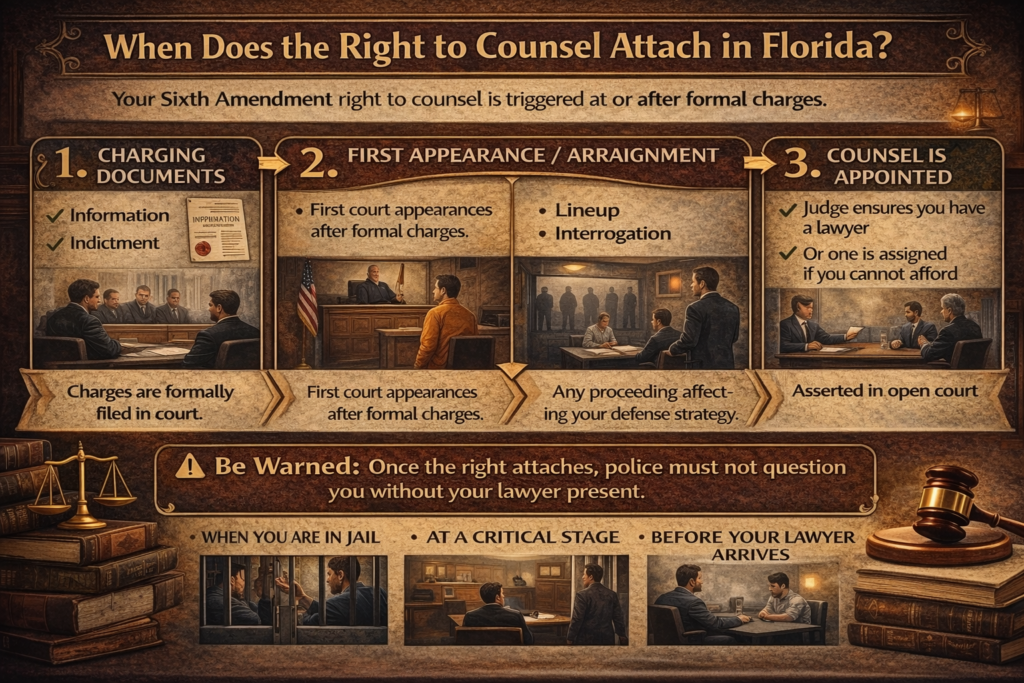
In Florida, the Sixth Amendment right to counsel generally attaches only after formal charges are filed. That timing matters because it determines when police must stop certain types of questioning and whether statements can be used against you.
For a broader overview of how this protection works, see our guide to right to counsel in Florida.
⚖️ The Rule: Attachment Begins After Formal Charges
The Sixth Amendment right to counsel typically attaches when formal judicial proceedings begin, including:
- filing of an information or indictment
- first appearance or arraignment
- formal charging in court
Before this point, the Sixth Amendment generally does not apply — even if you have been arrested or questioned.
🚫 Why the Timing of Attachment Matters
The distinction between pre-charge and post-charge questioning is critical.
Before charges:
- police may question you under Miranda rules
After charges:
- police face stricter limits
- deliberate attempts to obtain statements without counsel may violate the Constitution
This shift is often where suppression issues arise.
🧠 Where Attachment Issues Often Arise
Disputes over when the right to counsel attaches commonly arise in:
- delayed charging decisions
- post-arrest investigations
- jailhouse conversations
- follow-up questioning by detectives
In many cases, the timeline — not just the questioning — determines whether the right applies.
🔎 What Happens After the Right Attaches
Once the right to counsel has attached:
- police cannot deliberately elicit statements about the charged offense
- prosecutors cannot bypass your attorney
- questioning without counsel becomes heavily restricted
👉 Learn when police may still attempt questioning in police questioning after you have a lawyer in Florida
🕵️ Massiah Violations and Post-Charge Conduct
After the right attaches, police cannot use indirect tactics to obtain statements.
This includes:
- jailhouse informants
- undercover officers
- staged conversations designed to produce admissions
👉 Learn how these situations are analyzed in Massiah violations in Florida
⚠️ Common Misunderstandings
Many people believe:
- “I have a lawyer, so police can’t talk to me at all”
- “My rights start when I’m arrested”
In reality:
- the right to counsel attaches only after formal charges
- different rules apply before and after that point
Understanding this distinction is critical in evaluating whether statements can be used.
🧠 Where Right-to-Counsel Cases Are Won
In many cases, the issue is not whether a lawyer exists — it’s whether the right had attached at the time police obtained statements.
Common problems include:
- questioning that occurs just before formal charges
- confusion about whether charges had been filed
- officers attempting to obtain statements after attachment
- use of indirect tactics to bypass counsel
These timing issues often determine whether statements are admitted or suppressed.
⚖️ How Violations Are Challenged
If police violate the right to counsel after it attaches, statements may be excluded through a motion to suppress in Florida.
Courts will examine:
- when formal proceedings began
- whether police deliberately elicited statements
- whether a valid waiver occurred
If the statements are suppressed, the prosecution’s case may weaken significantly.
🛑 Was Your Right to Counsel Violated?
If police questioned you:
- after charges were filed
- without your lawyer present
- or through indirect methods
you may have strong grounds to challenge the evidence.
❓ Frequently Asked Questions
When does the right to counsel attach in Florida?
It generally attaches after formal charges are filed, such as at indictment, information, or first appearance.
Does the right to counsel apply at arrest?
Not automatically. The Sixth Amendment right usually begins after formal proceedings start.
Can police question me after charges are filed?
Only in limited circumstances. Once the right attaches, police cannot deliberately elicit statements without counsel.
What happens if police violate my right to counsel?
Statements obtained in violation of the Sixth Amendment may be suppressed.