
Last updated March 2026
⚖️ When a Relationship Increases the Severity of a Charge
In some sexual battery cases, the nature of the relationship between the parties can significantly increase the seriousness of the charge.
Florida law recognizes that certain individuals hold positions of authority, supervision, or trust, and allegations involving those relationships may trigger enhanced penalties.
These cases are not just about what allegedly occurred — they are about who was involved and the power dynamic between them.
For a broader overview of how sexual battery charges are prosecuted and defended, see our guide to Sexual Battery Charges in Florida.
❗ What Is a “Position of Trust” Under Florida Law?
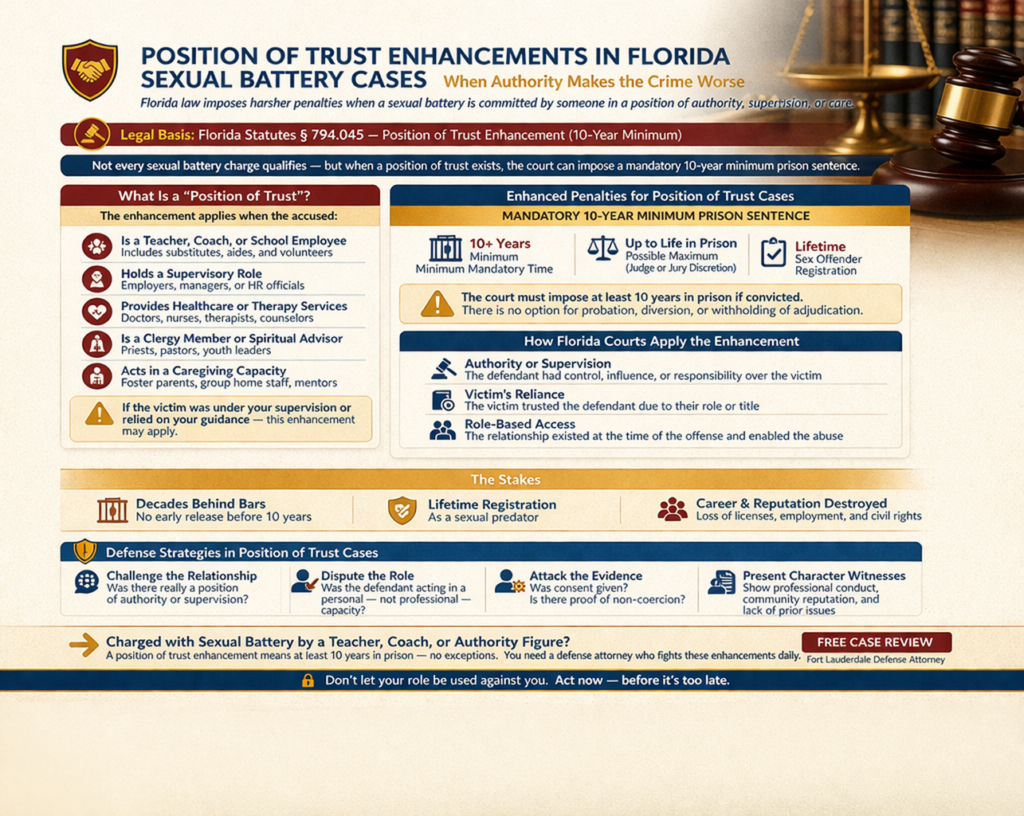
A position of trust generally refers to a situation where one person has:
- Authority over another
- Supervisory responsibility
- A role involving care, guidance, or control
Examples may include:
- Teachers or school personnel
- Coaches or mentors
- Caregivers or guardians
- Individuals in supervisory roles over minors
The exact classification depends on the statute and the specific facts of the case.
⚠️ Why Position of Trust Matters
When this type of relationship is alleged, the law may treat the case more seriously because of the perceived imbalance of power.
This can affect:
- How the case is charged
- Whether the offense is elevated to aggravated sexual battery
- Whether enhanced sentencing provisions apply
For a deeper look at how charges may be elevated, see our guide to Aggravated Sexual Battery in Florida.
⛓️ How This Enhancement Affects Penalties
A position of trust allegation can significantly increase sentencing exposure.
Depending on how the case is charged, it may lead to:
- Higher-level felony classification
- Mandatory minimum sentencing structures
- Increased likelihood of life felony exposure
For a full breakdown of how these penalties apply, see our guide to Life Felony Exposure in Florida Sexual Battery Cases.
🧠 How These Cases Are Evaluated
The key issue is often not just whether contact occurred, but whether the relationship meets the legal definition of a position of trust.
Important questions include:
- What was the actual nature of the relationship?
- Did the accused have real authority or control?
- Was the alleged victim dependent on or influenced by that role?
- Does the evidence support the State’s characterization?
These questions are often heavily disputed and fact-specific.
🔍 Position of Trust vs. Consent Issues
In some cases, the defense may argue that the relationship did not negate consent or did not meet the statutory threshold for enhancement.
Even where a relationship exists, the State must still prove:
- The elements of the underlying offense
- That the relationship qualifies under the statute
- That the enhancement is properly applied
Understanding how consent is evaluated remains critical. See our guide to Consent Defense in Florida Sexual Battery Cases.
🛡️ Defense Strategies in Position of Trust Cases
Because this enhancement can dramatically increase exposure, it must be carefully challenged.
Common strategies include:
Disputing the Relationship
- Arguing that no qualifying position of trust existed
- Challenging the scope of authority or control
Challenging the Legal Classification
- Whether the facts actually meet statutory requirements
- Whether the enhancement is being over-applied
Attacking the Evidence
- Inconsistencies in statements
- Lack of corroboration
- Context of the relationship
Limiting Exposure
- Preventing escalation to aggravated charges
- Reducing sentencing consequences
📞 Facing a Sexual Battery Allegation Involving a Position of Trust?
When a position of trust is alleged, the stakes increase quickly.
What might otherwise be a serious charge can become a life-altering case involving enhanced penalties and long-term consequences.
❓ FREQUENTLY ASKED QUESTIONS ABOUT POSITION OF TRUST
❓ What qualifies as a position of trust in Florida?
A position of trust generally involves authority, supervision, or responsibility over another person, such as a teacher, coach, or caregiver.
❓ Does a position of trust automatically make a charge aggravated?
Not automatically. The State must prove that the relationship meets statutory criteria and that the enhancement properly applies.
❓ Can a position of trust enhancement be challenged?
Yes. The defense may dispute whether the relationship qualifies or whether the facts support applying the enhancement.