
Last updated March 2026
Robbery in Florida is not just about taking property — it’s about how the State claims the property was taken.
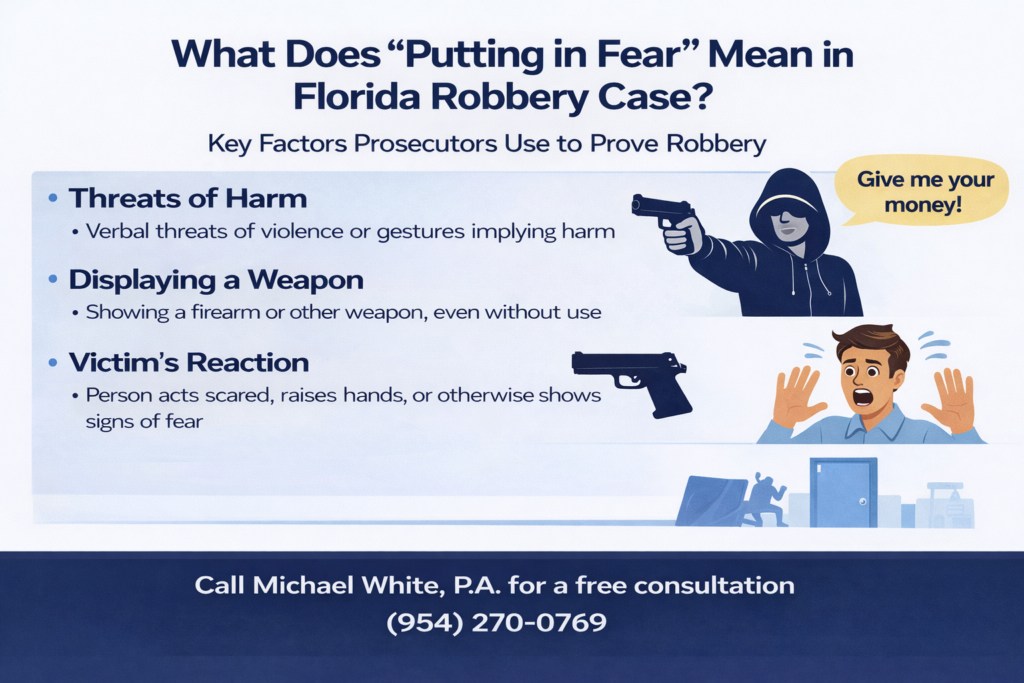
Under Florida Statute § 812.13, robbery may be proven through:
Force
Violence
Assault
Or “putting in fear.”
When there is no injury and no clear physical force, prosecutors often rely on “putting in fear” to elevate what might otherwise be theft into a serious violent felony.
Understanding what that phrase legally means — and what it does not mean — is critical to defending a robbery charge.
Robbery is prosecuted aggressively as a violent felony under Florida law. For a complete overview of Florida robbery charges, penalties, and defense strategies, see our guide to robbery charges in Florida.
⚖️ The Legal Standard: Florida Statute § 812.13
Florida law defines robbery as a taking of property with the use of:
“force, violence, assault, or putting in fear.”
“Putting in fear” allows prosecutors to argue robbery even when:
No weapon was used
No one was physically touched
No injury occurred
But the fear must be legally sufficient.
Florida appellate courts have consistently held that the fear must be objectively reasonable and must occur at the time of the taking.
That distinction often decides whether a case is robbery — or just theft.
🔍 What Prosecutors Must Prove
To sustain a robbery charge based on “putting in fear,” the State must prove:
1️⃣ A taking of property
2️⃣ Intent to deprive
3️⃣ The alleged victim experienced a reasonable fear of imminent harm
4️⃣ That the fear occurred during the taking (or immediate flight)
If fear arises later — during pursuit or after confrontation — the element may fail.
Timing is often the battleground.
🎯 The Fear Must Be Objectively Reasonable
This is critical.
The standard is not:
“Was the person scared?”
The standard is:
Would a reasonable person in the same circumstances have feared imminent harm?
That means courts look at:
Tone of voice
Words used
Body positioning
Physical proximity
Hand movements
Gestures implying a weapon
Context of the encounter
A witness saying “I was scared” is not automatically enough.
The fear must be grounded in conduct that would create reasonable apprehension of immediate harm.
❓ Is Saying “Give Me Your Wallet” Enough for Robbery?
Not automatically.
Florida courts analyze:
Was the statement accompanied by threatening gestures?
Was the defendant blocking movement?
Was there aggressive body language?
Did the situation imply violence?
A calm request without force or implied threat may support theft — not robbery.
Context determines everything.
🚨 Common Scenarios Prosecutors Use to Argue “Putting in Fear”
Demanding property in an aggressive tone
• Closing physical distance rapidly
• Reaching into a pocket as if implying a weapon
• Blocking a doorway while making a demand
• Snatching property while making threatening statements
In many of these cases, there is no physical force and no visible weapon.
The entire robbery charge hinges on perception.
❌ When “Putting in Fear” May Be Legally Insufficient
Robbery cases frequently collapse when:
No Express or Implied Threat Exists
Mere presence or sudden movement is not automatically robbery.
Fear Occurred After the Taking
Force or fear must coincide with the taking.
The Encounter Was Mere Theft
A quick grab without additional force beyond that inherent in taking property may not qualify.
For a deeper breakdown of that distinction, see robbery vs. theft in Florida.
The Alleged Fear Was Subjective Only
Fear that is exaggerated, assumed, or unsupported by conduct may fail the objective test.
🔫 Does a Weapon Have to Be Used?
No.
“Putting in fear” does not require a weapon.
However, if prosecutors allege that a weapon was displayed or implied, the case may escalate to armed robbery, which dramatically increases sentencing exposure.
For a breakdown of how weapon allegations change robbery charges, see strong-arm robbery vs. armed robbery in Florida.
🎥 Evidence That Decides These Cases
Because “putting in fear” is perception-driven, evidence becomes decisive:
• Surveillance footage
• Body-worn camera
• Audio recordings
• 911 calls
• Physical positioning
• Lighting and visibility
• Distance between parties
• Whether hands were visible
Police reports often summarize “victim was placed in fear.”
Video sometimes tells a different story.
Details matter.
⚖️ Can Robbery Be Reduced to Theft?
Yes — and this is often the defense objective.
If the State cannot prove:
Objective fear
Threat of imminent harm
Force or fear at the moment of the taking
The charge may be reduced to theft.
That distinction is enormous:
Robbery = violent felony
Theft = non-violent offense (in many cases)
The difference can mean years of prison exposure versus probation or diversion.
📍 Broward County Reality
In Broward County, prosecutors frequently rely on “putting in fear” when:
There is no weapon
There is no injury
Video evidence is ambiguous
The alleged victim later expands their statement
Early intervention — especially securing surveillance before it is overwritten — can determine whether the robbery charge survives.
🛡️ Defense Strategies in “Putting in Fear” Cases
Effective defenses may include:
✔ Challenging objective reasonableness of fear
✔ Establishing lack of threatening conduct
✔ Demonstrating theft rather than robbery
✔ Contesting identification
✔ Attacking witness credibility
✔ Filing suppression motions where applicable
Because robbery is prosecuted as a serious violent felony, early legal strategy often shapes the outcome.
📞 Charged With Robbery in Florida?
If your robbery charge is based on alleged “putting in fear,” the case may be more defensible than it appears.
Many robbery cases hinge on interpretation — not injury.
The difference between theft and robbery can define your record, sentencing exposure, and future.
Call Michael White, P.A. at (954) 270-0769 for a confidential consultation.
❓ FAQs: “Putting in Fear” in Florida Robbery Cases
Is fear required to prove robbery in Florida?
Yes. If the State is not relying on force or violence, it must prove the victim was placed in reasonable fear of imminent harm.
Does the victim have to say they were afraid?
Not necessarily. Courts apply an objective standard — but the State must prove facts that would cause reasonable fear.
Can robbery be charged without touching someone?
Yes. Physical contact is not required if the State proves force or “putting in fear.”
What if the alleged victim later says they were not afraid?
That can significantly weaken the prosecution’s case, especially if no other threatening conduct is proven.
Is “putting in fear” enough to make it armed robbery?
No. Armed robbery requires proof that a firearm, deadly weapon, or weapon was used or carried during the taking.