
Last updated April 2026
In Florida, Racing on Highways is a serious criminal offense—not a simple traffic ticket. Prosecutors aggressively pursue these cases, especially in Fort Lauderdale and throughout South Florida, where street racing events have gained attention.
Whether you’re the driver, a passenger, or even a spectator, you can be charged under Florida law. Here’s what you need to know about the law, penalties, and how a defense attorney can fight the charges.
For a broader overview of criminal traffic offenses in Florida, see our guide to Traffic Crimes in Florida.
🚓 What Is Considered “Racing on Highways” in Florida?
Racing on highways is one of Florida’s most aggressively prosecuted criminal traffic offenses. These cases are not treated like ordinary speeding tickets — and the consequences can be immediate and severe, including jail time, mandatory license suspension, vehicle impoundment, and even forfeiture.
Law enforcement agencies in Fort Lauderdale and across South Florida actively target alleged street racing, often relying on officer opinion, eyewitness claims, or social media footage. But many racing cases are overcharged and defensible when the evidence is closely examined.
This page explains what legally qualifies as racing, who can be charged, and how these cases are fought in Florida courts.
🧠 How Racing Charges Are Actually Filed in South Florida
In many cases, racing charges are not based on clear, provable competition — they are based on how law enforcement interprets fast or aggressive driving in real time.
In Broward County and across South Florida, we often see racing charges filed when:
- Two vehicles accelerate at the same time without clear coordination
- Officers assume competition based on speed alone
- Social media footage is incomplete or taken out of context
- There is no identifiable agreement or communication between drivers
These cases are frequently charged aggressively at the arrest stage — but the legal standard still requires proof of actual competition.
🚓 Examples of “Racing on Highways” in Florida?
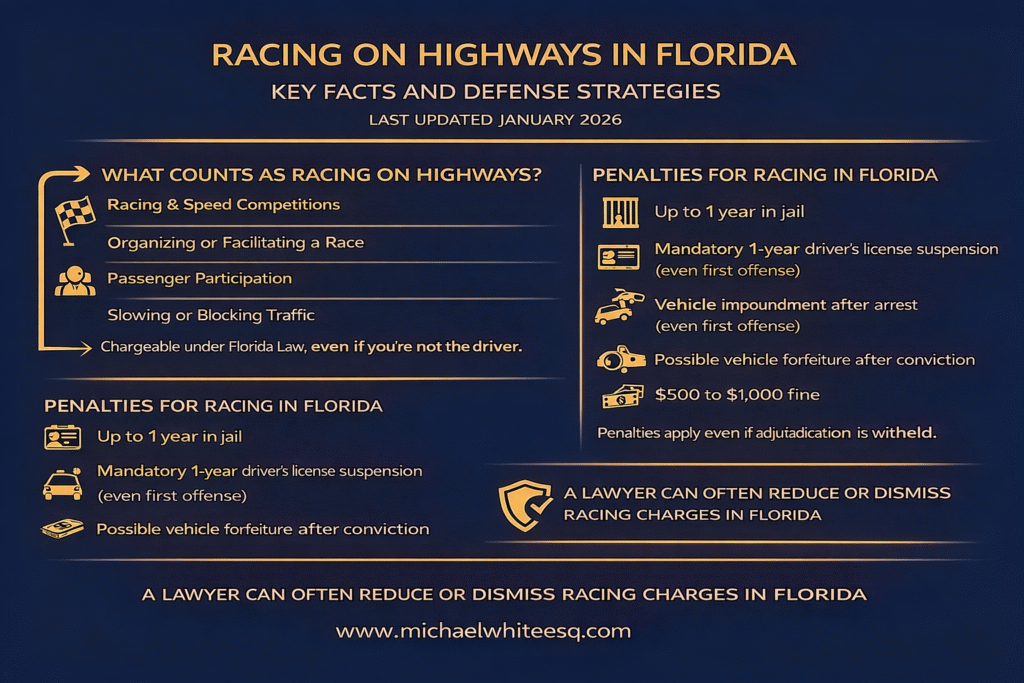
Florida law criminalizes more than just two cars speeding side by side. Prosecutors may file racing charges based on four broad theories:
🏎️ 1. Racing or Speed Competitions
Operating a vehicle in a race, speed contest, drag race, or exhibition intended to test speed, acceleration, or endurance.
🧑🤝🧑 2. Organizing or Facilitating a Race
You do not need to be driving to be charged. Police may arrest individuals accused of:
-
organizing a race
-
coordinating participants
-
collecting money
-
actively watching or assisting an event
🚗 3. Passenger Participation
Knowingly participating in or facilitating a race — including riding as a passenger with awareness of the competition — can result in criminal charges.
🚧 4. Interfering With Traffic
Intentionally slowing or blocking traffic to create space for a race is separately chargeable conduct.
Importantly, fast driving alone is not racing. The State must prove actual competition or coordination between vehicles. In some cases, extreme speed may lead to separate criminal charges — see Criminal Speeding in Florida.
⚠️ Race vs. Drag Race: What the Law Actually Requires
A race typically involves two or more vehicles attempting to:
-
outdistance one another
-
prevent passing
-
reach a destination first
A drag race usually involves:
-
side-by-side acceleration
-
a pre-selected course
-
competitive starts
In court, prosecutors must show intentional competition — not just speed, noise, or aggressive driving.
⚖️ What the State Must Prove vs. What They Often Actually Have
To sustain a racing charge, the State must prove that drivers were actively competing — not just driving fast.
But in practice, many cases rely on:
- Officer opinion about intent
- Assumptions based on speed or proximity
- Limited or unclear video evidence
- Lack of direct proof of coordination between drivers
This gap between the legal standard and the available evidence is where many racing cases weaken — and where defense strategy becomes critical.
📋 Penalties for Racing on Highways in Florida
Even a first allegation carries serious exposure:
-
Up to 1 year in jail
-
Mandatory 1-year driver’s license suspension upon conviction
-
Vehicle impoundment (often immediately after arrest)
-
Possible vehicle forfeiture after conviction
-
Fines typically ranging from $500 to $1,000
These consequences can apply even if adjudication is withheld, which surprises many first-time defendants.
In many cases, the most important issue is not how serious the penalties are — but whether the State can actually prove a race occurred.
🧾 Real-World Example: When “Racing” Cannot Be Proven
In one South Florida case, two drivers were charged with racing after accelerating at the same time on a multi-lane roadway late at night.
The officer alleged a speed contest — but video evidence showed:
- No communication or coordination between drivers
- No attempt to outdistance or block one another
- Minimal traffic and no identifiable risk to others
The case was ultimately reduced because the State could not prove actual competition — only simultaneous driving behavior.
Situations like this are common, and they highlight the difference between how a case is described in an arrest report and what can actually be proven in court.
🛡️ Common Defenses to Racing Charges
Racing cases often fall apart when the evidence is tested.
🔹 No Actual Competition
Police must prove two or more vehicles were actively competing. One fast car is not a race.
🔹 Misidentification
Crowds, multiple vehicles, and nighttime conditions frequently lead to incorrect accusations.
🔹 Reckless vs. Racing
Many cases support, at most, reckless driving, not racing — a critical distinction that often leads to reduced charges. See Racing vs. Reckless Driving in Florida for a full breakdown.
In real-world cases, these charges are often alleged together based on how officers interpret high-speed driving — see how reckless driving and street racing overlap.
🔹 Weak or Speculative Evidence
Video footage, body-worn cameras, and eyewitness accounts often contradict the arrest narrative.
⚠️ Common Mistakes That Make Racing Cases Worse
Many drivers unintentionally strengthen the State’s case after being charged.
Common mistakes include:
- Admitting “we were just messing around” at the scene
- Posting videos or comments on social media
- Failing to preserve dashcam or phone footage
- Accepting a plea without reviewing the evidence
Early legal strategy — especially preserving evidence and controlling statements — can significantly affect whether a racing charge holds up in court.
📍 Fort Lauderdale Defense for Racing on Highways
If you’ve been accused of racing on highways in Fort Lauderdale or South Florida, early defense matters. Once impoundment or forfeiture proceedings begin, leverage drops quickly.
As a former prosecutor, Michael White understands how these cases are built — and where they break. Our firm works to:
-
challenge claims of competition
-
suppress weak evidence
-
avoid license suspension and forfeiture
-
negotiate reductions to lesser traffic offenses
📞 Call (954) 270-0769 for a free consultation.
❓ FAQs: Racing on Highways in Florida
Is racing on highways a criminal charge in Florida?
Yes. It is a criminal misdemeanor with jail exposure and mandatory license consequences.
Can I be charged if I wasn’t driving?
Yes. Passengers, organizers, and facilitators can also be charged under Florida law.
What’s the difference between racing and reckless driving?
Racing requires proof of competition between vehicles. Reckless driving involves dangerous conduct without competition and is often a lesser charge.
Can my car really be impounded or forfeited?
Yes. Impoundment is common after arrest, and forfeiture may be pursued after conviction.
Are racing charges defensible?
Often, yes — especially when the State cannot prove actual competition or intent.