
Last updated April 2026
In Florida, high-speed driving can lead to very different criminal charges depending on what prosecutors believe happened.
Two of the most commonly confused offenses are:
-
Racing on highways, and
-
Reckless driving
Both are criminal traffic offenses.
But they require different proof — and carry different legal consequences.
In many cases, this distinction determines whether a driver faces racing charges or a lesser reckless driving charge — making it a critical issue in Florida criminal traffic cases.
For a detailed analysis of the racing statutes and penalties, visit Racing on Highways in Florida.
This page focuses specifically on how the two charges differ.
⚖️ The Core Legal Difference
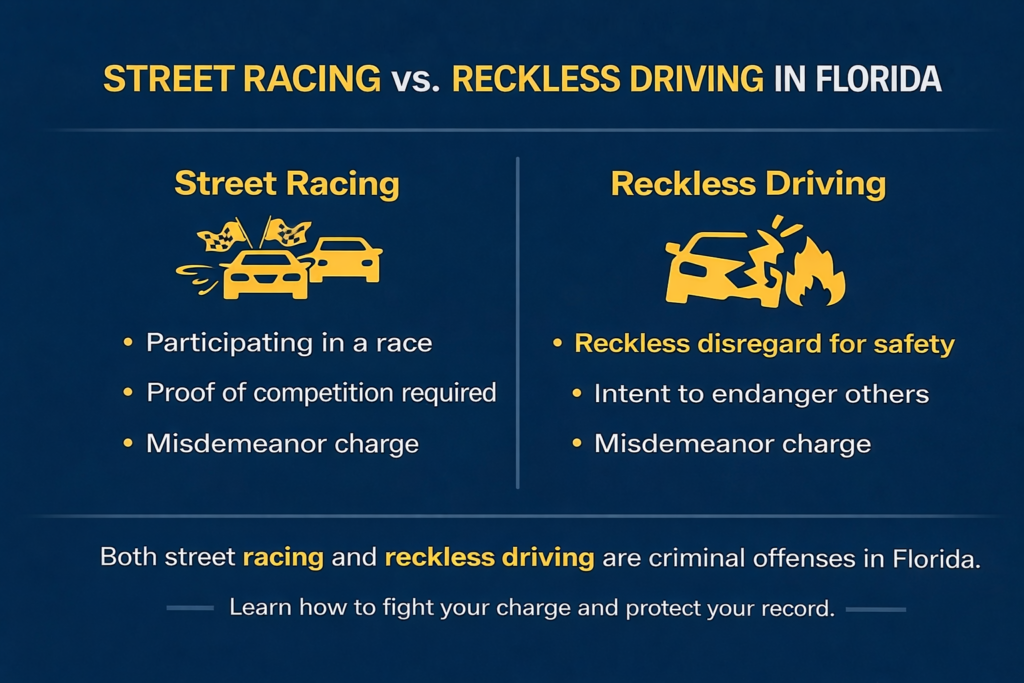
The distinction comes down to competition vs. conduct.
🔴 Racing on Highways (Fla. Stat. § 316.191)
Racing requires proof of competition or coordination between vehicles.
The State must typically show:
-
Two or more vehicles
-
Intent to compete in speed, acceleration, or performance
-
Organized or coordinated behavior
Racing charges can apply not only to drivers — but also to:
-
Organizers
-
Facilitators
-
Certain passengers
-
Individuals interfering with traffic to enable the race
Competition is the key element.
Speed alone is not enough.
🟡 Reckless Driving (Fla. Stat. § 316.192)
Reckless driving does not require competition.
Instead, the State must prove: Willful or wanton disregard for the safety of persons or property.
This means:
-
Conscious disregard of risk
-
Intentional dangerous conduct
-
Behavior beyond simple negligence
A single driver can be charged with reckless driving — even without another vehicle involved.
For more on reckless driving charges, see our guide to Reckless Driving in Florida.
Because reckless driving requires proof of willful or wanton disregard, understanding how it differs from lesser offenses is critical — see Reckless vs. Careless Driving in Florida.
🚨 Why Prosecutors Sometimes Choose One Over the Other
Law enforcement may initially label conduct as “racing” when:
-
Two vehicles are seen accelerating side by side
-
Social media footage suggests competition
-
Officers interpret behavior as coordinated
But when proof of actual competition is weak, prosecutors sometimes reduce racing charges to reckless driving.
Conversely, when alleged reckless conduct appears coordinated between vehicles, the State may attempt to elevate reckless behavior into racing.
The evidence — not just the speed — determines the charge.
In real-world cases, these charges are often alleged together based on high-speed or aggressive driving — see how reckless driving and street racing charges overlap in Florida.
📊 Key Differences at a Glance
| Factor | Racing | Reckless Driving |
|---|---|---|
| Requires competition? | Yes | No |
| Can involve passengers/organizers? | Yes | No |
| Requires willful disregard? | Not necessarily (focus is competition) | Yes |
| Always criminal? | Yes | Yes |
| Can escalate to felony? | Yes (in some circumstances) | Yes (if injury involved) |
💥 When Racing Becomes More Serious Than Reckless
Racing charges often carry:
-
Mandatory license suspension upon conviction
-
Vehicle impoundment
-
Possible forfeiture
-
Misdemeanor exposure
Reckless driving may escalate to felony level if it causes:
-
Serious bodily injury
-
Death
Both charges can become life-altering depending on the facts.
🛡️ Defense Strategies Differ
Because the legal elements differ, defense strategies differ.
Defending Racing Allegations
The defense often focuses on:
-
Lack of proof of competition
-
No coordination between vehicles
-
Misidentification
-
Video inconsistencies
-
Lack of clear communication between drivers
If the State cannot prove competitive intent, the charge may weaken significantly.
Defending Reckless Driving Allegations
Reckless defenses typically focus on:
-
Lack of willful intent
-
Officer opinion vs objective facts
-
Overcharging
-
Video contradicting dangerous conduct
-
Downgrading to careless driving
The legal battleground is different in each case.
🚦 Speed Alone Is Not Enough for Either Charge
Extreme speed may support either charge — but only when paired with the required elements.
-
Speed + competition → racing
-
Speed + willful disregard → reckless
Without those elements, the charge may not stand.
In some cases, extreme speed alone may lead to separate charges — see Criminal Speeding in Florida.
🧑⚖️ Fort Lauderdale Racing & Reckless Defense Lawyer
If you’ve been charged with racing or reckless driving in Fort Lauderdale or anywhere in South Florida, do not assume the label fits the facts.
As a former prosecutor, Michael White understands how these cases are charged — and where proof breaks down.
📞 Call (954) 270-0769 or schedule a confidential consultation today.
Protect your license.
Protect your record.
Protect your future.
❓ FAQs
1️⃣ Is racing more serious than reckless driving in Florida?
Racing and reckless driving are both criminal offenses, but racing often carries mandatory license suspension and vehicle consequences, while reckless driving escalates based on injury or harm.
2️⃣ Can racing charges be reduced to reckless driving?
Yes. If the State cannot prove actual competition between vehicles, racing charges are sometimes reduced to reckless driving.
3️⃣ Does reckless driving require proof of competition?
No. Reckless driving requires proof of willful or wanton disregard for safety, not competition between vehicles.