
Last updated February 2026
It’s one of the most misunderstood criminal charges in Florida — and also one of the most overused. If you’re arrested for resisting without violence, you may not even know what you did wrong. But under Florida law, you don’t have to fight, run, or yell to face this charge.
For the bigger picture — including the difference between misdemeanor and felony resistance — see our Fort Lauderdale guide to resisting arrest.
Here’s what it means, how it’s commonly used, and what you can do to fight back.
📜 Florida’s Legal Definition of Resisting Without Violence
Under Florida Statute § 843.02, resisting without violence occurs when:
“A person resists, obstructs, or opposes any officer… in the lawful execution of any legal duty, without offering or doing violence.”
That means any act that delays or interferes with a lawful police action can lead to this charge — even passive behavior.
❗Examples of Resisting Without Violence
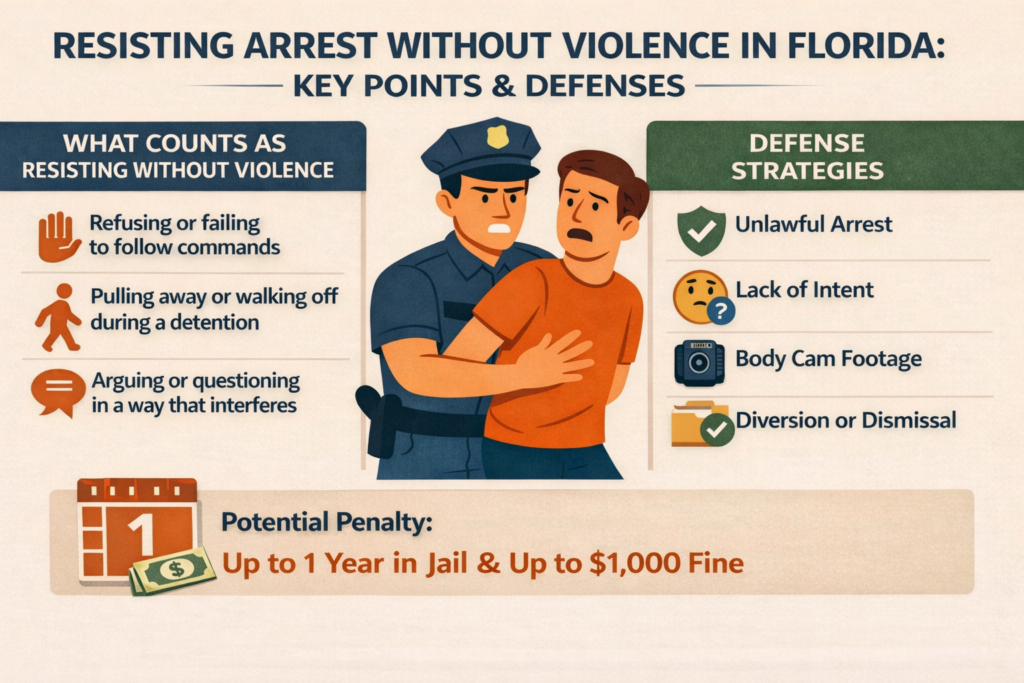
Refusing to put your hands behind your back
Verbally objecting to arrest
Walking away from a lawful stop
Arguing or questioning in a way that interferes with a lawful duty
Delaying compliance after a lawful command
Not following orders “fast enough” during a heated moment
💡 Important: This charge often appears when there is no other criminal conduct — and it’s sometimes used to justify force or cover a bad arrest.
🧾 Penalties for Resisting Without Violence in Florida
1st-degree misdemeanor
Up to 364 days in jail
Up to 12 months probation
Up to $1,000 fine
Even though it’s a misdemeanor, it’s still a criminal charge — and a conviction creates a permanent record.
Not sure whether police are alleging a felony or a misdemeanor? See our breakdown of resisting without violence vs. resisting with violence in Florida
🚫 Common Misconceptions About Resisting Without Violence
Many people are charged with resisting without violence based on misunderstandings of what the law actually requires.
Myth: You can be arrested just for arguing with police.
Reality: Verbal disagreement alone is usually not enough unless it actually obstructs a lawful police duty.
Myth: Any hesitation or confusion is “resistance.”
Reality: Panic, confusion, or reflexive movement does not automatically equal willful obstruction.
Myth: If police say you resisted, that’s the end of the story.
Reality: These cases often depend on credibility — and body-worn camera footage frequently tells a very different story.
🚨 When Police Commonly Add a Resisting Without Violence Charge
In real cases, resisting without violence is often added after the fact — not because of genuine obstruction, but to justify force or bolster an arrest.
This charge commonly appears:
When no other criminal offense clearly applies
After an officer uses force during handcuffing
When a detention is extended without justification
When a stop escalates and officers need leverage
When bodycam footage does not match the written report
Understanding why the charge was added is often the first step toward getting it dismissed.
🛡️ How We Defend Resisting Without Violence Charges
At Michael White, P.A., we know how vague this charge is — and how often it’s used in the absence of real criminal conduct.
🔹 Unlawful Arrest
If the arrest was illegal or lacked probable cause, then your response may have been legally justified.
🔹 No Willful Obstruction
We challenge whether your actions truly constituted obstruction or were simply misunderstanding, fear, or confusion.
🔹 Body Cam Footage
We demand body camera or witness video to disprove exaggerated claims and document what actually happened.
🔹 Dismissal Through Diversion
For first-time offenders, we often negotiate diversion or dismissal to protect your record.
✅ Why Clients Hire Michael White
✅ Former prosecutor who understands how police reports are built — and how to tear them apart
✅ Skilled in early-stage negotiations and motions to dismiss
✅ Trusted by students, professionals, and community members accused of obstruction or resisting
✅ Aggressive courtroom advocate with a focus on clean records
📞 Charged With Resisting Without Violence in Florida? Let’s Set the Record Straight.
This is one of the most beatable charges — but only if you take it seriously.
❓ FAQs: Resisting Without Violence in Florida
👮 Can I be arrested for resisting without actually touching an officer?
Yes — but only if your conduct actually interfered with a lawful police duty.
Resisting without violence does not require physical force. Actions like pulling away, walking off during a lawful detention, or physically interfering with an officer’s duties can qualify. Words alone are usually not enough unless they truly obstruct the officer’s lawful actions.
📄 Is resisting without violence a misdemeanor or a felony?
Resisting without violence is a first-degree misdemeanor under Florida Statute § 843.02. It carries up to 364 days in jail, 12 months of probation, and a $1,000 fine.
🧠 Does the officer have to be acting lawfully?
Yes — this is a critical element of the charge.
The officer must be engaged in the lawful execution of a legal duty. If the stop, detention, arrest, or commands were unlawful, the resisting charge may fail entirely.
📹 Can body camera footage help beat a resisting without violence charge?
Absolutely. Body-worn camera footage is often decisive in these cases. Video frequently shows confusion, panic, or non-obstructive behavior — not intentional resistance — and can contradict exaggerated police reports.
📉 Can resisting without violence charges be dropped?
Yes. These charges are frequently dismissed, diverted, or reduced, especially for first-time offenders or when video evidence undermines the officer’s version of events.
📂 Will a resisting without violence charge stay on my record?
If convicted, yes — it creates a permanent criminal record. However, dismissed cases or cases resolved without adjudication may qualify for record sealing or expungement under Florida law.
⚖️ Can I fight a resisting without violence charge in court?
Yes. These cases are highly fact-specific, and many are won through early motions, suppression arguments, or credibility challenges — particularly when the arrest itself was unlawful.