
Last updated March 2026
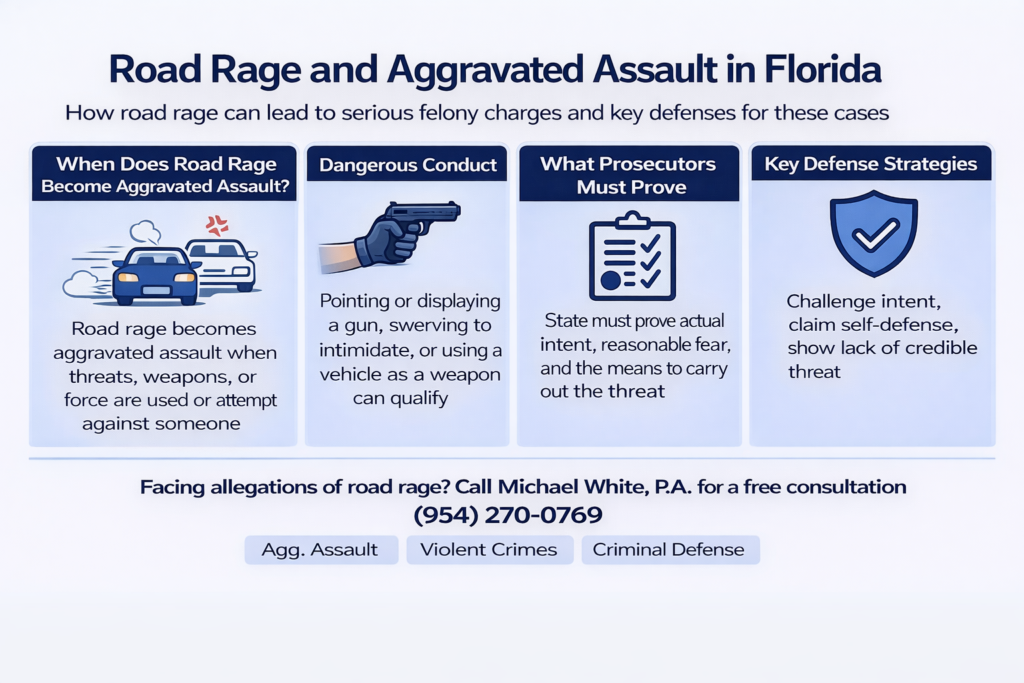
Road rage incidents happen every day in Florida. But when anger behind the wheel turns into threats, weapon display, or aggressive use of a vehicle, what started as a traffic dispute can quickly escalate into a felony aggravated assault charge.
Under Florida law, aggravated assault does not require physical contact. A threat combined with a deadly weapon — including a firearm or even a vehicle — can be enough.
For a full overview of aggravated assault charges, penalties, and sentencing exposure, see our guide to aggravated assault in Florida.
⚖️ When Does Road Rage Become Aggravated Assault?
Under Florida Statute § 784.021, aggravated assault occurs when someone:
Makes an intentional threat of violence
Has the apparent ability to carry it out
Creates a well-founded fear of imminent harm
Uses a deadly weapon (or acts with intent to commit a felony)
In road rage cases, prosecutors often argue that:
A vehicle was used as a deadly weapon
A firearm was displayed
A threat was made during a traffic confrontation
The other driver reasonably feared imminent harm
The key issue is not whether there was a traffic dispute.
The issue is whether the State can prove a legally sufficient threat with a deadly weapon.
🔫 Common Road Rage Scenarios That Lead to Charges
🔹 Displaying a Firearm
Pointing, brandishing, or even displaying a firearm during a traffic dispute can trigger aggravated assault charges — even if the gun was never fired.
Florida’s 10-20-Life law may apply if prosecutors pursue firearm enhancements.
🔹 Using a Vehicle as a Weapon
A vehicle can qualify as a deadly weapon when used in a manner likely to cause death or great bodily harm.
Examples prosecutors rely on:
Intentionally swerving toward another vehicle
Accelerating toward a pedestrian
Attempting to ram another car
Blocking someone’s vehicle while making threats
As in other aggravated assault cases, manner of use controls.
🔹 Verbal Threat + Aggressive Driving
Even without a firearm, prosecutors may argue that:
A threat was made
The vehicle’s movement created imminent danger
The alleged victim reasonably feared harm
In many cases, this becomes a credibility battle.
🎯 The “Deadly Weapon” Issue in Road Rage Cases
Not every aggressive driving maneuver qualifies as use of a deadly weapon.
The State must prove that:
The vehicle was used in a way capable of causing death or great bodily harm
The threat was intentional
The fear was reasonable and imminent
Sudden braking, yelling, or reckless driving alone may support traffic charges — but not necessarily aggravated assault.
Whether a vehicle legally qualifies as a deadly weapon often becomes the central issue.
🔍 What Prosecutors Must Prove
In a road rage aggravated assault case, the State must establish:
✔ Intentional threat
✔ Apparent ability to carry out the threat
✔ Well-founded fear of imminent violence
✔ Use of a deadly weapon (vehicle or firearm)
These cases frequently hinge on:
Dashcam footage
Traffic camera video
Body-worn camera
911 recordings
Statements made at the scene
Whether a firearm was legally possessed
Whether the threat was mutual
Small factual details can change everything.
🧠 Evidence That Wins (or Loses) These Cases
Because road rage incidents happen quickly, evidence preservation is critical.
Key evidence includes:
• Surveillance from nearby businesses
• Highway traffic cameras
• Dashcam footage (both parties)
• 911 call tone and language
• GPS and vehicle positioning
• Physical vehicle damage (or lack thereof)
• Firearm possession legality
Police reports often summarize events broadly. Video frequently tells a more nuanced story.
🚫 When Road Rage Does NOT Meet the Aggravated Assault Standard
Common defense themes include:
No True Threat
Angry words alone are not always enough.
No Imminent Fear
The other driver may not have been in actual danger.
Mutual Confrontation
Both drivers engaged in escalating conduct.
Lack of Deadly Use
Vehicle movement may have been defensive or evasive.
Self-Defense
If you were responding to another driver’s aggressive conduct, self-defense may apply.
For a deeper breakdown of justified use of force, see our guide to self-defense and Stand Your Ground in Florida.
🔥 Firearm Display in Road Rage Cases
Florida law treats firearm display seriously.
Even if:
The firearm was lawfully owned
The firearm was not fired
No one was injured
Brandishing during a confrontation can still support aggravated assault charges.
However, the State must prove the display was threatening and created reasonable fear.
Context matters.
📍 Broward County Enforcement Reality
In Broward County, road rage cases are often:
Filed aggressively
Enhanced when firearms are involved
Influenced by media attention
Heavily dependent on early narratives
Prosecutors frequently decide charging posture based on:
First police statements
Visible weapons
Injury claims
Public safety framing
Early intervention can significantly affect filing decisions.
⚖️ Can Road Rage Aggravated Assault Charges Be Reduced?
Yes.
If the defense shows:
No qualifying deadly weapon use
No legally sufficient threat
Lack of intent
Mutual escalation
Self-defense context
The charge may be reduced to:
Simple assault
Improper exhibition
Traffic offenses
Or dismissed entirely
In felony cases, dismantling the “deadly weapon” element is often decisive.
🛡️ Defense Strategy in Road Rage Cases
Effective defense often includes:
✔ Immediate evidence preservation
✔ Dashcam retrieval
✔ Scene reconstruction
✔ Bodycam review
✔ Witness cross-examination
✔ Challenging weapon classification
✔ Self-defense analysis
✔ Suppression motions where applicable
Because aggravated assault is a third-degree felony (and more severe if enhanced), early strategic action is critical.
📞 Charged With Road Rage Aggravated Assault in Florida?
What feels like a traffic dispute can become a felony charge in minutes.
If you are facing aggravated assault allegations arising from a road rage incident in Fort Lauderdale or anywhere in South Florida, early legal representation matters.
Call Michael White, P.A. at (954) 270-0769 for a confidential consultation.