
Last updated March 2026
Yes — in Florida, a person can be charged with robbery even if no weapon was displayed and no physical force was used.
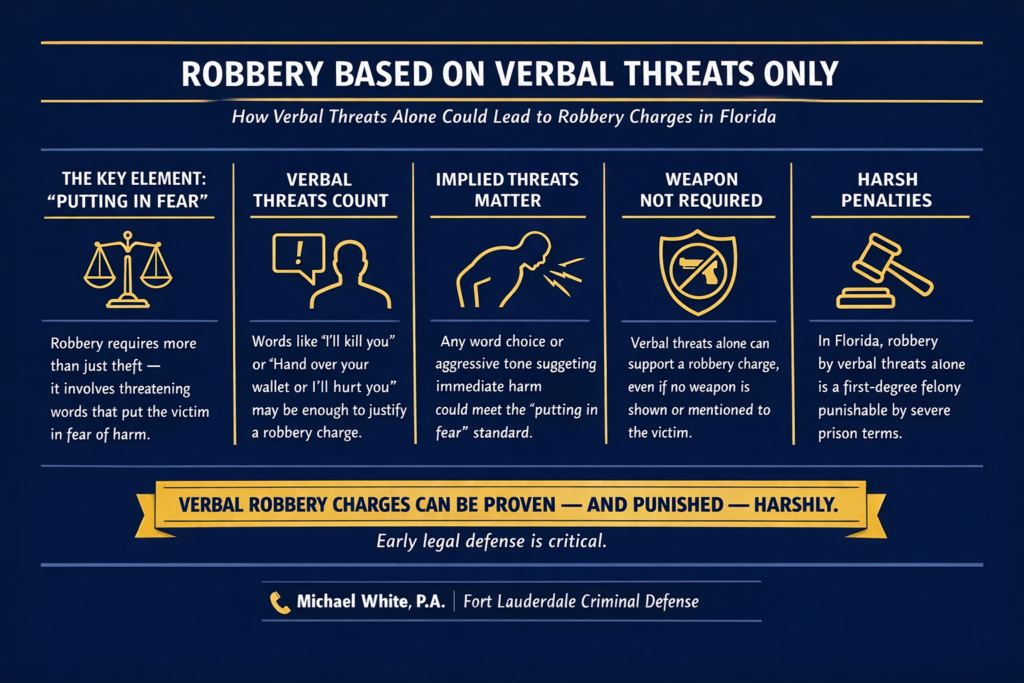
Under Florida Statutes § 812.13, robbery occurs when someone takes money or property with the use of force, violence, assault, or by “putting in fear.”
That final phrase — putting in fear — is where many verbal-threat robbery cases arise.
If you are facing allegations involving threats alone, understanding how Florida courts interpret “fear” is critical. For a complete overview of robbery penalties and defenses, visit our Robbery Charges in Florida page.
What Does “Putting in Fear” Mean?
Florida law does not require a weapon. It does not even require physical contact.
If the alleged victim reasonably believed they were about to suffer harm because of something said during the taking, prosecutors may argue that the “fear” element is satisfied.
The fear must be objectively reasonable — not merely subjective. That means the State must show that a reasonable person in the same situation would have felt threatened.
Words matter.
Tone matters.
Context matters.
But fear must still be proven beyond a reasonable doubt.
Is a Direct Threat Required?
Not always.
Statements such as:
“Give me your wallet.”
“You don’t want problems.”
“Hand it over.”
can sometimes be interpreted as implied threats depending on surrounding circumstances.
However, vague or ambiguous statements without aggressive conduct may not automatically rise to robbery.
The prosecution must connect the words to a credible threat of imminent harm.
No Weapon? It Can Still Be Robbery
A common misconception is that robbery requires a firearm or knife.
It does not.
If the State proves the alleged victim was placed in reasonable fear during the taking of property, the offense may qualify as strong-arm robbery — a first-degree felony punishable by up to 30 years in prison.
Even without a weapon enhancement, the penalties are severe.
When Verbal Threat Cases Become Weak
Verbal-only robbery cases often hinge on:
Conflicting witness accounts
Lack of surveillance footage
No physical contact
No injury
Disputed intent
If the alleged threat is unclear, exaggerated, or unsupported by independent evidence, the defense may argue that the conduct amounts to theft — not robbery.
The distinction between theft and robbery frequently turns on whether “fear” can truly be established.
Surveillance Video Can Change Everything
In many modern robbery cases, surveillance footage becomes central.
Video may show:
Calm interactions inconsistent with fear
No threatening gestures
No aggressive tone
A consensual exchange
Or it may show the opposite.
In verbal-only robbery allegations, video often determines whether prosecutors proceed aggressively or reconsider the charge.
Can Robbery Based on Verbal Threats Be Reduced?
Yes — depending on the evidence.
If the State cannot clearly prove:
A credible threat of imminent harm
Reasonable fear
Intent to intimidate
the charge may be reduced to theft.
Strategic pretrial litigation — including motions to suppress statements or challenge identification — can significantly affect negotiating leverage.
Context Is Everything
Every verbal-threat robbery case depends on specific facts:
Distance between parties
Relative size and positioning
Tone of voice
Body language
Presence of others
Surrounding circumstances
Florida courts evaluate whether the alleged victim’s fear was reasonable under the totality of the circumstances.
The words alone are rarely analyzed in isolation.
Robbery Charges Are Serious — Even Without a Weapon
A robbery charge based solely on words can still carry:
Up to 30 years in prison
A permanent felony record
Long-term employment consequences
Firearm rights restrictions
Early defense strategy matters — especially in cases built primarily on interpretation rather than physical evidence.
FAQs
Can words alone qualify as robbery in Florida?
Yes. If prosecutors prove the alleged victim was placed in reasonable fear during the taking of property, verbal threats alone may satisfy the robbery statute.
Does robbery require a weapon?
No. Robbery can occur without a weapon if force or fear is proven.
Can verbal-threat robbery charges be reduced to theft?
If the State cannot establish reasonable fear beyond a reasonable doubt, the charge may potentially be reduced to theft.