
Last updated March 2026
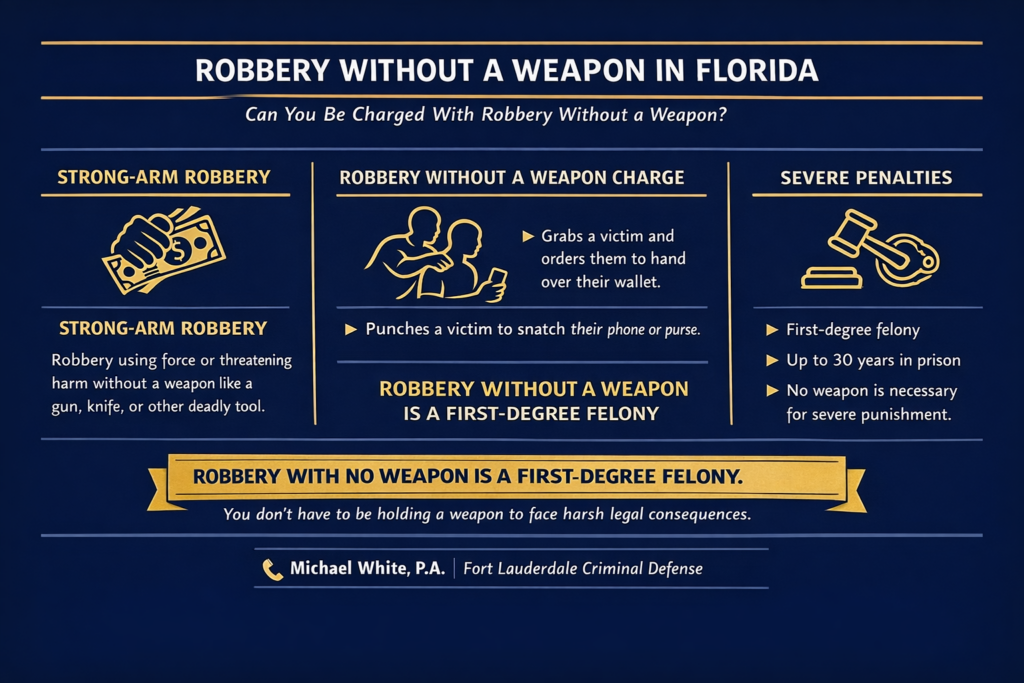
Yes — you can be charged with robbery in Florida even if no weapon was used, displayed, or possessed.
Under Florida Statutes § 812.13, robbery occurs when someone takes money or property from another person with the use of force, violence, assault, or by “putting in fear.”
A weapon is not required.
If you are facing this type of charge, understanding how Florida distinguishes robbery from theft is critical. For a complete breakdown of robbery penalties and defenses, visit our Robbery Charges in Florida guide.
What Is “Strong-Arm” Robbery?
Robbery without a weapon is commonly referred to as strong-arm robbery.
It typically involves:
Physical force without a weapon
Grabbing or pulling property from someone
Pushing or shoving during a taking
Threatening behavior without displaying a weapon
Even minimal force can satisfy the statute if it is used to overcome resistance.
The seriousness of the charge does not depend on whether a weapon was involved.
Is Robbery Without a Weapon Still a Felony?
Yes.
Robbery without a weapon is a first-degree felony in Florida, punishable by up to 30 years in prison.
That penalty exposure surprises many people.
The difference between armed robbery and strong-arm robbery affects sentencing enhancements, but both are extremely serious charges.
How Is Robbery Different From Theft?
The key distinction is force or fear.
Theft involves taking property without consent but without force or intimidation.
Robbery requires:
Force used during the taking
Violence
Assault
Or placing the alleged victim in fear
If prosecutors cannot prove force or fear, the charge may potentially be reduced to theft.
In many cases, this distinction becomes the central issue.
How Much Force Is Required?
Florida law does not require severe violence.
Even relatively minor contact — if used to overcome resistance — may qualify.
Examples may include:
Snatching property while the victim is holding it
Brief physical struggle
Pushing someone aside to take property
However, not every sudden taking qualifies as robbery. Courts often analyze whether the force was sufficient to overcome resistance or whether it was incidental.
These cases are highly fact-specific.
No Injury Does Not Mean No Robbery
Many strong-arm robbery cases involve:
No visible injuries
No medical treatment
No weapon
No lasting physical harm
Despite this, the charge can still be filed as a first-degree felony.
The absence of injury may become relevant during plea negotiations, but it does not automatically eliminate the robbery allegation.
Common Defense Issues in No-Weapon Robbery Cases
Robbery without a weapon cases often hinge on:
Whether force actually occurred
Whether resistance was overcome
Whether the alleged victim was placed in reasonable fear
Whether identification is reliable
Whether surveillance video contradicts the narrative
When the “force” element is weak or ambiguous, opportunities for reduction increase.
Can Robbery Without a Weapon Be Reduced?
Potentially.
If the evidence does not clearly establish:
Force sufficient to overcome resistance
A credible threat of harm
Intent to use intimidation
the charge may be reduced to theft or another lesser offense.
Early case evaluation and strategic pretrial litigation can significantly affect leverage.
Why Early Defense Strategy Matters
Robbery charges are aggressively prosecuted in Broward County.
But outcomes are shaped early — often before formal plea negotiations even begin.
Challenging the force element, contesting identification, and scrutinizing surveillance evidence can shift the trajectory of a case.
A robbery arrest does not automatically mean a robbery conviction.
FAQs
Is robbery without a weapon still a first-degree felony?
Yes. Strong-arm robbery in Florida is a first-degree felony punishable by up to 30 years in prison.
What makes robbery different from theft?
Robbery requires force, violence, assault, or putting in fear during the taking of property. Theft does not.
Can strong-arm robbery charges be reduced?
If prosecutors cannot prove the force or fear element beyond a reasonable doubt, the charge may potentially be reduced.