
Last updated February 2026
An arrest in Florida can follow you long after a case ends — even if charges were dropped or you were never convicted. Florida law allows eligible individuals to seal or expunge criminal records, but the two remedies are not the same.
Understanding the difference is critical. Choosing the wrong path can delay relief — or permanently limit your options.
👉 For the full statewide overview and step-by-step process, visit:
🔎 The Core Difference (Plain English)
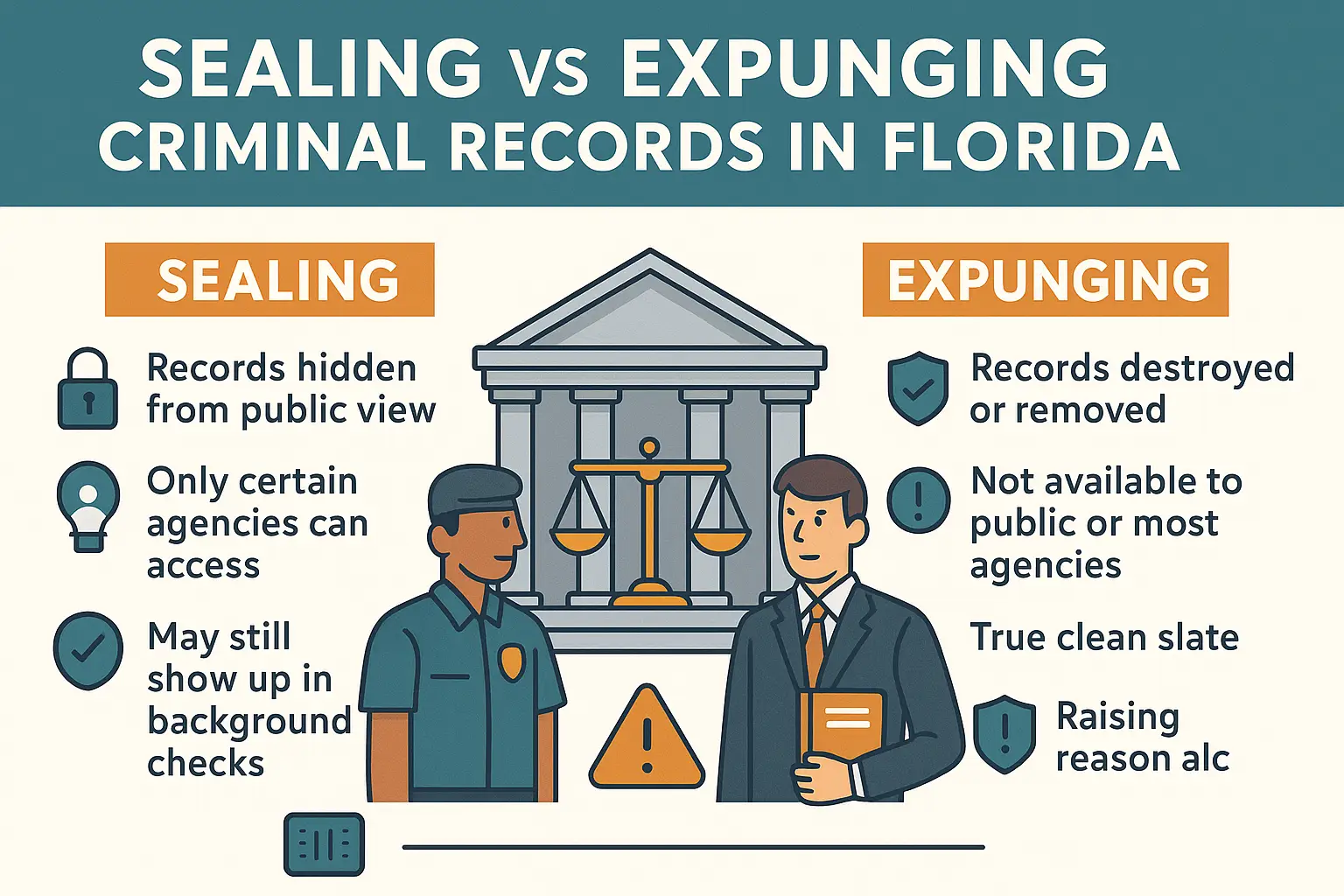
Sealing hides a criminal record from public view. The record still exists but becomes confidential.
Expungement destroys the record held by most agencies, with a limited confidential copy retained by FDLE.
In short:
Expungement offers stronger privacy protection.
Sealing is more widely available.
📊 Sealing vs. Expungement — Side-by-Side Comparison
The chart below summarizes the key legal differences under Florida law.
| Feature | Sealing | Expungement |
|---|---|---|
| Public visibility | Hidden | Destroyed |
| Record still exists? | Yes | No (FDLE keeps confidential copy) |
| Who can see it | Limited agencies | Very limited, usually court-ordered |
| Eligibility | Withhold of adjudication | Dismissed, dropped, not guilty |
| Can you deny the arrest | Usually yes | Usually yes |
| Can it be done more than once | Generally once | Generally once |
| Stronger option | ❌ | ✅ |
⚖️ Eligibility: Why the Outcome of Your Case Matters
The biggest difference between sealing and expungement is how your case ended.
If your charges were dismissed, no actioned, nolle prossed, or resulted in a not guilty verdict, you may qualify for expungement.
If adjudication was withheld on an eligible offense, sealing may be available.
Eligibility is strict and statute-driven. Prior convictions, prior sealing or expungement, pending charges, or certain disqualifying offenses can permanently bar relief.
For detailed breakdowns of specific scenarios, see:
🧠 Which Option Is Better?
If you qualify for expungement, it is usually the stronger option.
Because expungement destroys the record held by most agencies, it provides the cleanest slate available under Florida law.
However, many people do not qualify for expungement and must pursue sealing instead. While sealing does not destroy the record, it still provides substantial protection from employers, landlords, and the general public.
The “better” option depends entirely on eligibility — not preference.
The most common mistake is assuming you can choose expungement when the statute only allows sealing.
🔁 Can You Seal First and Expunge Later?
Sometimes.
In certain situations, a record may be sealed and later become eligible for expungement depending on statutory limits and timing rules.
But this must be handled carefully.
Sealing the wrong case — or misunderstanding eligibility — can permanently block future expungement.
Strategic sequencing matters.
🔍 Background Checks & Disclosure Rules
After sealing or expungement:
Most private employers will not see the record
Most standard background checks will come back clean
You may legally deny the arrest in most situations
However, disclosure exceptions still exist, particularly for:
Law enforcement employment
Certain professional licenses
Florida Bar admission
When charged with a new offense
Understanding these exceptions is critical if your future involves licensing, government work, or regulated professions.
⏳ How Long Does Each Take?
The process length is generally similar for sealing and expungement.
Most cases take 6–12 months, depending on:
FDLE processing times
Court scheduling
Whether a hearing is required
Whether any paperwork issues must be corrected
For a detailed timeline breakdown, see:
💬 Frequently Asked Questions
What’s the main difference between sealing and expungement?
Sealing makes a record confidential. Expungement destroys the record held by most agencies. Expungement offers stronger privacy protection but has stricter eligibility requirements.
Is expungement always better?
If you qualify, yes. But many people only qualify for sealing based on how their case ended.
Can I choose expungement if I qualify for sealing?
Only if your case meets expungement eligibility rules. You cannot simply choose expungement unless the statute allows it.
📣 Choosing the Right Path Matters
Sealing and expungement are not interchangeable.
The correct option depends entirely on:
How your case was resolved
Your prior criminal history
Whether you have previously cleared a record
Whether the offense qualifies under Florida law