
Last updated April 2026
Being accused of aggravated assault in Florida does not automatically mean you committed a crime. In many cases, what appears to be a threat is actually a lawful act of self-defense.
Florida law allows individuals to threaten — and in some cases use — force to protect themselves or others from imminent harm. When these laws apply, a person may be immune from prosecution entirely.
For a full overview of how aggravated assault charges are defined and prosecuted, see Aggravated Assault Charges in Florida.
Understanding how self-defense works — and how it can defeat a felony charge — is critical.
⚖️ Self-Defense and Aggravated Assault Under Florida Law
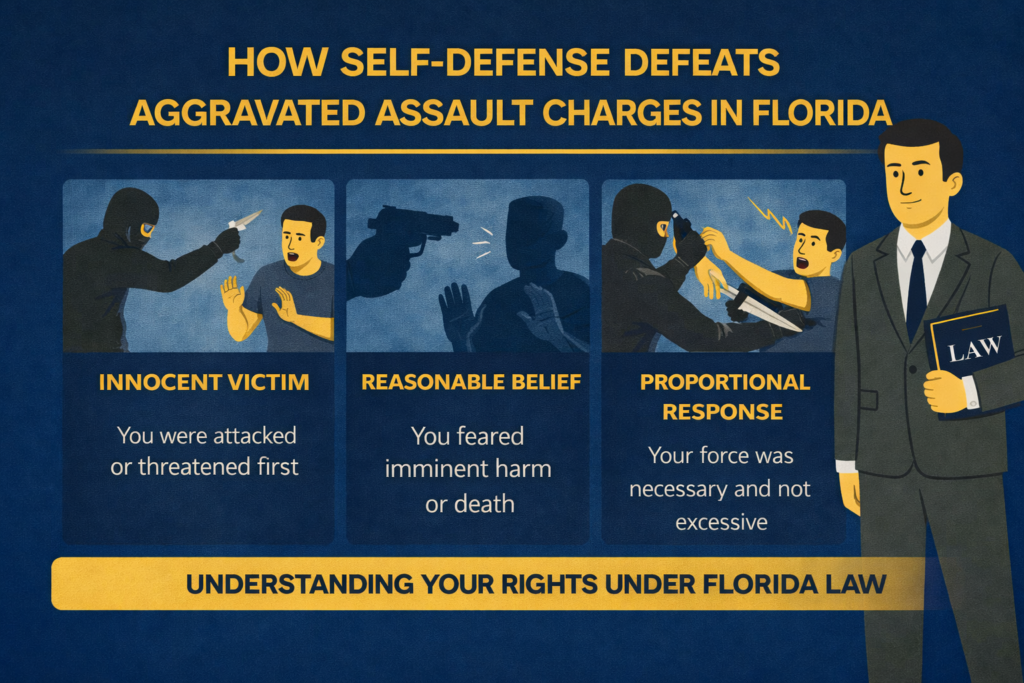
Under Florida law, a person is justified in using or threatening force if they reasonably believe it is necessary to prevent:
Imminent bodily harm
Death
The commission of a forcible felony
This means that conduct which might otherwise be charged as aggravated assault may be legally justified if it was done in response to a real and immediate threat.
Because aggravated assault is based on perception — not physical injury — many cases turn on whether the accused acted defensively rather than aggressively.
🔫 Do You Have to Use Force — or Is Threat Enough?
No physical contact is required.
Florida law recognizes the threatened use of force as lawful in appropriate circumstances. This is especially important in aggravated assault cases, where the allegation often involves:
Displaying a firearm
Raising or brandishing an object
Making a threat during a confrontation
For example, in some cases, pointing a firearm may be justified if it was done to stop an imminent threat. These scenarios are analyzed in Is Pointing a Gun Aggravated Assault in Florida.
Similarly, even objects that are not traditional firearms may be involved in defensive conduct. Courts evaluate how those objects were used and perceived, as discussed in Aggravated Assault With a BB Gun or Airsoft Gun in Florida.
🧠 What “Reasonable Belief” Means
Self-defense depends on what a reasonable person would believe under the same circumstances.
The law does not require that danger actually existed — only that the belief was reasonable at the time.
Courts consider factors such as:
The behavior of the other person
Prior threats or escalation
Physical proximity
Disparity in size, strength, or numbers
Whether a weapon appeared to be present
This analysis often overlaps with whether the accused had the apparent ability to carry out a threat — an issue explained further in What Is “Apparent Ability” in Florida Aggravated Assault Cases.
🧍 Stand Your Ground and Immunity From Prosecution
Florida’s Stand Your Ground law goes beyond traditional self-defense.
In qualifying cases, a person is entitled not just to a defense at trial — but to immunity from prosecution.
This means:
The case can be dismissed before trial
The defendant may never face a jury
The court can rule that the conduct was lawful
To obtain immunity, the defense must show that the use or threatened use of force was justified under Florida law.
If successful, the case ends.
⚖️ When Self-Defense Applies in Aggravated Assault Cases
Self-defense may apply in situations such as:
Responding to a threatening or aggressive individual
Preventing an imminent physical attack
Reacting to a perceived weapon
Defending another person from harm
For example, in fast-moving confrontations — including traffic disputes — a person may display a weapon defensively in response to another driver’s actions. These fact patterns often arise in Road Rage Aggravated Assault in Florida.
In other cases, disputes between acquaintances or family members may escalate quickly, raising similar issues of perception and justification.
🚫 When Self-Defense Does NOT Apply
Self-defense has limits.
It may not apply if:
The accused was the initial aggressor
The threat was not imminent
The response was clearly excessive
The situation involved mutual combat
These distinctions are critical. Many cases hinge on who initiated the encounter and whether the response was proportionate.
🔍 How Prosecutors Challenge Self-Defense Claims
Prosecutors often attempt to defeat self-defense by arguing:
The threat was exaggerated or fabricated
The alleged victim was not actually dangerous
The accused escalated the situation
The use of force was unnecessary
Because aggravated assault cases often rely on perception and conflicting accounts, credibility becomes central.
🛡️ Evidence That Supports Self-Defense
Strong self-defense claims are often supported by:
Surveillance or dashcam footage
Body-worn camera video
911 call recordings
Witness statements
Physical positioning and scene evidence
In many cases, early evidence preservation makes the difference between dismissal and prosecution.
⚖️ Can Self-Defense Lead to Charges Being Dropped?
Yes — and often before trial.
When self-defense is clearly supported, prosecutors may:
Decline to file charges
Dismiss the case
Agree to reduced charges
In some cases, a successful immunity motion ends the case entirely.
A broader discussion of how aggravated assault charges are dismissed or resolved before trial is explained in Can Aggravated Assault Be Dropped Before Trial in Florida.
📍 Why Early Legal Representation Matters
Timing is critical in self-defense cases.
Early intervention allows a defense attorney to:
Present evidence before filing decisions are made
Frame the narrative accurately
Prevent misinterpretation of events
Challenge probable cause early
Position the case for dismissal or immunity
Once a case is formally filed, the opportunity to shape the outcome becomes more limited.
📞 Charged With Aggravated Assault in Florida?
If you acted to protect yourself or someone else, you may have a complete defense under Florida law.
At Michael White, P.A., we bring former prosecutor insight to every case. We understand how these charges are evaluated — and how to present self-defense effectively.
If you are facing aggravated assault charges in Fort Lauderdale or anywhere in South Florida, call (954) 270-0769 for a confidential consultation.
❓ FAQs
Can self-defense completely defeat an aggravated assault charge?
Yes. If the conduct was legally justified, the case may be dismissed or result in immunity from prosecution.
Do I have to be attacked first to claim self-defense?
No. The law allows action when there is a reasonable belief of imminent harm.
What is Stand Your Ground immunity?
It allows a judge to dismiss the case before trial if the use of force was justified.
Can pointing a weapon be considered self-defense?
Yes. In some situations, displaying a weapon may be lawful if done to prevent imminent harm.
What if both people were involved in the confrontation?
Self-defense may still apply, but mutual combat or being the initial aggressor can limit the defense.