
Last updated March 2026
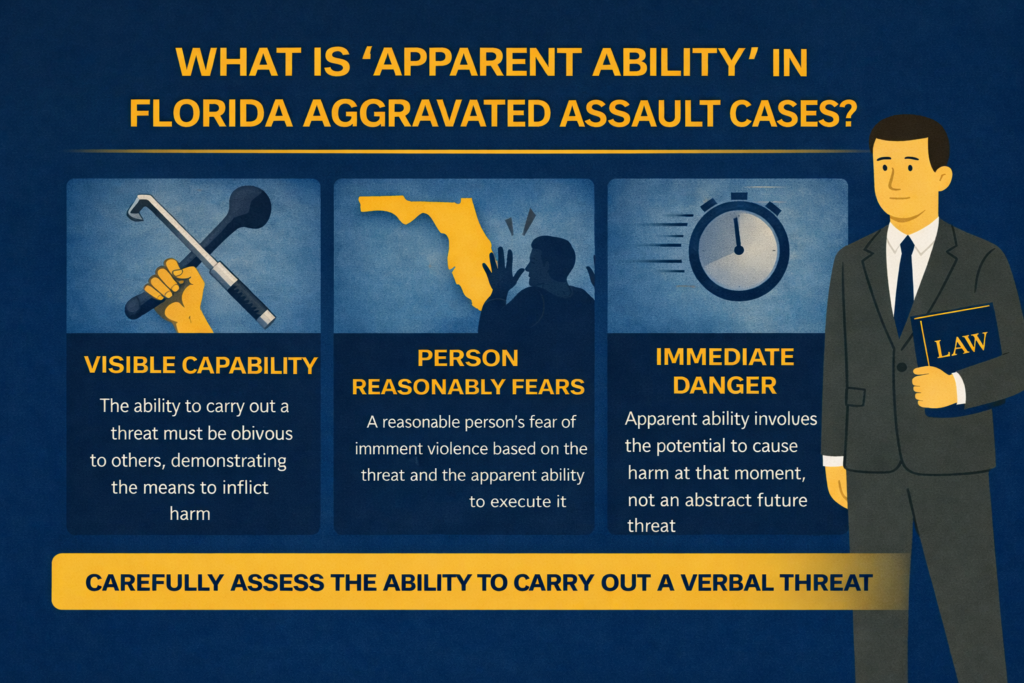
In Florida aggravated assault cases, one of the most important legal questions is whether the accused had the apparent ability to carry out the alleged threat.
That phrase matters because Florida law does not punish every angry statement or heated confrontation. To prove assault — and therefore aggravated assault — the State must show more than words alone. Prosecutors must show that the alleged victim reasonably believed the threatened violence could happen immediately.
In other words, the issue is not just what was said. The issue is whether the accused appeared able to carry out the threat at that moment.
For a broader overview of how these charges are defined and prosecuted, see Aggravated Assault Charges in Florida.
⚖️ What “Apparent Ability” Means Under Florida Law
Florida assault law requires proof of:
an intentional and unlawful threat by word or act
an apparent ability to carry out the threat
a well-founded fear that violence is imminent
Aggravated assault adds another element, such as the use of a deadly weapon or intent to commit a felony.
“Apparent ability” means the alleged victim must have reasonably believed the accused could immediately follow through on the threat.
This is a perception-based element. It focuses on how the situation appeared in real time — not just what was later claimed.
🔍 Why Apparent Ability Matters
This element often determines whether a confrontation was:
merely angry or offensive
simple assault
aggravated assault
If the accused did not appear capable of carrying out the threat, the State may fail to prove assault at all.
For that reason, many aggravated assault cases turn less on injury or physical evidence and more on whether the surrounding facts created a believable, immediate threat.
That is also why cases based mostly on speech are often weak. A fuller discussion of that issue appears in Can Words Alone Be Aggravated Assault in Florida.
🚫 When Apparent Ability May Be Missing
Apparent ability may be lacking when:
the accused was too far away to carry out the threat
physical barriers prevented immediate action
the alleged weapon was not accessible
the circumstances made the threat unrealistic
the conduct was ambiguous or misinterpreted
For example, a person shouting threats from across a parking lot may sound aggressive, but that does not automatically mean they had the apparent ability to inflict immediate harm.
These distinctions matter because Florida law requires a threat of imminent violence — not future violence or generalized anger.
🔫 Apparent Ability and Firearm Allegations
This issue frequently arises in firearm-based cases.
If someone is alleged to have displayed or pointed a gun, prosecutors often argue that apparent ability is obvious. But that is not always true. Context still matters, including:
distance between the parties
whether the weapon was actually accessible
whether it was pointed or merely visible
whether the conduct was defensive rather than threatening
These questions are explored further in Is Pointing a Gun Aggravated Assault in Florida.
In some cases, the object involved may not even be a real firearm. Courts then must consider how the object appeared and whether it could reasonably create fear.
🚗 Apparent Ability in Road Rage and Public Confrontations
Apparent ability is also a major issue in traffic disputes and public encounters.
In road rage cases, the State may claim that a driver used a vehicle as a deadly weapon or created an immediate threat through movement, positioning, or aggressive driving. But not every act of reckless driving or yelling from a car proves apparent ability in the legal sense.
🏠 Apparent Ability in Domestic Arguments
Domestic aggravated assault cases often depend heavily on apparent ability because they frequently involve:
emotional accusations
conflicting stories
unclear physical positioning
no independent witnesses
A person may claim they were threatened, but the defense may be able to show that the accused was not actually in a position to carry out any immediate harm.
🧠 How Prosecutors Try to Prove Apparent Ability
Prosecutors typically rely on:
witness statements
911 calls
body camera footage
surveillance video
physical layout of the scene
They try to show that the accused was close enough, positioned in a way, or acting with enough immediacy that the alleged victim reasonably believed violence was about to occur.
But these cases are often vulnerable to challenge because perception can be distorted by:
fear
confusion
poor vantage points
incomplete video
emotionally charged reporting
🛡️ Defense Strategies That Attack Apparent Ability
This element gives the defense a powerful way to challenge the charge.
Common arguments include:
No Immediate Capability
The accused was not in a position to carry out the threat.
No Accessible Weapon
The alleged weapon was not available for immediate use.
Distance or Obstruction
Physical separation or barriers made the threat unrealistic.
Misinterpretation
The alleged victim misunderstood gestures, movement, or tone.
Self-Defense Context
The conduct was defensive, not aggressive.
In some cases, the surrounding facts support lawful defensive conduct rather than criminal threat. These principles are discussed in How Self-Defense Defeats Aggravated Assault Charges in Florida.
⚖️ Can Weak Apparent Ability Lead to Dismissal?
Yes.
If the State cannot prove apparent ability, the aggravated assault charge may be reduced or dismissed.
That can happen when:
the threat was not immediate
the accused could not realistically carry it out
the evidence is inconsistent
the context does not support a reasonable fear of imminent violence
A fuller discussion of early dismissals appears in Can Aggravated Assault Be Dropped Before Trial in Florida.
📍 Why This Element Is So Important
“Apparent ability” is one of the most overlooked parts of aggravated assault law — but it is often one of the most defensible.
A person can sound angry, reckless, or even frightening without meeting the legal standard for aggravated assault.
That is why these cases must be examined carefully, with close attention to timing, distance, positioning, and context.
📞 Charged With Aggravated Assault in Florida?
If your case turns on whether you actually had the ability to carry out an alleged threat, the details matter.
At Michael White, P.A., we bring former prosecutor insight to every aggravated assault case. We know how the State tries to prove these elements — and where those arguments break down.
If you are facing aggravated assault charges in Fort Lauderdale or anywhere in South Florida, call (954) 270-0769 for a confidential consultation.
❓ FAQs
What does apparent ability mean in an aggravated assault case?
It means the alleged victim must have reasonably believed the accused could immediately carry out the threat.
Can there be assault without apparent ability?
Usually no. Apparent ability is one of the required elements of assault under Florida law.
Does distance matter in aggravated assault cases?
Yes. Distance, barriers, and positioning can all affect whether the accused had the apparent ability to inflict immediate harm.
How does apparent ability apply to gun cases?
Even in gun cases, context matters. The State still must prove the situation created a reasonable belief of imminent harm.
Can lack of apparent ability lead to dismissal?
Yes. If the State cannot prove apparent ability, the charge may be reduced or dismissed.