
Last updated March 2026
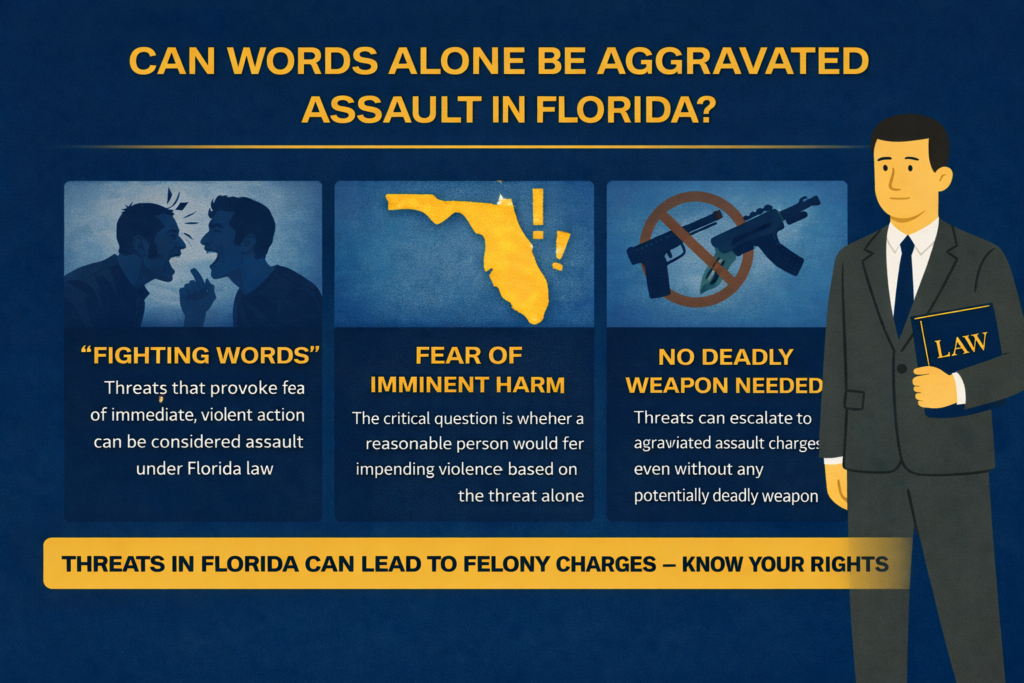
Many people are shocked to learn they can be arrested for aggravated assault without ever touching another person. That leads to a common question:
Can words alone lead to a felony charge?
In most cases, the answer is no — words alone are not enough. But the full answer is more nuanced, and the distinction matters.
In Florida, aggravated assault is based on threats, perception, and context — not just physical action. For a complete overview of how these charges are defined and prosecuted, see Aggravated Assault Charges in Florida.
⚖️ What Florida Law Requires
Under Florida law, assault is defined as:
An intentional and unlawful threat by word or act
Combined with an apparent ability to carry it out
That creates a well-founded fear of imminent violence
Aggravated assault adds one critical element:
Use of a deadly weapon or intent to commit a felony
This means that words can be part of an assault, but they must be accompanied by circumstances that make the threat real and immediate.
🚫 Why Words Alone Are Usually Not Enough
In most situations, verbal statements by themselves do not meet the legal standard for aggravated assault.
For example:
Yelling threats from a distance
Making angry or offensive statements
Insulting or provoking someone
These may be inappropriate — but they are not necessarily criminal.
The law requires more than words. It requires a credible, imminent threat.
🔍 The Missing Element: “Apparent Ability”
The key issue is whether the accused had the ability to carry out the threat at that moment.
If there is no realistic ability to act, the threat may not qualify as assault — let alone aggravated assault.
This concept is central to many cases and is explained in more detail in What Is “Apparent Ability” in Florida Aggravated Assault Cases.
⚠️ When Words PLUS Conduct Become a Crime
While words alone are usually insufficient, words combined with conduct can result in charges.
Examples include:
Threatening someone while holding or displaying a weapon
Making statements while advancing toward another person
Using gestures that reinforce a verbal threat
Blocking someone’s movement while making threats
In these situations, the issue is not just what was said — but how it was said and what was happening at the time.
For example, pointing or displaying a firearm while making a statement can elevate the situation into a felony. These scenarios are analyzed in Is Pointing a Gun Aggravated Assault in Florida.
🧠 Tone, Context, and Perception Matter
Aggravated assault is a perception-driven offense.
Courts and prosecutors consider:
Tone of voice
Physical proximity
Body language
Movement toward the alleged victim
Presence of objects that could be used as weapons
Two identical statements can be treated very differently depending on the context.
🏠 Words in Domestic or Emotional Situations
This issue frequently arises in domestic disputes, where arguments can escalate quickly.
In these cases:
Emotions are high
Statements may be exaggerated
Allegations may change over time
What was said — and how it was interpreted — becomes critical. These fact patterns are explored further in Domestic Arguments and Aggravated Assault Charges in Florida.
🚗 Words During Public or Road Rage Confrontations
In public confrontations, words are often combined with movement or perceived aggression.
For example:
Yelling threats while approaching another person
Making statements during a traffic confrontation
Gesturing while arguing in a parking lot
These scenarios are often evaluated based on how the situation appeared to others, as discussed in Road Rage Aggravated Assault in Florida and Aggravated Assault in a Parking Lot or Public Place in Florida.
🛡️ Defenses Based on Words vs. Conduct
When a case is based primarily on statements, several defenses may apply:
No True Threat
The words did not constitute a serious or intentional threat.
No Imminent Harm
The alleged threat was not immediate or realistic.
No Apparent Ability
The accused could not actually carry out the threat.
Misinterpretation or Exaggeration
The alleged victim misunderstood what was said.
Self-Defense Context
The statements were made in response to a perceived threat.
Florida law allows defensive conduct under certain circumstances. These principles are explained in How Self-Defense Defeats Aggravated Assault Charges in Florida.
⚖️ Can These Charges Be Dropped?
Yes — frequently.
Cases based primarily on words are often dismissed or reduced because:
The threat is not legally sufficient
The evidence is inconsistent
The context does not support fear of imminent harm
A full breakdown of how these cases are resolved early is explained in Can Aggravated Assault Be Dropped Before Trial in Florida.
🔄 When Charges Get Reduced Instead
Even if charges are not dismissed, they are often reduced to lesser offenses such as:
Simple assault
Disorderly conduct
Non-criminal violations
A closer look at how these outcomes occur is covered in How Aggravated Assault Charges Get Reduced in Florida.
📞 Accused of Making a Threat in Florida?
Not every argument is a crime — even when harsh words are exchanged.
If you are facing aggravated assault allegations based on what was said during a confrontation, the context matters.
At Michael White, P.A., we bring former prosecutor insight to every case. We understand how these charges are evaluated — and how to challenge them effectively.
Call (954) 270-0769 for a confidential consultation.
❓ FAQs
Can you be charged with aggravated assault for just words?
Usually no. Words alone are generally not enough without a real and immediate threat.
What makes a verbal threat illegal?
It must be combined with apparent ability and create a reasonable fear of imminent harm.
Does yelling count as aggravated assault?
Not by itself. Yelling without a credible threat is typically not sufficient.
What if the other person says they were afraid?
Their fear must be reasonable and supported by the circumstances.
Can these cases be dismissed?
Yes. Many cases based primarily on words are dismissed or reduced before trial.