
Last updated March 2026
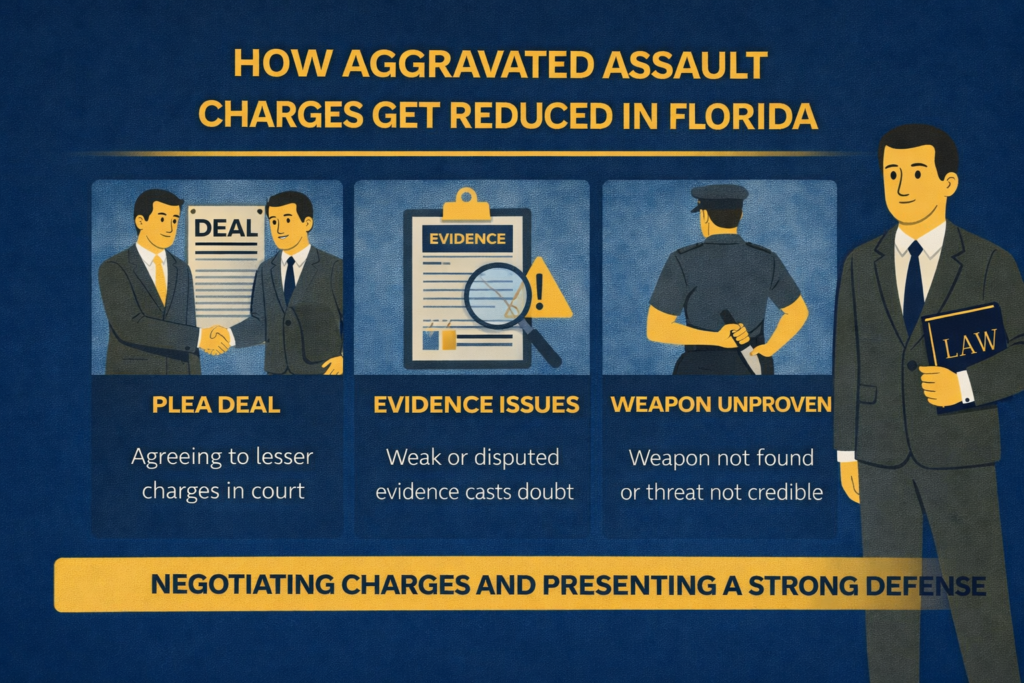
Being charged with aggravated assault in Florida does not mean you will be convicted of a felony. In many cases, these charges are reduced — sometimes significantly — before a case ever reaches trial.
Aggravated assault is often based on perception, context, and incomplete information gathered during a fast-moving incident. As a result, early investigation and strategic defense can expose weaknesses that lead to lesser charges or negotiated outcomes.
For a full overview of how aggravated assault is defined and prosecuted, see Aggravated Assault Charges in Florida.
🔍 Why Aggravated Assault Charges Are Often Reduced
Aggravated assault requires proof of specific legal elements, including:
An intentional threat
Apparent ability to carry it out
A well-founded fear of imminent harm
Use of a deadly weapon or intent to commit a felony
If the State cannot clearly prove any of these elements, the charge may be reduced.
For example, disputes over whether a threat was immediate or realistic often center on issues like perception and positioning — concepts explained further in What Is “Apparent Ability” in Florida Aggravated Assault Cases.
⚖️ Common Reduced Charges
When aggravated assault charges are reduced, they are often reclassified as:
Simple Assault
A misdemeanor involving a threat without a deadly weapon.
Improper Exhibition of a Weapon
Often charged when a weapon was displayed but not used in a threatening or legally sufficient way.
Disorderly Conduct
In cases involving arguments or public disturbances without a true threat.
These outcomes can eliminate felony exposure and significantly reduce long-term consequences.
🔫 When Weapon Allegations Break Down
Many aggravated assault cases involve allegations of a weapon — but those allegations are often disputed.
For example:
The object may not qualify as a deadly weapon
The weapon may not have been used in a threatening manner
The alleged victim may have misinterpreted what occurred
In firearm-related cases, context is critical. Even displaying or pointing a weapon does not automatically satisfy the legal standard. These issues are explored in Is Pointing a Gun Aggravated Assault in Florida.
Similarly, cases involving replica or non-traditional weapons may be treated differently depending on how the object was perceived, as discussed in Aggravated Assault With a BB Gun or Airsoft Gun in Florida.
🛡️ Self-Defense and Reduction Strategy
Self-defense is one of the most powerful tools for reducing or eliminating charges.
If the defense can show that the accused acted in response to a perceived threat, prosecutors may:
Reduce the charge
Decline to pursue enhancements
Reevaluate the strength of the case
In some situations, self-defense may lead to dismissal rather than reduction. These principles are explained in How Self-Defense Defeats Aggravated Assault Charges in Florida.
🧠 Credibility Issues and Conflicting Evidence
Many aggravated assault cases depend heavily on one person’s account of what happened.
When that account is inconsistent, exaggerated, or contradicted by evidence, the case weakens.
Common issues include:
Conflicting witness statements
Lack of video or incomplete footage
Changing or recanted allegations
Misinterpretation of gestures or words
These weaknesses often create leverage for reduction.
⚖️ Pre-Filing vs. Post-Filing Reductions
Reductions can happen at different stages:
Before Charges Are Filed
Defense counsel may present evidence to prosecutors that prevents felony charges from being filed at all.
After Filing, Before Trial
Charges may be reduced through negotiation, motion practice, or evidentiary challenges.
In some cases, charges are not just reduced — they are dismissed entirely. A fuller discussion of early dismissal appears in Can Aggravated Assault Be Dropped Before Trial in Florida.
🚗 Real-World Examples of Reductions
Aggravated assault charges are often reduced in situations such as:
Road rage incidents with no clear threat
Arguments where a weapon was present but not used
Domestic disputes involving conflicting accounts
Cases based primarily on words or gestures
In these situations, the issue is often whether the conduct actually met the legal definition of a felony.
📍 Why Early Defense Strategy Matters
The outcome of an aggravated assault case is often determined early.
A strong defense can:
Challenge the legal sufficiency of the charge
Reframe the facts before they become fixed
Prevent enhancements (such as firearm minimums)
Create leverage for negotiation
Once a case progresses, options can become more limited.
📞 Charged With Aggravated Assault in Florida?
A felony charge does not have to define your future.
Many aggravated assault cases are reduced — and the earlier you act, the better your chances.
At Michael White, P.A., we bring former prosecutor insight to every case. We know how these charges are evaluated — and how to negotiate outcomes that protect your future.
If you are facing aggravated assault charges in Fort Lauderdale or anywhere in South Florida, call (954) 270-0769 for a confidential consultation.
❓ FAQs
Can aggravated assault charges be reduced in Florida?
Yes. Many cases are reduced to misdemeanor offenses depending on the evidence and defense strategy.
What is the most common reduced charge?
Simple assault or improper exhibition of a weapon are common outcomes.
Does a weapon automatically mean a felony?
No. The State must still prove it was used in a threatening way that meets the legal standard.
Can self-defense lead to a reduced charge?
Yes. It can also lead to dismissal in some cases.
When do reductions usually happen?
Often before trial, either during pre-filing review or through negotiation after charges are filed.