
Last updated March 2026
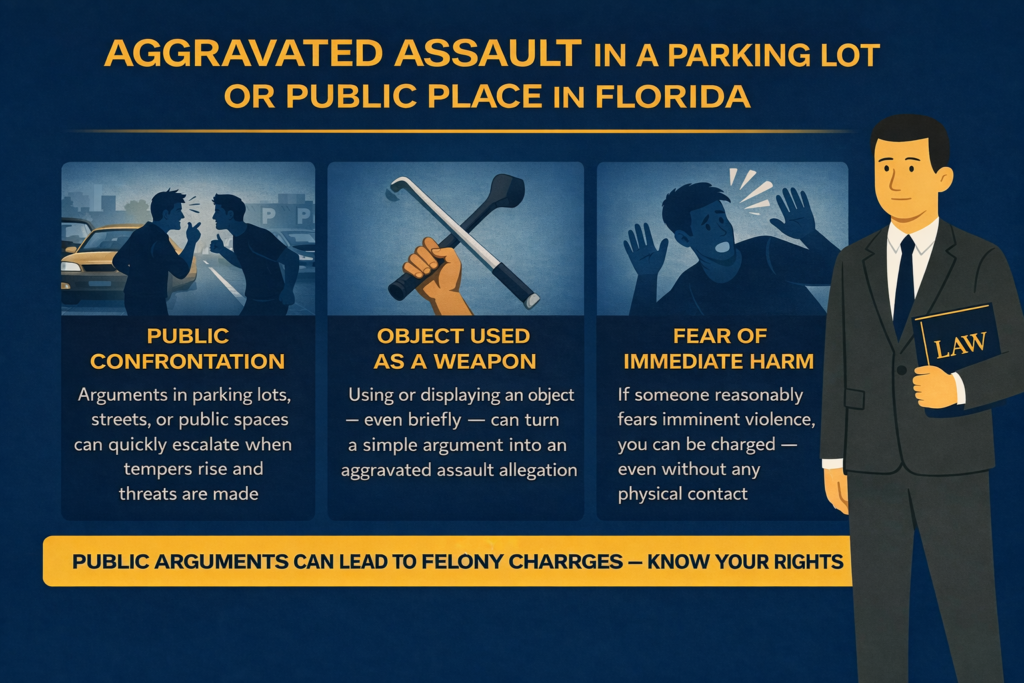
Arguments in parking lots, outside businesses, or in other public places can escalate quickly. What begins as a minor disagreement can lead to a felony arrest if law enforcement believes a threat was made with a weapon.
In Florida, aggravated assault does not require physical contact. A perceived threat — combined with the presence of a deadly weapon — can be enough to support a charge.
For a full overview of how these charges are defined and prosecuted, see Aggravated Assault Charges in Florida.
⚖️ When a Public Confrontation Becomes Aggravated Assault
Under Florida law, aggravated assault occurs when someone:
Intentionally threatens violence
Has the apparent ability to carry it out
Creates a well-founded fear of imminent harm
Uses a deadly weapon or acts with intent to commit a felony
In public settings, these elements are often evaluated based on:
What witnesses saw
What cameras captured
How the situation appeared in real time
Because these cases often unfold quickly and in crowded environments, perception becomes critical.
🔍 Why Public Location Changes the Case
Parking lots and public areas introduce factors that are not present in private disputes:
Surveillance cameras from nearby businesses
Multiple witnesses with different perspectives
Bystanders who may misinterpret events
Increased police presence and rapid response
Video footage can be powerful — but it does not always tell the full story. Angles, timing, and missing context can distort what actually happened.
🚨 Common Situations That Lead to Arrest
Aggravated assault arrests in public places often arise from:
Disputes over parking spaces
Confrontations outside stores, bars, or apartment complexes
Arguments between strangers
Escalations involving vehicles
Displaying or gesturing with an object perceived as a weapon
For example, in vehicle-related confrontations, a person may claim that a threat was made during a brief encounter. These scenarios are similar to those discussed in Road Rage Aggravated Assault in Florida.
In other cases, the allegation may involve displaying a firearm or object during a confrontation. Whether that conduct qualifies as a felony depends heavily on context, as explained in Is Pointing a Gun Aggravated Assault in Florida.
🎥 The Role of Surveillance and Video Evidence
One of the defining features of public-place cases is the presence of video.
Common sources include:
Store security cameras
Parking lot surveillance systems
Traffic cameras
Cell phone recordings
Video can either support or undermine the State’s case.
However, footage often:
Lacks audio
Captures only part of the encounter
Misses events leading up to the incident
Fails to show perceived threats
Because aggravated assault is based on fear and intent, what is not shown on video can be just as important as what is.
🔫 What Counts as a “Weapon” in Public Cases
In public confrontations, many objects may be treated as deadly weapons depending on how they are used, including:
Firearms
Vehicles
Tools or heavy objects
Items that appear to be weapons
In some cases, the object involved may not even be a real firearm. Courts analyze how the item was perceived and whether it could reasonably cause fear. These issues are explored in Aggravated Assault With a BB Gun or Airsoft Gun in Florida.
🧠 Witnesses, Perception, and Misinterpretation
Public cases often involve multiple witnesses — but that does not mean the facts are clear.
Different witnesses may:
See different parts of the encounter
Misinterpret gestures or movements
Be influenced by stress or confusion
Provide inconsistent statements
Because aggravated assault is a perception-based offense, these inconsistencies can significantly affect the case.
🛡️ Defenses in Public Aggravated Assault Cases
Common defenses include:
Lack of Intent
A heated argument or sudden movement may be misinterpreted as a threat.
No Reasonable Fear
The alleged victim’s reaction may not have been objectively reasonable.
No Deadly Weapon
The object involved may not legally qualify as a deadly weapon.
Self-Defense
The accused may have acted in response to another person’s aggressive behavior.
Florida law allows the threatened use of force in certain situations. These principles are explained in How Self-Defense Defeats Aggravated Assault Charges in Florida.
⚖️ Can These Charges Be Dropped Before Trial?
Yes.
Public-place aggravated assault cases are often dismissed or reduced when:
Video contradicts the allegation
Witness statements are inconsistent
The threat is legally insufficient
Self-defense applies
A full breakdown of how these cases are resolved early is explained in Can Aggravated Assault Be Dropped Before Trial in Florida.
🔄 Charge Reductions in Public Cases
Even when charges are not dismissed, they are often reduced.
Common outcomes include:
Simple assault
Improper exhibition
Non-criminal resolutions
A deeper look at how these outcomes occur is covered in How Aggravated Assault Charges Get Reduced in Florida.
📍 Broward County Reality in Public Arrests
In Broward County and throughout South Florida:
Public disturbances often result in immediate police response
Arrest decisions are made quickly
Officers rely heavily on initial witness accounts
Video evidence may not be fully reviewed before arrest
However, many of these cases weaken significantly after full investigation.
📞 Charged With Aggravated Assault in a Public Place?
What feels like a brief public confrontation can quickly become a felony charge.
If you are facing aggravated assault allegations in Fort Lauderdale or anywhere in South Florida, early legal representation matters.
At Michael White, P.A., we bring former prosecutor insight to every case. We know how these cases are built — and how to challenge them.
Call (954) 270-0769 for a confidential consultation.
❓ FAQs
Can a parking lot argument lead to aggravated assault charges?
Yes. If a threat is made with a weapon and creates fear of imminent harm, charges may be filed.
Does video footage guarantee a conviction?
No. Video may be incomplete or misleading and often lacks context.
What if witnesses disagree about what happened?
Inconsistent witness statements can weaken the State’s case and support dismissal or reduction.
Can self-defense apply in public places?
Yes. If you reasonably believed you were in danger, self-defense may apply.
Can these charges be dropped?
Yes. Many public-place aggravated assault cases are dismissed or reduced before trial.