
Last updated March 2026
Not all probation violations are treated the same.
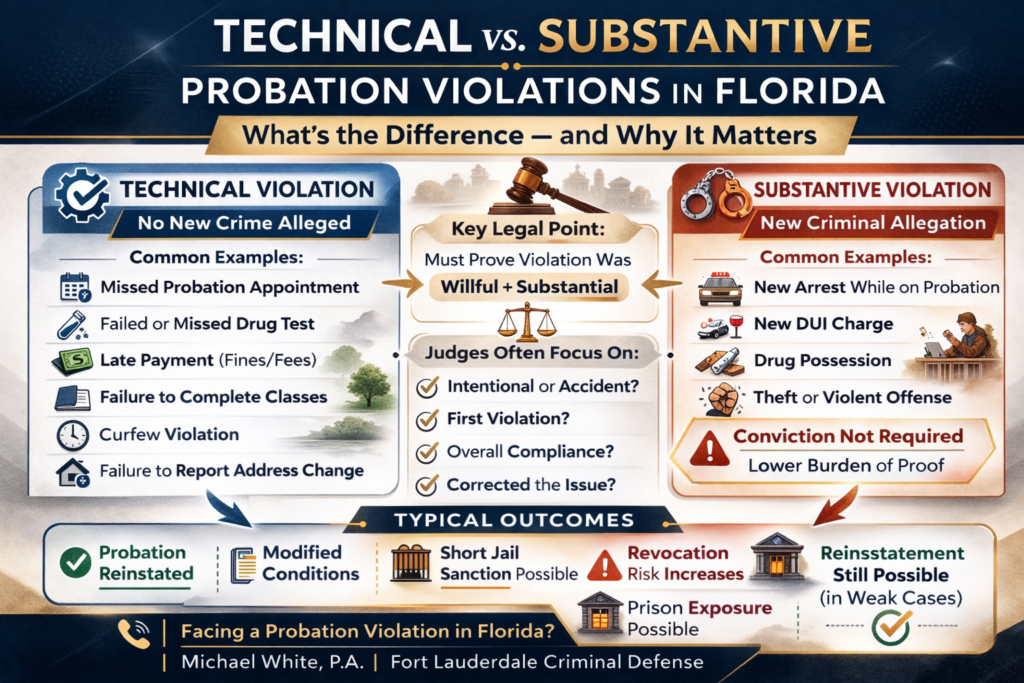
In Florida, violations generally fall into two categories: technical violations and substantive violations. The distinction matters because it affects custody decisions, evidentiary standards, bond likelihood, and the risk of revocation.
For a broader explanation of how probation violations work in Florida — including hearings, burdens of proof, and possible outcomes — see our guide to probation violations in Florida.
Here’s what separates technical from substantive violations — and why it matters.
⚖️ What Is a Technical Probation Violation?
A technical violation occurs when someone allegedly fails to comply with a condition of probation — but does not commit a new criminal offense.
Common Examples of Technical Violations
Missing a probation appointment
Failing or missing a drug or alcohol test
Late or missed payments of fines or restitution
Failure to complete required classes or counseling
Curfew violations
Failure to report address or employment changes
Most first-time probation violations are technical in nature.
What the State Must Prove
Even for a technical violation, the State must prove the violation was:
✔ Willful
✔ Substantial
If the conduct was accidental, unavoidable, or not significant, revocation may be improper.
For a deeper explanation of what “willful and substantial” means in a VOP case, review our detailed breakdown of that standard.
🚨 What Is a Substantive Probation Violation?
A substantive violation occurs when a person on probation is accused of committing a new criminal offense.
This does not require a conviction.
In many cases, the State may attempt to prove a violation based on:
A new arrest
Police reports
Testimony from officers or witnesses
Evidence introduced at a VOP hearing
For more on how new arrests impact probation status, see our guide to new arrests while on probation.
Does a New Arrest Automatically Violate Probation?
Not automatically — but it often triggers a violation proceeding.
A conviction is not required. The judge may find a violation under a lower burden of proof than in a criminal trial.
That means:
The State does not have to prove guilt beyond a reasonable doubt
Hearsay may be admissible
The judge decides the outcome (no jury)
Substantive violations typically carry higher revocation risk than technical violations.
Key Differences Between Technical and Substantive Violations
1️⃣ Custody & Bond Risk
Technical violations may still result in a no-bond hold — but judges are often more receptive to reinstatement when the violation is minor or correctable.
Substantive violations, especially those involving violence or drugs, significantly increase the likelihood of detention.
If you are already in custody, see our guide on whether you will be held without bond for a probation violation.
2️⃣ Strength of Evidence
Technical violations usually rely on:
Probation officer testimony
Compliance records
Drug test results
Substantive violations often rely on:
Arrest affidavits
Police reports
Witness statements
Pending criminal charges
In both cases, the State must present competent, substantial evidence.
3️⃣ Revocation Exposure
Technical violations often lead to:
Reinstatement
Modified probation terms
Treatment-based conditions
Short jail sanctions
Substantive violations increase the risk of:
Revocation
Imposition of the suspended sentence
Prison exposure in felony cases
But even substantive violations can be defended, especially when the new charge is weak or unsupported.
What Judges Focus on in Both Types of Violations
Regardless of classification, judges commonly evaluate:
Whether the violation was willful
Prior compliance history
Whether the issue was corrected
Public safety concerns
Credibility of the evidence
A violation that appears technical at first glance may still lead to revocation if it shows a pattern of disregard.
Conversely, a substantive allegation may not result in revocation if the evidence is unreliable.
Why the Distinction Matters
Understanding whether your case is technical or substantive affects:
Bond strategy
Hearing preparation
Mitigation approach
Negotiation posture
Sentencing exposure
Early legal strategy often determines whether probation is reinstated — or revoked.
FAQs: Technical vs. Substantive Probation Violations
Can a technical violation still send me to jail?
Yes. A technical violation can result in jail if the court finds it was willful and substantial. However, judges are often more receptive to reinstatement in technical cases.
Is a new arrest automatically a probation violation?
No. A new arrest triggers a violation proceeding, but the State must still prove the violation under the applicable burden of proof.
Which type of violation is more serious?
Substantive violations generally carry higher revocation and incarceration risk, especially when involving violent or drug-related allegations.
Can probation be reinstated after a substantive violation?
Yes. Reinstatement remains possible if the evidence is weak, mitigation is strong, or the alleged new charge is dismissed.
Facing a Probation Violation in Florida?
Whether the allegation is technical or substantive, the strategy differs.
Technical violations often focus on mitigation and proof of compliance.
Substantive violations often require simultaneous defense of both the new charge and the VOP proceeding.
Understanding the distinction is the first step in protecting your freedom.