
Last updated March 2026
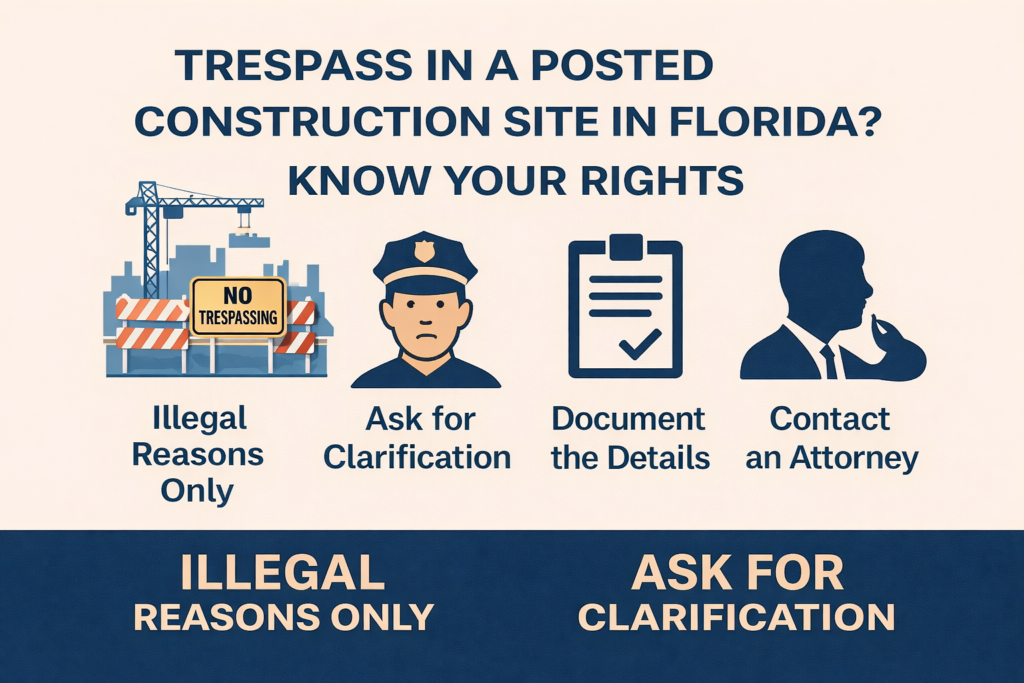
Trespassing at a construction site in Florida is commonly charged when a person enters an area that is clearly restricted or posted against entry.
These cases often depend on whether proper notice was given — especially through signs, barriers, or fencing.
For a full overview of trespassing laws in Florida, see Florida Trespassing Law.
⚖️ What Makes a Construction Site “Posted”?
A construction site is typically considered “posted” when:
- Signs clearly indicate no trespassing
- The area is fenced or blocked off
- Entry is restricted to authorized personnel
Florida law allows posted notice to serve as a warning — meaning a person may be charged even without a verbal warning.
For a deeper explanation of how notice works, see Trespass After Warning in Florida.
🔍 What Prosecutors Must Prove
To convict someone of trespass at a construction site, the State generally must prove:
- The property was posted or clearly restricted
- The person entered or remained without authorization
- The person knew or should have known entry was not allowed
These cases often focus on visibility and clarity of posted signs.
🚨 Why Construction Site Trespass Is Common
Construction sites frequently lead to trespass charges because:
- They are often left unattended
- They contain visible equipment or materials
- They may attract curiosity or unauthorized access
Despite this, the law treats these areas as restricted — even when no one is present.
🧠 Common Situations Leading to Charges
These cases often arise from:
- Entering a fenced or gated construction site
- Walking through a posted area as a shortcut
- Exploring or photographing the site
- Being present after hours
Many of these situations involve misunderstandings rather than criminal intent.
⚖️ When Charges Become More Serious
Construction site trespass may become more serious if additional factors are present:
- Refusal to leave after being confronted
- Damage to property or equipment
- Repeated violations
- Carrying a weapon
For example, refusing to leave after being told can strengthen the case. See Defiant Trespass / Refusal to Leave Property in Florida
If property damage is alleged, additional charges may apply. See Property Damage Charges in Florida
🛡️ Common Defense Issues
Construction site trespass cases often turn on:
Visibility of Signs
Were the signs clearly posted and visible?
Access Points
Was the area actually secured or restricted?
Intent
Did the person knowingly enter a restricted area?
Mistake or Confusion
Was the entry accidental or based on misunderstanding?
🔑 Why These Cases Are Often Defensible
Because these cases depend heavily on notice and visibility, they are often:
- Fact-specific
- Dependent on physical layout
- Open to challenge
If signage is unclear or barriers are insufficient, the charge may be vulnerable.
For situations where charges may be dismissed, see Can Trespassing Charges Be Dropped in Florida?
📍 Charged With Trespassing at a Construction Site in South Florida?
Construction site trespass charges can arise quickly — even in situations involving confusion or curiosity.
If you are under investigation or facing charges, early legal strategy can make a major difference.
Call Michael White, P.A. at (954) 270-0769 for a confidential consultation.
FAQs
Do I have to be told not to enter a construction site?
Not necessarily. Posted signs or fencing may be enough.
What if there were no visible signs?
That may be a defense if the State cannot prove notice.
Can I be charged if I didn’t damage anything?
Yes. Trespass does not require damage.
Can these charges be dropped?
Yes. Many cases are dismissed when notice or intent cannot be proven.