
Last updated March 2026
Many Florida drivers assume DUI cases revolve around alcohol. But when prescription medication is involved, police often rely on urine testing — and that changes the legal landscape entirely.
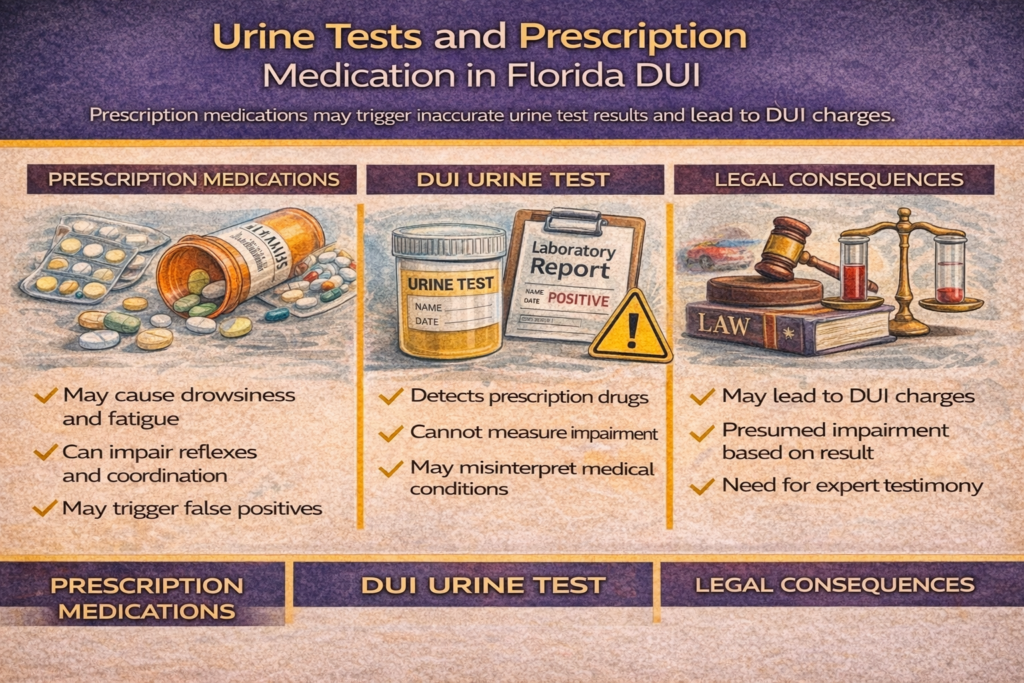
Urine tests do not measure real-time impairment. Instead, they detect drug metabolites — chemical byproducts that can remain in the body long after any impairing effects have worn off.
Understanding how urine testing works — and its limitations — is critical in Florida DUI cases involving prescription medication.
These limitations are part of Florida’s broader DUI testing framework, which governs how chemical evidence is collected, interpreted, and used in criminal cases.
⚖️ How Florida Law Treats Drug-Based DUI
Under Florida law, DUI does not require alcohol. A person may be charged if they are:
Driving or in actual physical control of a vehicle
While impaired by alcohol, controlled substances, or certain prescription medications
Unlike alcohol, Florida does not set a numerical “legal limit” for most prescription drugs. That means prosecutors must prove actual impairment of normal faculties, not just the presence of a substance.
This is where urine testing becomes controversial.
🧪 What Urine Tests Actually Measure
Urine tests detect metabolites, not active drugs.
Metabolites are:
Chemical byproducts left after the body processes a substance
Detectable hours or days after use
Not necessarily connected to impairment at the time of driving
A urine test may show:
That a medication was taken
That the body processed it
That metabolites are present
But it does not show:
When the drug was consumed
Whether the drug was active while driving
Whether the person was impaired
This gap between presence and impairment is central in many Florida DUI drug cases.
We break down how this issue arises in cannabis cases in our guide to weed DUI in Florida and why testing does not prove impairment.
💊 Prescription Medications Commonly Involved in DUI Cases
Urine testing frequently detects medications such as:
Benzodiazepines (e.g., Xanax, Valium)
Opioids (e.g., hydrocodone, oxycodone)
Sleep aids
Stimulants
Antidepressants
Many of these medications are:
Lawfully prescribed
Taken as directed
Not impairing at therapeutic levels
The mere presence of a prescribed medication does not automatically prove DUI.
These limitations are part of Florida’s broader DUI testing framework, which governs how chemical evidence is collected, interpreted, and used in criminal cases.
🚨 Why Urine Testing Is Scientifically Limited
Urine testing presents several reliability concerns:
⏱️ No Real-Time Measurement
Unlike alcohol breath testing, urine tests do not reflect the driver’s condition at the time of driving.
🧬 Metabolites vs. Active Drug
Metabolites may remain long after impairment has ended.
📊 No Correlation to Impairment
The concentration of metabolites in urine does not reliably correlate with impaired driving ability.
🧪 Testing Delays
Urine samples are often collected long after arrest, making timing even more disconnected from driving.
Similar timing problems arise in alcohol cases, as explained in our guide to how long after driving police can test your BAC in Florida.
Because of these issues, urine test results must be interpreted cautiously.
🛡️ Defense Strategies in Prescription Medication DUI Cases
In Florida DUI cases involving urine testing, defense strategy often focuses on:
🔍 Impairment vs. Presence
The State must prove impairment — not just the existence of a drug.
🩺 Medical Records and Prescriptions
Documentation showing lawful use, dosage, and timing can undermine impairment claims.
🧪 Expert Toxicology Testimony
Experts may explain:
The difference between metabolites and active compounds
Therapeutic vs. impairing levels
Why urine testing does not prove real-time impairment
📹 Officer Observations
Body-worn camera footage may contradict claims of slurred speech, poor balance, or confusion.
⚖️ Procedural Issues
Improper collection, storage, or documentation may raise reliability concerns.
When urine testing is the primary evidence, these cases are often more defensible than they initially appear.
🔬 Urine Testing vs. Blood Testing in DUI Cases
Unlike blood testing — which measures concentration at a specific time — urine testing does not provide a direct measurement of impairment.
Blood testing attempts to reflect alcohol or drug concentration in the bloodstream. Urine testing merely shows that the body has processed a substance at some point.
We explain how blood evidence is evaluated differently in our guide to hospital blood draws vs. legal DUI blood tests in Florida.
This distinction can be decisive in court.
📍 Charged With DUI Based on Prescription Medication?
Being prescribed a medication does not make you automatically guilty of DUI. The prosecution must prove that the medication actually impaired your normal faculties at the time you were driving.
If your DUI case relies heavily on urine testing, understanding the scientific limitations of that method may significantly affect your defense strategy.
Early review of lab reports, prescription history, and video evidence is essential.
❓ Frequently Asked Questions
Can I be charged with DUI for taking prescribed medication?
Yes, but the State must prove that the medication actually impaired your ability to drive — not merely that it was present in your system.
Does a positive urine test prove I was impaired?
No. Urine tests detect metabolites, which do not prove impairment at the time of driving.
Are urine tests reliable in DUI cases?
They can detect prior use but are limited in showing real-time impairment.
Can lawful prescription use be a defense?
It can be relevant. Evidence that the medication was taken as prescribed and not impairing may undermine the State’s case.
Can urine test results be challenged in court?
Yes. Challenges may focus on scientific reliability, interpretation, timing, and whether the results actually prove impairment.