
Last updated March 2026
If you’re arrested for DUI in Florida, one of the most common questions is:
“How long after I was driving can police legally test my BAC?”
The answer depends on several factors — including the type of test, the timing of the stop, and how the State attempts to prove impairment.
In many cases, timing becomes the central defense issue.
Understanding how long police have to test your blood alcohol concentration (BAC) — and how delays affect accuracy — can dramatically change the outcome of a DUI case.
Breath and blood testing procedures must follow strict regulatory rules. For a breakdown of compliance requirements and common errors, see our Florida DUI Testing guide.
⏱️ Is There a Legal Time Limit to Test BAC in Florida?
Florida law does not impose a strict “two-hour rule” that automatically invalidates testing after a certain time. However, timing matters — and it matters a lot.
Under Florida Statute § 316.193, prosecutors must prove that:
You were driving or in actual physical control of a vehicle
You were impaired at the time of driving
orYour BAC was 0.08% or higher at the time of driving
Notice the key phrase: “at the time of driving.”
That creates a legal problem when testing happens well after the stop.
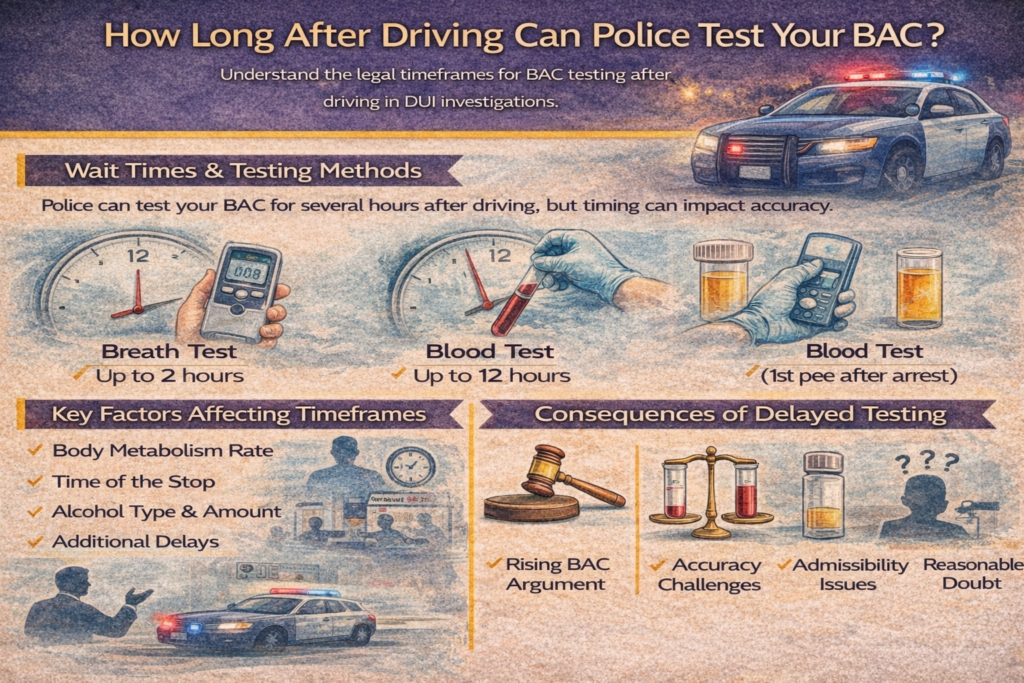
🧪 How Long After Driving Can Breath Tests Be Given?
Breath testing is typically performed shortly after a DUI arrest, but delays can still occur depending on the circumstances of the stop, transport, and testing process.
Even relatively short delays can affect accuracy because BAC changes over time.
🩸 What About Blood Tests?
Blood testing is often used when:
There is an accident involving injury
A breath test is refused
The driver is hospitalized — where medical treatment can affect results, as explained in our guide to how IV fluids affect blood alcohol results in Florida DUI cases
Law enforcement seeks a warrant
We also explain the legal distinction between medical and evidentiary blood testing in our guide to hospital blood draws vs. legal DUI blood tests in Florida.
Unlike breath testing, blood draws frequently occur hours after driving, especially in crash investigations.
When delays occur, prosecutors often rely on retrograde extrapolation — an attempt to estimate BAC backward in time.
This method is heavily challengeable when:
Drinking patterns are unclear
The time of last drink is disputed
The driver was still absorbing alcohol
Medical factors interfere with metabolism
In serious cases involving injury or death, these timing issues become even more critical.
⚖️ What Is the “Rising BAC” Defense?
Alcohol does not instantly peak in the bloodstream. After drinking:
Alcohol is absorbed
BAC rises
BAC peaks
BAC gradually falls
If you were tested an hour or more after driving, your BAC at the time of driving may have been lower than the test result.
This is known as the rising BAC defense defense in Florida DUI cases.
The viability of this argument depends on:
Time between driving and testing
Food consumption
Type and quantity of alcohol
Body weight and metabolism
Additional delays (waiting for tow, crash scene investigation, hospital transfer, etc.)
🚓 What Happens If Testing Is Delayed?
When police delay BAC testing, several legal issues arise:
✔ Accuracy Challenges
The longer the delay, the harder it becomes to prove BAC at the time of driving.
✔ Admissibility Issues
Improper procedures, chain-of-custody gaps, or noncompliance can result in suppression of evidence.
✔ Reasonable Doubt
If the State cannot reliably establish BAC at the time of driving, a jury may question the entire case.
🛑 Does Florida Have a “Two-Hour Rule”?
Some states have presumptions tied to two-hour windows. Florida does not have a strict automatic invalidation rule.
However:
The further testing occurs from the time of driving,
The weaker the State’s case may become,
And the stronger timing-based defenses become.
The issue is not simply legality — it is proof.
🔁 How Prosecutors Try to Overcome Delays
In delayed-testing cases, prosecutors may attempt to:
Introduce officer observations
Use retrograde extrapolation testimony
Argue impairment independent of numeric BAC
Rely on crash circumstances
But these arguments often depend on assumptions that can be challenged.
📑 How Timing Affects DUI Penalties
Penalties depend on whether the State proves:
Impairment
A BAC of 0.08% or higher
Aggravating factors (0.15+, injury, minor in vehicle)
When timing undermines the BAC reading, exposure can change significantly.
For a full breakdown of sentencing ranges and enhancements, see Florida DUI Penalties.
🧠 Why Early Legal Representation Matters
Timing defenses require:
Immediate preservation of video
Accurate timeline reconstruction
Analysis of dispatch logs
Review of breath machine records
Medical and metabolic evaluation
Delays in hiring counsel can mean:
Lost surveillance footage
Lost bodycam data
Missed opportunities to challenge retrograde assumptions
If your test occurred long after driving, timing may be the most important issue in your case.
📍 Arrested for DUI in Fort Lauderdale?
DUI cases in Broward County move quickly, and prosecutors begin reviewing evidence immediately after arrest.
Understanding how timing affects BAC testing — and how to challenge delayed results — can make the difference between a conviction and a reduced charge.
❓ Frequently Asked Questions
How long after driving can police legally test my BAC in Florida?
There is no strict cutoff, but the State must prove your BAC at the time of driving. Delays weaken that proof.
Can I be convicted if my test was taken hours later?
Possibly — but timing creates strong defense arguments, especially when absorption and metabolism are disputed.
What if I refused a breath test?
Police may seek a warrant for blood testing. Refusal also triggers license consequences.
Does delayed testing automatically dismiss a DUI?
No. But it can create significant evidentiary weaknesses that lead to suppression, reduction, or dismissal.
What is retrograde extrapolation?
A method prosecutors use to estimate BAC at an earlier time. It is often vulnerable to scientific challenge.
📞 Speak With a Fort Lauderdale DUI Defense Lawyer Today
If you were tested hours after driving — especially after a crash or hospital transport — your case may hinge on timing.
Call (954) 270-0769 or request a consultation to evaluate whether delayed testing creates a viable defense strategy in your case.
Early action preserves evidence. Late action limits options.