
Last updated March 2026
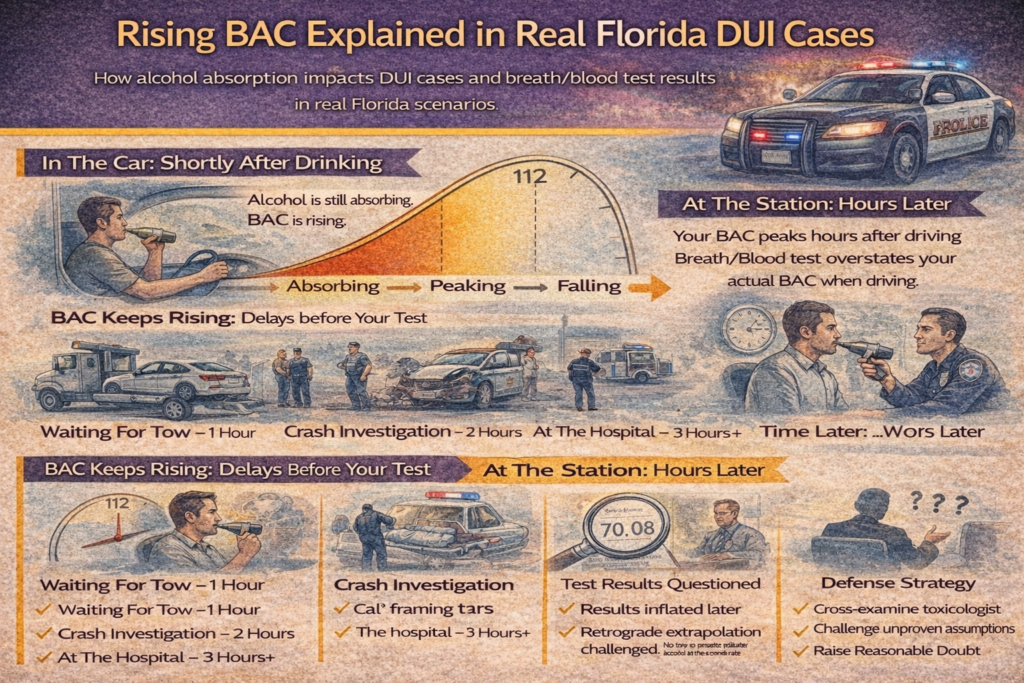
If you were arrested for DUI hours after driving, your breath or blood test result may not reflect what your blood alcohol concentration (BAC) was at the time you were actually behind the wheel.
This concept is known as rising BAC — and in real Florida DUI cases, it can make the difference between a conviction and a reduction.
Understanding how alcohol absorption works — and how prosecutors attempt to work backward in time — is critical when timing becomes the central issue in your case.
For a broader overview of testing timelines and procedures, see our Florida DUI Testing Guide.
🍺 What Is “Rising BAC”?
Rising BAC refers to the period after drinking but before peak absorption, when alcohol is still entering your bloodstream.
Alcohol does not instantly spike to its highest level. Instead, it follows a general pattern:
Absorption Phase – BAC rises as alcohol enters the bloodstream
Peak Phase – BAC reaches its highest point
Elimination Phase – BAC gradually falls
If you were stopped shortly after drinking — but tested much later — your BAC at the time of testing may have been higher than it was while driving.
Florida law requires prosecutors to prove impairment or a BAC of 0.08% or higher at the time of driving, not at the time of testing.
⏱️ Why Timing Matters in Florida DUI Cases
Delays are common in real DUI investigations:
Waiting for backup
Waiting for a tow truck
Crash scene investigation
Transport to the station
Hospital blood draws
Breath machine availability
Even a delay of 60–120 minutes can significantly affect BAC levels during the absorption phase.
We break down how testing delays affect DUI cases in our guide to how long after driving police can test your BAC in Florida.
🩸 Breath vs. Blood Testing in Rising BAC Cases
Breath Testing
Breath tests measure BAC at the time of the test — not at the time of driving.
If you were still absorbing alcohol, the reading may overstate your earlier BAC.
Blood Testing
Blood draws often occur hours after driving, especially in crash investigations — often after medical treatment, which can affect interpretation, as explained in our guide to how IV fluids affect blood alcohol results in Florida DUI cases.
When this happens, prosecutors frequently rely on retrograde extrapolation to estimate your BAC at an earlier time.
We also explain how medical versus legal blood testing affects admissibility in our guide to hospital blood draws vs. legal DUI blood tests in Florida.
🔬 What Is Retrograde Extrapolation?
Retrograde extrapolation is an attempt to calculate what your BAC must have been earlier by working backward from a later test result.
This method depends on assumptions about:
Time of last drink
Quantity consumed
Body weight
Food intake
Metabolic rate
Whether alcohol absorption was complete
If those assumptions are inaccurate, the estimate becomes unreliable.
In many Florida DUI cases, retrograde extrapolation becomes the focal point of expert testimony and cross-examination.
🚗 Real-World Rising BAC Scenarios
✔ Scenario 1: Short Delay After Drinking
You leave a restaurant after finishing drinks and are stopped within 10–15 minutes.
Your test occurs 90 minutes later.
Your BAC may have been rising during that entire period.
✔ Scenario 2: Crash Investigation Delay
After a minor accident, officers investigate for two hours before testing.
By the time breath or blood testing occurs, absorption may have peaked.
✔ Scenario 3: Hospital Blood Draw
In injury cases, blood may not be drawn until 3–4 hours after driving.
Prosecutors rely heavily on retrograde extrapolation in these situations.
⚖️ How Rising BAC Creates Reasonable Doubt
When rising BAC is present, the defense may argue:
The test result does not reflect BAC at the time of driving
The State cannot reliably prove impairment at that earlier time
Retrograde extrapolation is based on speculative assumptions
Scientific uncertainty creates reasonable doubt
📑 How Rising BAC Affects DUI Penalties
If the State cannot prove a BAC of 0.08% or higher at the time of driving:
Aggravated penalties may not apply
Enhancements (0.15+ BAC) may be undermined
Negotiation leverage increases
🧠 Common Misconceptions About Rising BAC
“If I blew over 0.08, I’m automatically guilty.”
Not necessarily. The number alone is not the full story — timing matters.
“Police only have two hours to test me.”
Florida does not have a strict automatic two-hour invalidation rule. The issue is proof, not timing alone.
“Rising BAC works in every case.”
No. It depends on specific facts — including drinking timeline and absorption stage.
🛡️ How DUI Defense Lawyers Challenge Rising BAC Assumptions
Effective defense strategies may include:
Reviewing bodycam to establish timeline
Analyzing dispatch logs and crash reports
Evaluating breath machine compliance
Challenging the toxicologist’s assumptions
Cross-examining extrapolation methodology
Presenting competing expert testimony
Rising BAC cases are fact-intensive. Early investigation is critical to preserve evidence before timelines are lost.
📍 Arrested for DUI in Fort Lauderdale?
In Broward County DUI cases, prosecutors begin building their timeline immediately after arrest. If testing occurred well after driving, rising BAC may be one of the most important issues in your defense.
❓ Frequently Asked Questions
What is rising BAC in a Florida DUI case?
It means your blood alcohol level was still increasing after you stopped driving, potentially making your later test result higher than it was while you were behind the wheel.
Does rising BAC automatically dismiss a DUI?
No. But it can create doubt about whether the State can prove impairment or unlawful BAC at the time of driving.
Is retrograde extrapolation reliable?
It depends on accurate assumptions. When those assumptions are uncertain or incomplete, the calculation can be challenged.
How long after driving can BAC still rise?
BAC can continue rising for 30 minutes to over two hours depending on drinking patterns and metabolism.
Should I talk to police about when I drank?
Statements about drinking timelines can significantly affect a rising BAC analysis. Consult a lawyer before discussing details.
📞 Speak With a Fort Lauderdale DUI Defense Lawyer Today
If your breath or blood test occurred long after driving, your case may depend on rising BAC and timing.
Call (954) 270-0769 or request a consultation to evaluate how absorption timing and retrograde extrapolation may affect your DUI case.
Early strategy changes outcomes.