
Last updated March 2026
When a DUI arrest follows a crash or medical emergency, blood testing often becomes central to the case. But what many drivers don’t realize is that medical treatment itself can affect blood-alcohol results.
One of the most misunderstood factors in DUI blood testing is the use of intravenous (IV) fluids. In accident cases, IV fluids are commonly administered before blood is drawn — and that timing can matter.
This page explains how IV fluids interact with blood-alcohol concentration (BAC) testing, what courts look at, and why these cases often require careful scientific and legal review.
For a broader explanation of how chemical testing works — and where these issues arise — see our Florida DUI testing guide.
🏥 Why IV Fluids Are Common in DUI Accident Cases
After a crash, emergency responders frequently administer IV fluids to:
Stabilize blood pressure
Treat shock
Prevent dehydration
Deliver medications
These treatments are focused on saving lives — not preserving forensic evidence. But when blood is drawn after IV fluids are introduced, the reliability of BAC interpretation becomes more complex.
🧪 How Blood Alcohol Testing Works
A DUI blood test measures the concentration of alcohol in a sample of whole blood at a specific moment in time.
These timing and reliability issues are part of Florida’s broader DUI testing framework, which governs how chemical evidence is collected, preserved, and interpreted in criminal cases. We explain the legal distinction between medical and evidentiary blood testing in our guide to hospital blood draws vs. legal DUI blood tests in Florida.
Important limitations:
The test reflects the time of the draw, not necessarily the time of driving
BAC levels change continuously as alcohol is absorbed and eliminated
Medical intervention can alter the composition of blood before testing
Understanding timing is critical in IV-related cases.
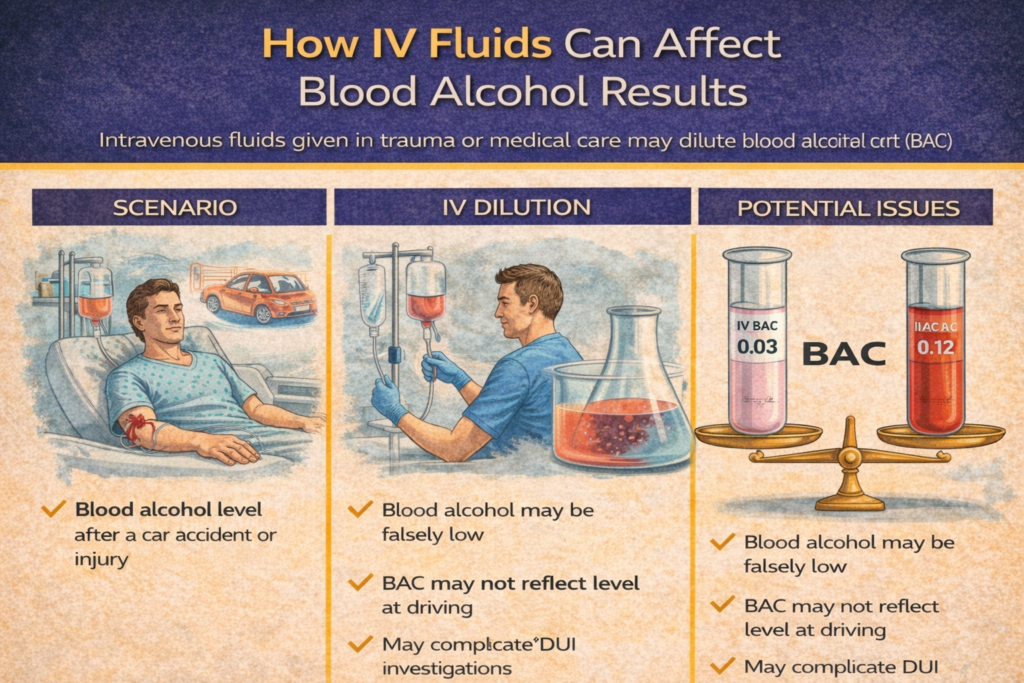
💧 Do IV Fluids “Dilute” BAC Results?
The short answer: It depends.
IV fluids can:
Increase plasma volume
Alter the concentration of substances in circulating blood
Change lab interpretation depending on timing
In some cases, IV fluids may theoretically dilute alcohol concentration. In others, the effect may be negligible or scientifically disputed. The answer is highly fact-specific and depends on:
The type and volume of fluids administered
The timing of IV administration
The timing of the blood draw
The patient’s physiology and alcohol absorption phase
There is no automatic rule — and courts evaluate these issues carefully.
⏱️ Timing Is Often the Real Issue
More important than “dilution” is timing.
In many accident cases:
The driver is transported to a hospital
Treatment begins
Blood is drawn one or more hours after driving
Alcohol absorption may still be occurring. Medical treatment may alter the body’s physiological state. The BAC reported at the hospital may not reflect the BAC at the time of driving.
This creates room for legitimate scientific dispute. We break down how delayed testing affects DUI cases in our guide to how long after driving police can test your BAC in Florida.
These cases often overlap with what is known as a rising BAC defense in Florida DUI cases, where alcohol concentration continues to increase after driving.
⚖️ How Courts Evaluate IV-Related BAC Challenges
Courts do not automatically exclude blood evidence because IV fluids were administered. Instead, they look at:
Whether the blood sample was properly collected
Whether chain-of-custody procedures were followed
Whether expert testimony explains the physiological impact
Whether the State can reliably connect the test result to the time of driving
When assumptions are weak or unsupported, BAC interpretation becomes vulnerable to challenge.
🛡️ Defense Strategies in IV-Related DUI Cases
In DUI cases involving IV fluids, defense counsel may:
Obtain full hospital treatment records
Review fluid type, volume, and timing
Consult medical or toxicology experts
Challenge assumptions about absorption and elimination
Question retrograde extrapolation calculations
In some cases, IV-related issues significantly weaken the prosecution’s theory of impairment.
🚨 Common Misconceptions About IV Fluids and DUI
“IV fluids always lower BAC.”
Not necessarily. The effect depends on timing and physiology.
“Hospital blood is automatically reliable.”
Not always. Medical blood draws are not performed under forensic testing protocols.
“A high BAC at the hospital proves impairment while driving.”
Only if the State can reliably connect the test result to the time of operation.
📍 Charged With DUI After a Crash and Hospital Treatment?
If your DUI case involved a hospital visit and IV fluids were administered before blood testing, those facts may be critical.
Blood evidence is only as strong as the assumptions behind it. When medical treatment alters those assumptions, the reliability of the result can become a central issue.
Early legal review allows defense counsel to secure hospital records and evaluate whether the State’s interpretation of the blood result is scientifically sound.
❓ Frequently Asked Questions
Can IV fluids change blood alcohol levels?
They may alter blood composition depending on timing and volume. The scientific impact is case-specific.
Does IV treatment automatically invalidate a DUI blood test?
No. Courts evaluate reliability based on evidence and expert testimony.
Why does timing matter in DUI blood testing?
BAC changes over time. A delayed test may not reflect the level at the time of driving.
Is hospital blood the same as a legal DUI blood test?
No. Hospital blood is taken for medical purposes and may raise different admissibility and reliability issues.
Can blood test results be challenged because of IV fluids?
Yes. Medical records, timing, and expert analysis can be used to challenge interpretation of the result.