
Last updated February 2026
When a child is arrested in Florida, everything moves fast — often faster than parents expect. Law enforcement, the Department of Juvenile Justice, and prosecutors can make decisions that affect detention, diversion eligibility, and even whether the case stays in juvenile court.
Understanding what happens after a juvenile arrest — and when to act — can make the difference between rehabilitation and long-term consequences.
As a former prosecutor, I help families across Fort Lauderdale and South Florida step in early, protect their child’s rights, and keep cases on the right track.
📍 Step 1: Arrest or Civil Citation
Not every juvenile arrest involves handcuffs or jail.
Depending on the offense, age, and prior history, police may:
issue a civil citation (alternative to arrest), or
take the child into custody for processing
Even when a citation is issued, the case can still move forward — and mistakes made early can affect diversion eligibility.
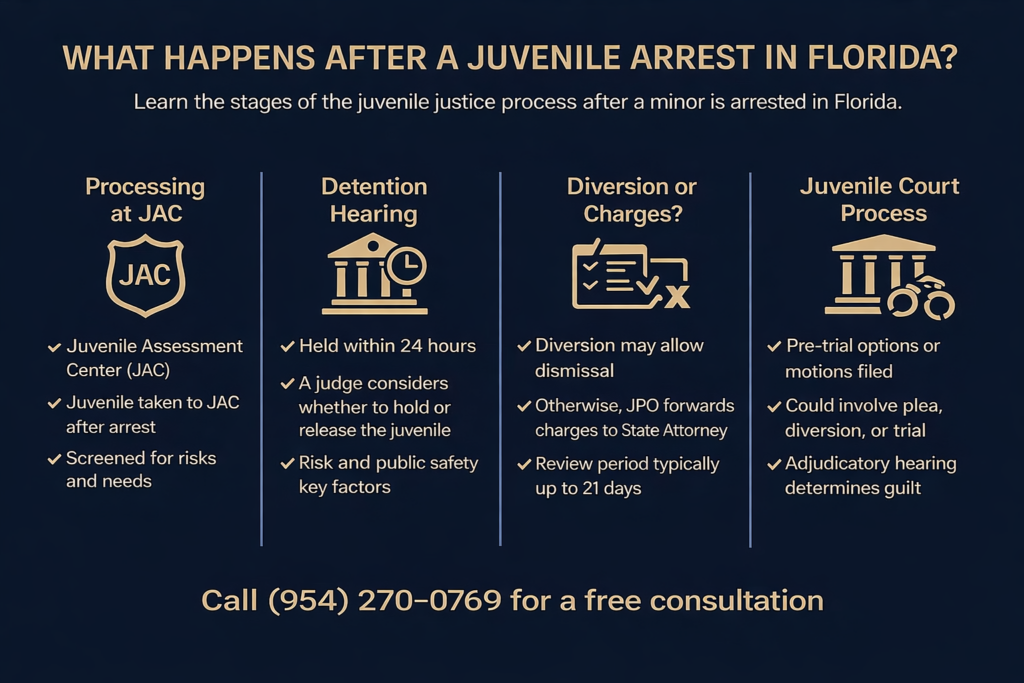
🏢 Step 2: Intake at the Juvenile Assessment Center (JAC)
If taken into custody, the child is brought to a Juvenile Assessment Center (JAC).
At the JAC:
the juvenile is booked and identified
risk and needs assessments are conducted
DJJ evaluates whether detention is recommended
parents or guardians are notified
⚠️ Important: Statements made at the JAC — even informal ones — can be used later. This is one of the most common points where rights are unintentionally waived.
⏱️ Step 3: Detention Decision (Within 24 Hours)
Florida law requires a detention hearing within 24 hours of arrest.
At this hearing, a juvenile judge decides whether the child:
is released to a parent or guardian
placed on home detention or supervision
held in secure juvenile detention
Judges consider:
the seriousness of the charge
prior juvenile history
risk of reoffending
public safety
Early legal advocacy can often prevent unnecessary detention.
⚖️ Step 4: Filing Decision — Diversion or Charges?
After intake, the case is reviewed by:
DJJ
the State Attorney’s Office
At this stage, prosecutors may:
decline to file charges
offer diversion (Teen Court, counseling, community service)
file a formal delinquency petition
⏳ This review period can last up to 21 days in many cases — and intervention during this window is critical.
👉 Learn more about rehabilitation-focused outcomes in our guide to Juvenile Crimes in Fort Lauderdale.
🧑⚖️ Step 5: Juvenile Court Proceedings
If charges are filed, the case moves into juvenile court.
Possible stages include:
arraignment
pretrial conferences
motions to suppress or dismiss
adjudicatory hearing (juvenile trial)
Unlike adult court:
juveniles are not “convicted”
outcomes focus on rehabilitation
records are handled differently — but not automatically erased
🚨 Could the Case Be Sent to Adult Court?
In serious cases, prosecutors may consider direct file, which moves a juvenile into adult criminal court.
Direct file decisions are often made early, sometimes before families realize the risk exists.
👉 See: Can a Juvenile Be Tried as an Adult in Florida? (Direct File Explained)
🛡️ Why Early Legal Intervention Matters
The first days after a juvenile arrest are the most important.
A defense attorney may be able to:
prevent detention
protect diversion eligibility
challenge unlawful searches or questioning
intervene before charges are filed
reduce the risk of adult court transfer
Waiting often limits options.
📞 Juvenile Arrest in Florida? Get Answers Now.
A juvenile arrest does not have to define a child’s future — but delay can.
Contact Michael White, P.A. for immediate guidance from a former prosecutor who defends juvenile cases across South Florida with one goal: protecting kids and keeping cases in juvenile court whenever possible.
❓ Frequently Asked Questions
Does a juvenile arrest mean my child will go to court?
Not always. Many cases are resolved through diversion or no-file decisions, especially with early advocacy.
How long can a juvenile be held after arrest?
A detention hearing must occur within 24 hours, where a judge decides release or detention.
Can parents be present during questioning?
Often yes — but parents should speak with an attorney before any questioning occurs.
Will a juvenile arrest stay on my child’s record?
It can, unless the case is diverted, dismissed, sealed, or expunged.
Should I hire a lawyer even for a minor offense?
Yes. Small cases can still affect diversion eligibility, detention, and long-term records.