
Last updated April 2026
Most people assume that if police obtain evidence illegally, it automatically gets thrown out.
That’s not always true.
While the exclusionary rule and the “fruit of the poisonous tree” doctrine can prevent unlawfully obtained evidence from being used in court, there are important exceptions that sometimes allow that evidence to come in anyway.
If you’re not familiar with how illegally obtained evidence is normally excluded, start with our guide to fruit of the poisonous tree in Florida.
🚨 The General Rule: Illegal Evidence Is Excluded
Under Florida and federal law:
- Evidence obtained through unconstitutional police conduct may be suppressed
- This includes illegal searches, unlawful detentions, and improper interrogations
This is typically challenged through a motion to suppress in Florida.
But the rule has limits.
⚠️ The Key Exceptions to the Exclusionary Rule
Courts recognize several situations where evidence may still be used — even if something went wrong earlier.
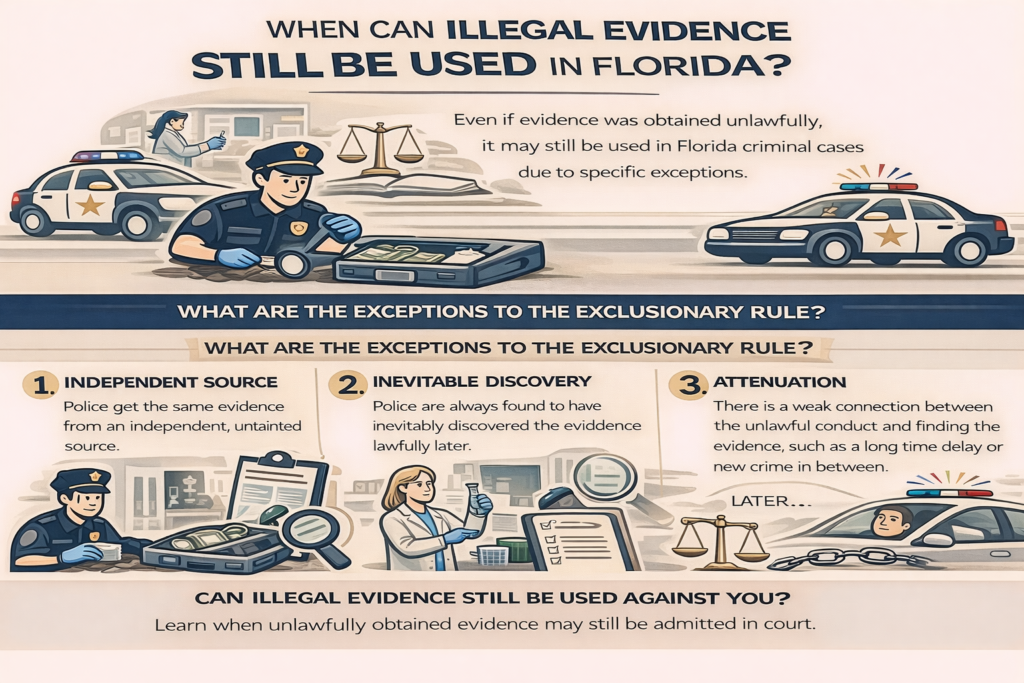
1️⃣ Independent Source Doctrine
Evidence may still be admissible if police obtained it from a separate, lawful source.
👉 Example:
Police conduct an illegal search but later obtain a valid warrant based on independent information. Evidence found under that warrant may still be used.
The key question is whether the lawful source is truly independent of the original illegality.
2️⃣ Inevitable Discovery Doctrine
Evidence may be admitted if police can show it would have been discovered anyway, even without the illegal conduct.
👉 Example:
Officers improperly search a vehicle but would have lawfully inventoried it during a tow, leading to the same discovery.
This doctrine often comes up in vehicle searches and inventory procedures.
3️⃣ Attenuation Doctrine
Evidence may still be used if the connection between the illegal conduct and the evidence is too weak or remote.
Courts look at factors like:
- time between the violation and discovery
- intervening events
- whether the misconduct was purposeful
👉 Example:
An illegal stop occurs, but later the suspect commits a new, separate crime. Evidence tied to the new crime may be admissible.
🔗 How This Relates to “Fruit of the Poisonous Tree”
These exceptions limit how far the “poison” spreads.
Even if evidence initially appears tainted, courts may allow it if:
- the chain of causation is broken
- the evidence comes from a lawful path
- the connection to the violation is minimal
For a deeper explanation, see fruit of the poisonous tree in Florida.
🧠 Why These Exceptions Matter
This is where suppression litigation becomes highly fact-specific.
Two cases may look similar on the surface:
- both involve illegal searches
- both involve questionable stops
But one may result in suppression — while the other does not — depending on whether an exception applies.
⚖️ Common Situations Where These Issues Arise
These doctrines frequently come into play in cases involving:
- traffic stops that lead to searches
- inventory searches after vehicle impoundment
- prolonged detentions
- statements following questionable police conduct
For example, issues involving an illegal traffic stop in Florida can directly impact whether evidence is suppressed or admitted.
🛑 How Prosecutors Use These Exceptions
When a defense attorney files a motion to suppress, prosecutors often respond by arguing:
- the evidence came from an independent source
- it would have been inevitably discovered
- the connection to any illegality is too weak
These arguments are fact-driven — and often heavily contested.
🧠 Why Legal Strategy Matters
The difference between suppression and admissibility often comes down to:
- how the facts are framed
- how the timeline is presented
- how strongly the connection to the illegality is challenged
Even small details can determine whether evidence is excluded or allowed.
⚖️ Can Illegal Evidence Be Used Against You?
Sometimes — yes.
But only if the State can prove that one of these exceptions applies.
If they cannot, the evidence may still be suppressed, even if it appears damaging at first.
❓ Frequently Asked Questions
Can illegally obtained evidence ever be used in Florida?
Yes. Courts may allow it under exceptions such as independent source, inevitable discovery, or attenuation.
What is the inevitable discovery doctrine?
It allows evidence to be used if police can show it would have been discovered lawfully anyway.
What is the independent source doctrine?
It allows evidence obtained from a separate, lawful source to be admitted, even if earlier police conduct was illegal.
What does attenuation mean in criminal law?
It means the connection between illegal conduct and the evidence is weak enough that the evidence may still be used.