
Last updated April 2026
Police often use drug detection dogs during traffic stops — but that doesn’t mean every K-9 sniff is legal.
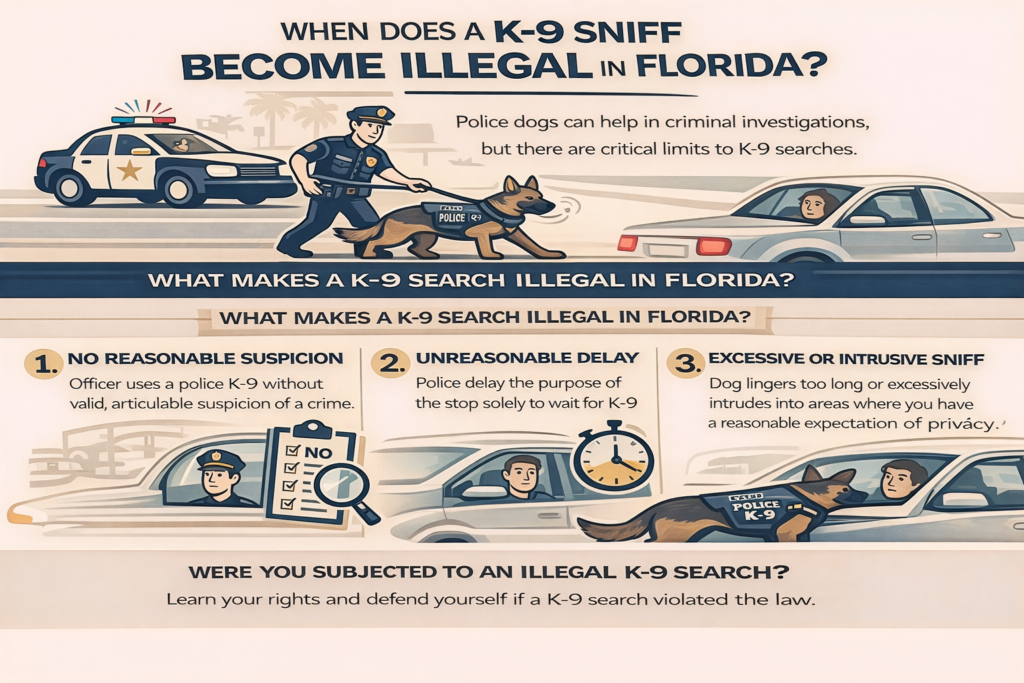
Under the Fourth Amendment, a K-9 sniff can become unconstitutional if it extends a traffic stop without proper justification or is conducted during an unlawful detention.
These issues frequently determine whether evidence is admissible or suppressed. For a broader overview, see our guide to illegal search and seizure in Florida.
⚖️ The General Rule: K-9 Sniffs Are Limited by the Traffic Stop
In many situations, a K-9 sniff of a vehicle’s exterior is not considered a search under the law.
However, there’s a critical limitation:
👉 Police cannot prolong a traffic stop just to conduct a K-9 sniff unless they have reasonable suspicion of criminal activity.
🚨 When Does a K-9 Sniff Become Illegal?
A K-9 sniff may be unlawful when:
- officers delay a stop to wait for a K-9 unit
- the traffic purpose has already been completed
- there is no reasonable suspicion to justify extending the stop
- the detention becomes longer than necessary
Even a short delay can violate the Constitution if it is not legally justified.
For a deeper breakdown, see unlawful prolonged traffic stops in Florida.
🧠 What Counts as “Reasonable Suspicion”?
To extend a stop for a K-9 sniff, officers must identify specific, articulable facts suggesting criminal activity.
This may include:
- conflicting statements
- visible contraband
- strong odors
- suspicious behavior linked to a crime
A vague hunch or general suspicion is not enough.
⏱️ Timing Is Everything
The legality of a K-9 sniff often comes down to timing:
- Was the sniff conducted while the ticket was still being written?
- Or did officers delay the stop to wait for the dog?
If the sniff occurs during a lawful stop, it may be valid.
If it extends the stop without justification, it may be illegal.
🔗 What Happens If the K-9 Sniff Was Illegal?
If a court finds that a K-9 sniff violated the Fourth Amendment:
- any evidence discovered may be suppressed
- drugs or contraband may be excluded
- charges may be reduced or dismissed
This is typically raised through a motion to suppress in Florida.
🍎 “Fruit of the Poisonous Tree” and K-9 Searches
When a K-9 sniff is illegal, everything that follows may be considered tainted.
That includes:
- drugs discovered after the alert
- statements made during or after the stop
- additional evidence uncovered during the investigation
Learn more in fruit of the poisonous tree in Florida.
⚠️ Can Evidence Still Be Used?
In some cases, prosecutors may argue that the evidence should still be admitted under exceptions such as:
- inevitable discovery
- independent source
- attenuation
These arguments depend heavily on the facts of the case.
For more, see when illegal evidence can still be used in Florida.
🧠 Why K-9 Cases Are Often Challenged
K-9 cases are frequently contested because:
- timing issues are common
- body camera footage may contradict reports
- officers may extend stops without clear justification
Small details — sometimes just minutes — can determine whether evidence is admitted or excluded.
⚖️ Was a K-9 Used During Your Traffic Stop?
If your case involves:
- waiting for a K-9 unit
- extended roadside detention
- a dog alert leading to a search
- evidence found after a delay
you may have grounds to challenge the legality of the search.
❓ Frequently Asked Questions
Is a K-9 sniff considered a search in Florida?
Not always. A dog sniff of a vehicle’s exterior is generally not considered a search, but it cannot extend a stop without reasonable suspicion.
Can police make you wait for a K-9 unit?
Only if they have reasonable suspicion. Without it, the delay may be unconstitutional.
What happens if a K-9 sniff is illegal?
Evidence discovered as a result may be suppressed, which can significantly weaken the case.
Does timing matter in a K-9 search?
Yes. If the sniff prolongs the stop without justification, it may violate the Fourth Amendment.