
Last updated March 2026
How Fatal Traffic Accidents Turn Into Criminal Cases
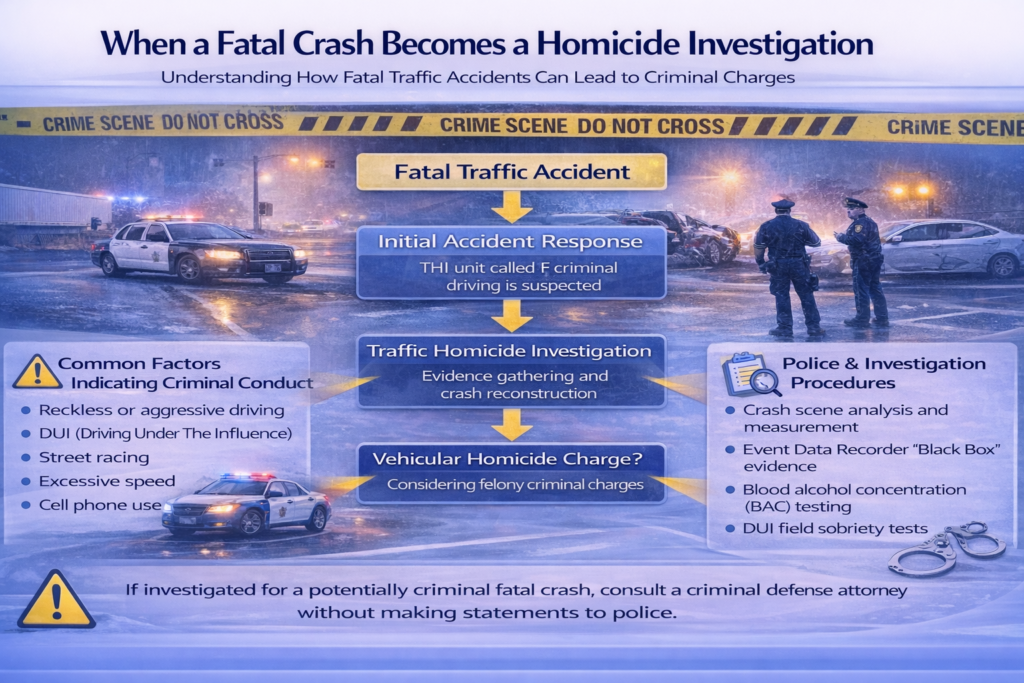
Most fatal car crashes initially appear to be tragic accidents. However, when investigators believe that a driver’s conduct may have contributed to the death, the incident can quickly escalate into a Traffic Homicide Investigation.
In these situations, law enforcement agencies conduct a detailed forensic investigation to determine whether criminal charges — such as vehicular homicide, manslaughter, or other homicide charges — may be appropriate.
The difference between a tragic accident and a criminal case often depends on whether investigators believe the driver engaged in reckless behavior likely to cause death or great bodily harm.
Understanding how and why fatal crashes evolve into homicide investigations can help explain what investigators look for and how these cases are prosecuted under Florida law.
For a broader explanation of the elements involved in these cases, see our guide to Vehicular Homicide in Florida.
What Is a Traffic Homicide Investigation?
When a crash results in a fatality, specialized investigators may be called to the scene to determine the cause of the collision.
These investigators are often members of dedicated Traffic Homicide Investigation units trained in crash reconstruction and forensic evidence analysis.
Their role is to determine:
• how the crash occurred
• whether traffic laws were violated
• whether reckless conduct contributed to the collision
• whether criminal charges may be appropriate
Unlike routine traffic accident reports, homicide investigations involve extensive evidence collection and detailed forensic analysis.
Evidence Collected During Fatal Crash Investigations
When investigators believe a fatal crash may involve criminal conduct, they typically gather a wide range of evidence.
Common investigative steps include:
• detailed scene measurements
• photographing vehicle damage and debris patterns
• collecting witness statements
• reviewing surveillance or traffic camera footage
• retrieving Event Data Recorder Evidence from the vehicles
• conducting Crash Data Retrieval analysis
This information is often used to build a Crash Reconstruction model that explains how the collision occurred.
Driving Behaviors That Often Trigger Criminal Investigations
Fatal crashes may escalate into homicide investigations when investigators believe the driver engaged in dangerous or reckless conduct.
Common behaviors examined during investigations include:
• excessive speed
• aggressive or reckless driving
• distracted driving, including cellphone use
• street racing
• driving under the influence of alcohol or drugs
These behaviors may suggest that the driver operated the vehicle in a manner likely to cause death or serious bodily harm, which is a key element of vehicular homicide under Florida Statutes.
However, investigators must still determine whether the conduct actually caused the fatal crash.
The Importance of Causation
In any vehicular homicide case, prosecutors must prove causation in criminal law — meaning that the driver’s conduct directly caused the death.
This is often the most contested issue in fatal crash prosecutions.
Even when a driver violated traffic laws, criminal liability may not exist if:
• another driver caused the crash
• a sudden emergency occurred
• environmental hazards contributed to the collision
• mechanical failure caused the loss of control
These issues are explored in greater detail in our discussion of Challenging Causation in Vehicular Homicide Cases.
The Role of Crash Reconstruction
Fatal crash investigations frequently rely on specialized Crash Reconstruction analysis.
Reconstruction experts examine physical evidence to determine how a crash occurred, including:
• vehicle speed estimates
• braking distances
• collision angles
• debris distribution
• driver reaction times
Although reconstruction can provide valuable insight, it is based on assumptions and calculations that must be interpreted carefully.
Errors in reconstruction analysis can lead to incorrect conclusions about what actually caused the crash.
We examine these issues further in our article on Accident Reconstruction Errors in Vehicular Homicide Cases.
Vehicle Data and Black Box Evidence
Modern vehicles often contain Event Data Recorders, commonly called vehicle “black boxes.”
These systems may record information such as:
• vehicle speed
• brake application
• throttle input
• seatbelt use
• airbag deployment timing
Investigators retrieve this information using specialized Crash Data Retrieval tools.
While black box data can be helpful, it does not capture every factor involved in a crash.
External conditions, driver reactions, and the actions of other vehicles may not appear in the recorded data.
We explain these limitations in more detail in our guide on Whether Black Box Evidence Can Be Wrong in Vehicular Homicide Cases.
When a Fatal Crash Leads to Criminal Charges
After reviewing the evidence, investigators may present their findings to prosecutors.
Prosecutors then decide whether the evidence supports criminal charges.
In Florida, a fatal crash may lead to charges such as:
• vehicular homicide
• manslaughter
• DUI manslaughter
• leaving the scene of an accident involving death
Each charge requires prosecutors to prove specific elements under Florida Statutes.
For example, vehicular homicide requires proof that the driver operated the vehicle recklessly and that the conduct caused the death.
Why Early Legal Representation Matters
Fatal crash investigations can develop quickly, and early conclusions by investigators may shape how prosecutors evaluate the case.
Because these cases often rely heavily on forensic evidence — including reconstruction analysis and vehicle data — early independent review of the evidence can be critical.
Careful examination of crash reports, reconstruction assumptions, and digital vehicle data may reveal important questions about how the crash occurred.
Speak With a Florida Vehicular Homicide Defense Attorney
When a fatal crash triggers a homicide investigation, the consequences can be severe.
However, determining whether criminal charges are appropriate requires a careful examination of the evidence and the circumstances surrounding the crash.
If you are under investigation or facing charges related to a fatal accident in Broward County courts or elsewhere in South Florida, speaking with an experienced defense attorney early can help protect your rights.
Request a confidential consultation to discuss your situation.
FAQs
What is a traffic homicide investigation?
A traffic homicide investigation is a specialized crash investigation conducted when a fatal accident occurs. Investigators analyze evidence to determine whether criminal charges such as vehicular homicide may be appropriate.
Does every fatal crash lead to criminal charges?
No. Many fatal crashes are determined to be accidents. Criminal charges are typically considered only when investigators believe reckless conduct or illegal behavior contributed to the death.
What evidence is used in fatal crash investigations?
Investigators often review crash reconstruction evidence, witness statements, surveillance footage, vehicle black box data, and scene measurements to determine how the collision occurred.
How do investigators determine if a crash caused a death?
Investigators analyze physical evidence, crash dynamics, and medical findings to determine whether the driver’s conduct directly caused the fatal injuries.