
Last updated April 2026
Witness tampering charges can arise from something as simple as a conversation.
In Florida, these cases often involve communication between people who already know each other — friends, family members, or individuals connected to an incident. But not every conversation with a witness is a crime.
The key issue is intent — whether the communication was meant to influence testimony or interfere with a legal process.
For a broader overview of how these charges are analyzed, see our guide to Evidence & Witness Tampering in Florida.
⚖️ What Is Witness Tampering in Florida?
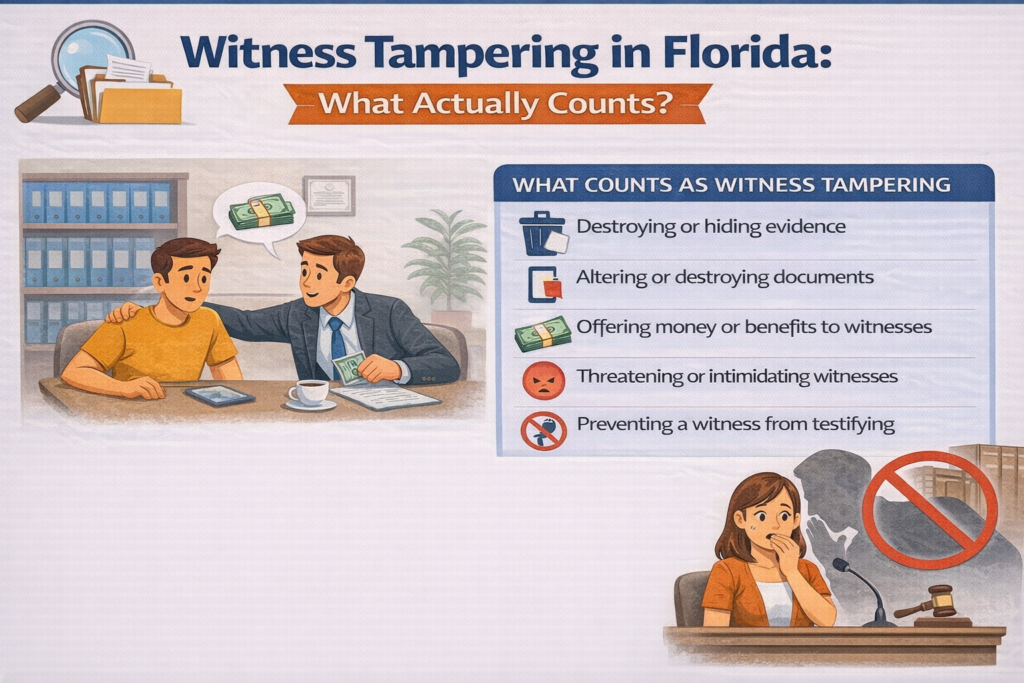
Witness tampering generally involves attempting to influence, alter, or prevent someone’s testimony or cooperation in a criminal investigation or proceeding.
This can include:
- pressuring a witness not to testify
- attempting to influence what someone says
- offering incentives or making threats
- interfering with cooperation in an investigation
These charges are often prosecuted as third-degree felonies.
🚨 Common Situations That Lead to Charges
Many cases arise from real-world interactions, including:
- contacting a witness after an incident
- asking someone to “help you out”
- discussing what should be said to police
- attempting to resolve the situation privately
In many cases, these conversations are informal — but may later be interpreted as attempts to interfere.
⚠️ When Does Communication Become a Crime?
Not every conversation with a witness is illegal.
The law focuses on whether the communication was intended to influence testimony or interfere with the legal process.
Situations that often fall into a gray area include:
- emotional or personal conversations after an incident
- asking someone not to get involved
- discussing events without directing what to say
- misinterpreted or unclear statements
In these situations, what law enforcement views as tampering may actually be misunderstanding, emotion, or lack of intent.
🧠 Intent Is the Key Issue
To prove witness tampering, the State must show that the communication was made with the purpose of influencing a witness.
This means:
- casual conversation is not enough
- intent must be proven, not assumed
- context and tone often matter
Because of this, these cases frequently depend on how communication is interpreted.
🔍 Witness Tampering vs. Asking Someone Not to Testify
Many people assume that simply asking someone not to testify is always a crime.
That is not necessarily true.
The legality depends on:
- whether the request involved pressure, coercion, or influence
- how the communication was made
- whether the intent was to interfere with a legal proceeding
👉 For a deeper breakdown, see Can Asking a Witness Not to Testify Be a Felony in Florida?.
🔗 Witness Tampering vs. Evidence Tampering
Witness tampering involves communication with people.
Evidence tampering involves physical or digital items.
👉 For that distinction, see Tampering With Evidence in Florida.
🛡️ Defenses to Witness Tampering Charges
These cases are often highly fact-specific and defensible.
Common defense strategies include:
- lack of intent to influence testimony
- communication taken out of context
- no coercion, threat, or improper influence
- insufficient or circumstantial evidence
- misinterpretation of conversations
These cases often turn on how statements are interpreted, not just what was said.
⚖️ Potential Penalties
Witness tampering is typically charged as a:
- Third-degree felony
- Up to 5 years in prison
- Up to 5 years probation
- Up to $5,000 fine
It may also be charged alongside other offenses.
📍 Why These Cases Are Often Challenged
Witness tampering cases are rarely straightforward.
They often depend on:
- interpretation of intent
- tone and context of communication
- timing of conversations
- whether a legal proceeding was actually affected
Because of this, small details — including texts, calls, and witness statements — can significantly affect the outcome.
📞 Charged With Witness Tampering in Florida?
If you are accused of influencing a witness, the context of the communication matters.
Many of these cases hinge on intent — and whether the conduct actually interfered with a legal process.
❓ Frequently Asked Questions
Is witness tampering always a felony in Florida?
Often, yes. Many charges are filed as third-degree felonies depending on the circumstances.
Can talking to a witness get you charged?
It can — but only if the communication was intended to influence testimony or interfere with a legal process.
What if I didn’t threaten or pressure anyone?
That can be a key defense. Lack of coercion and intent are critical issues.
Is asking someone not to testify illegal?
Not always. It depends on how the request was made and whether it was intended to interfere with a legal proceeding.