
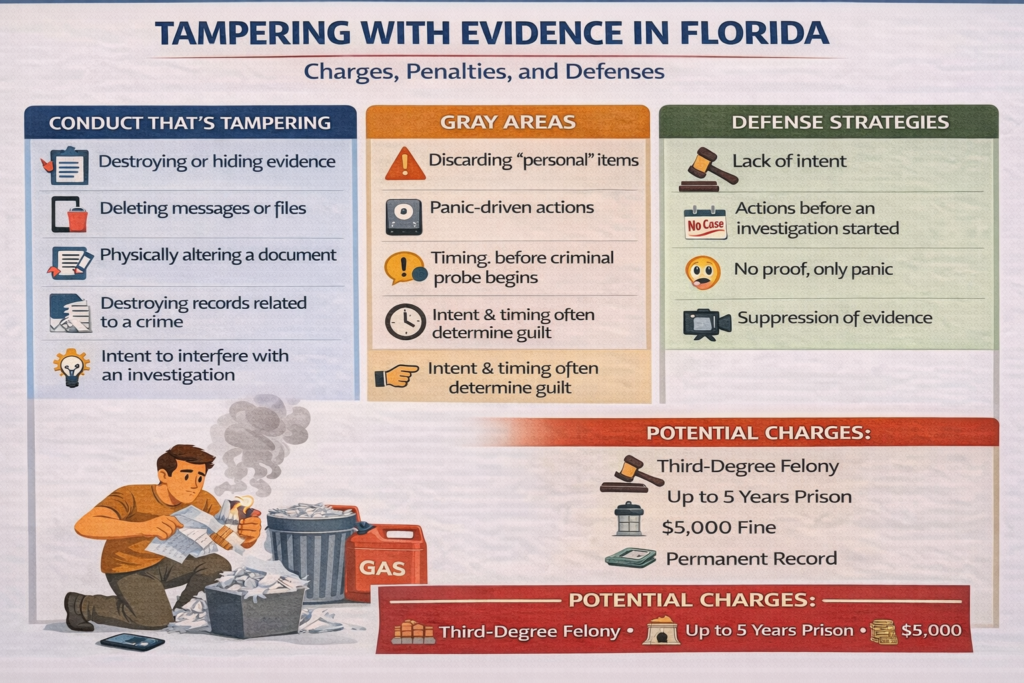
Last updated April 2026
Being accused of tampering with evidence in Florida can quickly turn a minor situation into a felony case.
These charges often arise in fast-moving moments — during traffic stops, investigations, or immediately after an incident — when people act out of panic, confusion, or poor judgment. But not every action involving evidence is a crime.
The key issue in most cases is intent — whether the conduct was meant to interfere with an investigation or legal proceeding.
For a broader overview of how these charges are analyzed, see our guide to Evidence & Witness Tampering in Florida.
⚖️ What Is Tampering With Evidence in Florida?
Under Florida Statute § 918.13, a person commits evidence tampering if they:
- alter, destroy, conceal, or remove evidence
- knowing that an investigation or proceeding is pending or likely
- with the intent to impair its availability
This is typically charged as a third-degree felony.
Tampering can also involve influencing people, not just physical or digital evidence. For a related analysis, see Witness Tampering in Florida.
🚨 Common Examples of Evidence Tampering
These charges often arise from situations like:
- throwing away or hiding suspected contraband
- deleting text messages, photos, or digital records
- altering documents or physical evidence
- moving or concealing items connected to an incident
In many cases, these actions occur quickly — often before a person fully understands the legal consequences.
⚠️ When Does It Become a Crime?
Not every act involving evidence is illegal.
In many cases, the key question is whether the person intended to interfere with an investigation and knew that one was likely or underway.
Situations that often fall into a gray area include:
- deleting files before knowing police are involved
- discarding items without understanding their relevance
- routine or automatic deletion of digital data
- actions taken during panic or stress
In these situations, what may appear to be tampering can actually be misunderstanding, lack of intent, or poor judgment — not criminal conduct.
🧠 Why Intent and Timing Matter
Two factors often determine whether a charge can be proven:
Intent
The State must show that the act was done knowingly and with the purpose of impairing evidence.
Timing
Conduct that occurs before an investigation begins is often treated differently than actions taken after a person knows law enforcement is involved.
These issues are often the center of the defense.
🔍 Destroying Evidence vs. Tampering
Many people assume that destroying evidence automatically results in a criminal charge.
That is not always true.
The law requires proof of intent to interfere with an investigation — not just the act of destruction.
👉 For a deeper look, see Can Police Charge You With Destroying Evidence in Florida?
🛡️ Defenses to Evidence Tampering Charges
These cases are often highly defensible.
Common defense strategies include:
- lack of intent to interfere with an investigation
- no pending or foreseeable investigation
- no actual destruction or concealment of evidence
- innocent explanation for the conduct
- insufficient or circumstantial evidence
These cases frequently turn on context and interpretation, not just the alleged act.
📍 Why These Cases Are Often Challenged
Evidence tampering cases are rarely as simple as they appear.
Unlike other offenses, they often depend on:
- interpretation of intent
- timing of events
- whether an investigation was actually underway
- how conduct is characterized by law enforcement
Because of this, small details — especially digital timelines and communications — can significantly affect the outcome.
⚖️ Potential Penalties
Tampering with evidence is typically charged as a:
- Third-degree felony
- Up to 5 years in prison
- Up to 5 years probation
- Up to $5,000 fine
It can also be used to strengthen or add leverage to an underlying case.
📞 Charged With Evidence Tampering in Florida?
If you are accused of tampering with evidence, the details of what happened — and when — matter.
These cases often hinge on intent and timing, and many are more defensible than they first appear.
❓ Frequently Asked Questions
Is tampering with evidence always a felony in Florida?
Often, yes. Most charges are filed as third-degree felonies, depending on the circumstances.
Does deleting messages count as tampering?
It can — but only if done with the intent to interfere with an investigation.
What if I didn’t know there was an investigation?
That can be a key defense. Knowledge and timing are critical elements.
Can throwing something away be considered tampering?
Sometimes — but only if prosecutors can prove intent to impair evidence.