
Last updated April 2026
Destroying evidence may seem like a quick way to avoid trouble — but in Florida, it can create a much more serious legal problem.
In many cases, what starts as a minor situation can turn into a felony charge if law enforcement believes evidence was intentionally destroyed to interfere with an investigation. But not every act of throwing something away or deleting information is a crime.
The key issue is intent — and whether the conduct was meant to impair evidence in a legal proceeding or investigation.
For a broader overview of how these charges are analyzed, see our guide to Evidence & Witness Tampering in Florida.
⚖️ What Does “Destroying Evidence” Mean Under Florida Law?
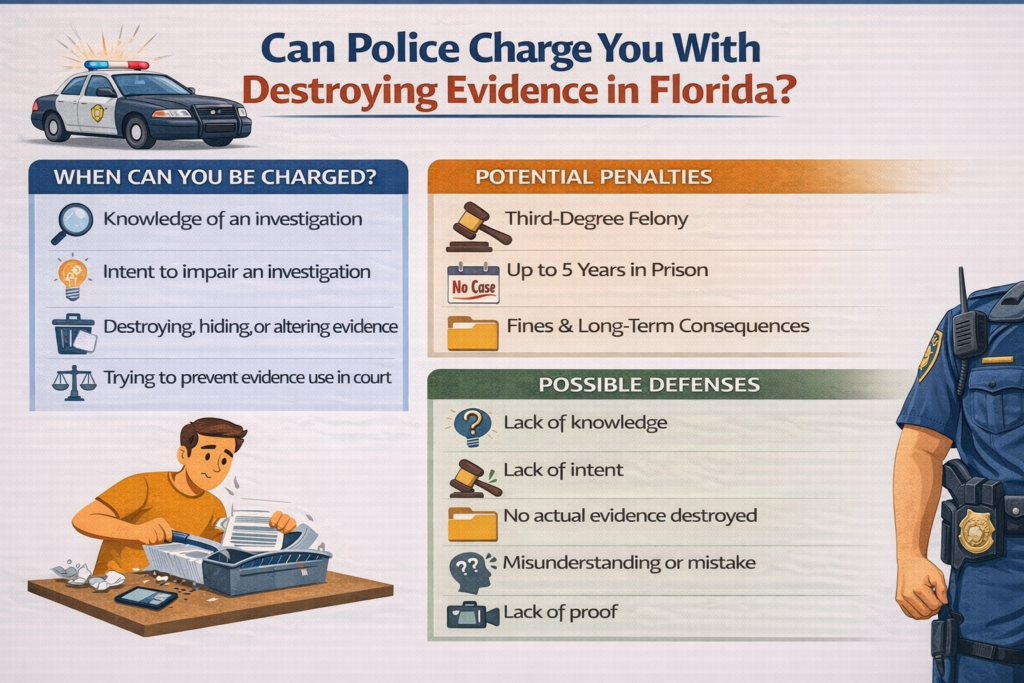
In Florida, destroying evidence is typically prosecuted under the evidence tampering statute, § 918.13.
A person may be charged if they:
- destroy, conceal, or remove evidence
- knowing that an investigation or proceeding is pending or likely
- with the intent to impair its availability
This is usually charged as a third-degree felony.
👉 For a full breakdown of the statute, see Tampering With Evidence in Florida.
🚨 Common Situations That Lead to Charges
These cases often arise in fast-moving, high-pressure situations:
- discarding suspected contraband during a traffic stop
- deleting messages after police contact
- attempting to get rid of items linked to an incident
- disposing of objects before law enforcement arrives
In many situations, these actions happen quickly — often before a person fully understands the legal consequences.
⚠️ When Does Destroying Evidence Become a Crime?
Not every act of destruction is illegal.
The law requires more than just getting rid of something — it requires proof that the act was done to interfere with an investigation.
Situations that often fall into a gray area include:
- throwing something away before knowing police are involved
- deleting files as part of routine behavior
- discarding items without understanding their relevance
- acting in panic or confusion
In these cases, what may appear to be tampering can actually be lack of intent — a critical distinction in defending the charge.
🧠 Intent and Timing Are Everything
Two factors determine whether a charge can be proven:
Intent
The State must show that the act was done knowingly and with the purpose of impairing evidence.
Timing
Actions taken before an investigation begins are often treated very differently than those taken after police involvement is clear.
These issues are often the focus of the defense.
🔍 Destroying Evidence vs. Witness Tampering
Destroying evidence involves physical or digital items.
But some cases involve communication — not objects.
For example, attempting to influence someone’s testimony or cooperation can lead to separate charges.
👉 See Witness Tampering in Florida.
🛡️ Defenses to Destroying Evidence Charges
These cases are often more defensible than they first appear.
Common defense strategies include:
- lack of intent to interfere with an investigation
- no pending or foreseeable investigation
- innocent explanation for the conduct
- no actual impact on evidence availability
- insufficient or circumstantial proof
Because these cases depend heavily on interpretation, small details can significantly affect the outcome.
⚖️ Potential Penalties
Destroying evidence is typically charged as a:
- Third-degree felony
- Up to 5 years in prison
- Up to 5 years probation
- Up to $5,000 fine
It can also increase exposure in an underlying case.
📍 Why These Cases Are Often Challenged
Evidence destruction cases are rarely straightforward.
They often depend on:
- whether an investigation was underway
- how the conduct is interpreted
- whether intent can be proven
- the timing of events
Because of this, these cases are frequently challenged — especially when the facts are unclear.
📞 Charged With Destroying Evidence in Florida?
If you are accused of destroying evidence, the timing of events and your intent are critical.
Many of these cases hinge on details that are not obvious at first glance — but can make all the difference in the outcome.
❓ Frequently Asked Questions
Is destroying evidence always a felony in Florida?
Often, yes. Most charges fall under felony evidence tampering statutes.
Does deleting messages count as destroying evidence?
It can — but only if done with the intent to interfere with an investigation.
What if I didn’t know there was an investigation?
That can be a key defense. Knowledge and timing are critical elements.
Can throwing something away be considered a crime?
Sometimes — but only if prosecutors can prove intent to impair evidence.