
Last updated March 2026
Many people assume that a gun crime requires a shot to be fired.
Under Florida law, that’s not true.
Simply pointing a firearm at another person can be charged as aggravated assault, even if the gun is never fired and no one is injured. These cases often arise from fast-moving arguments, road rage incidents, or domestic disputes—and they carry serious felony consequences.
In Florida, these allegations fall within the broader category of felony assault offenses. For a full overview of how these charges are defined, prosecuted, and defended, see Aggravated Assault Charges in Florida.
Below is how Florida law treats these cases, when an arrest is likely, and how these charges are defended.
⚖️ What Florida Law Says About Pointing a Gun
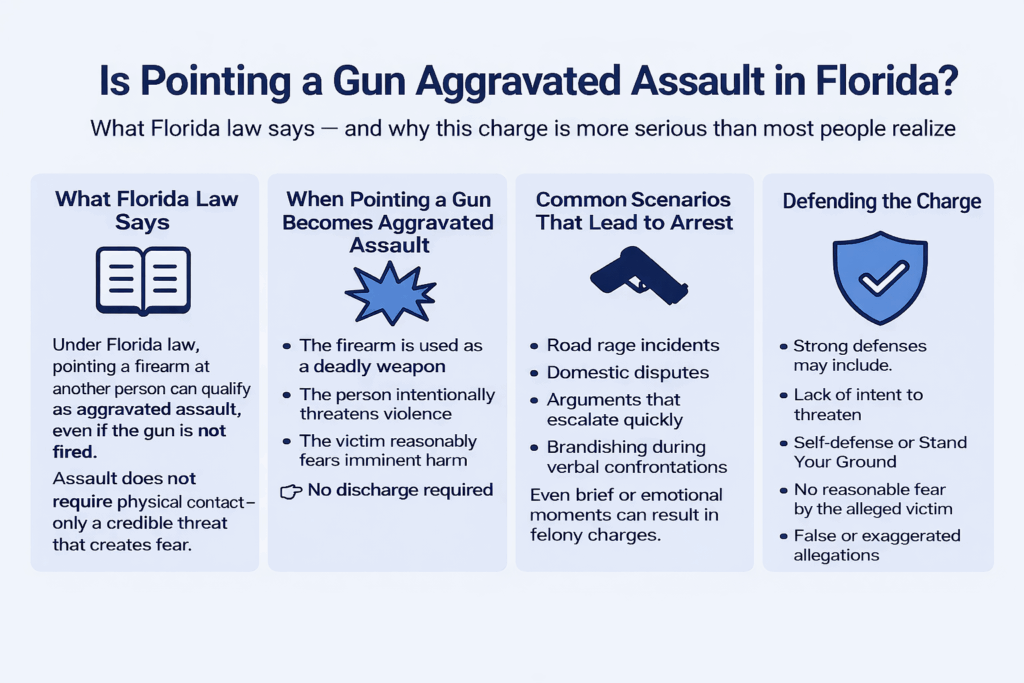
Florida defines assault as an intentional and unlawful threat — by word or act — that creates a well-founded fear of imminent violence. No physical contact is required.
When a deadly weapon is involved, that conduct may be elevated to aggravated assault.
A firearm is generally considered a deadly weapon under Florida law. As a result, pointing a gun at someone may satisfy the elements of aggravated assault — depending on context, intent, and how the situation was perceived.
Importantly, the law focuses on threat and fear, not injury.
That means the key issue is not whether harm occurred, but whether the alleged victim reasonably believed harm was about to occur. This perception-based analysis is central to how prosecutors evaluate these cases and is discussed more deeply in our breakdown of What Is “Apparent Ability” in Florida Aggravated Assault Cases.
🚨 When Pointing a Gun Becomes Aggravated Assault
Pointing a firearm may be charged as aggravated assault when prosecutors believe they can prove:
The firearm was used or displayed as a deadly weapon
The accused intentionally threatened violence
The alleged victim reasonably feared imminent harm
There is no requirement that:
The gun be fired
The gun be loaded
Anyone be physically harmed
If law enforcement believes the act created an immediate threat, an arrest often follows — even in situations where the encounter lasted only seconds.
🚔 Common Scenarios That Lead to Arrest
Aggravated assault with a firearm charges frequently arise from situations that escalate quickly, including:
Road rage incidents involving a firearm
Domestic arguments where a gun is displayed
Verbal disputes that turn confrontational
Encounters outside homes, bars, or vehicles
For example, in traffic-related confrontations, a driver may claim that a weapon was pointed during a brief exchange. These fact patterns are explored further in Road Rage Aggravated Assault in Florida.
Similarly, many arrests occur during emotionally charged disputes between people who know each other. These cases often involve conflicting accounts and are examined more closely in Domestic Arguments and Aggravated Assault Charges in Florida.
In many of these situations, the firearm is displayed only momentarily — but that moment can still lead to a felony charge.
🔍 Does the Gun Have to Be Real or Loaded?
No — but this issue can be more complex than it appears.
The gun does not have to be loaded to support an aggravated assault charge. However, whether the object qualifies as a “deadly weapon” can become a key legal issue in some cases.
Courts may distinguish between real firearms and other objects such as pellet guns, BB guns, or replicas. These distinctions can affect how a case is charged or defended. For a deeper explanation, see Aggravated Assault with a BB Gun or Airsoft Gun in Florida.
🛡️ How These Charges Are Defended
Every aggravated assault case is fact-specific, and many are defensible. Common strategies include:
Lack of intent to threaten or intimidate
No reasonable fear of imminent harm
False, exaggerated, or inconsistent allegations
Video, witness, or physical evidence contradicting the accusation
In some situations, pointing a firearm may be legally justified. Florida law allows the threatened use of force when a person reasonably believes it is necessary to prevent imminent harm. These issues are analyzed under Self-Defense and Stand Your Ground in Florida, and in some cases may result in dismissal before trial.
Because these cases often depend on perception and credibility rather than physical evidence, early legal intervention is critical.
In many situations, weaknesses in the State’s case can lead to reduced charges or negotiated outcomes. A closer look at how these resolutions occur is explained in How Aggravated Assault Charges Get Reduced in Florida.
📌 Why This Charge Is So Serious
Aggravated assault with a firearm is a felony offense in Florida. A conviction can carry:
Prison exposure
A permanent felony record
Loss of firearm rights
Immigration consequences
Long-term employment barriers
Even cases that seem minor at first can escalate quickly once a gun is alleged to be involved.
❓ Frequently Asked Questions
Is pointing a gun always aggravated assault in Florida?
No. Prosecutors must still prove intent and reasonable fear. However, pointing a firearm often provides the basis for an aggravated assault charge.
Does the gun have to be loaded?
No. The gun does not need to be loaded for aggravated assault charges to apply.
What if I never pulled the trigger?
Discharging the firearm is not required. The threat and fear created by pointing the gun may be enough.
Can this charge be dropped or reduced?
Yes. Depending on the evidence, charges may be reduced, dismissed, or resolved through negotiation or pretrial motions.
Is this different from brandishing a firearm?
Brandishing is not a standalone Florida charge, but similar conduct is often charged as aggravated assault when a firearm is involved.