
Last updated April 2026
🚨 Why Criminal Traffic Charges Matter in South Florida
A criminal traffic charge in Florida is not “just a ticket.” It is a misdemeanor or felony offense that can lead to jail, probation, license suspension, and a permanent criminal record.
In South Florida — particularly in Broward County — these cases are aggressively prosecuted. What begins as a routine traffic stop can quickly escalate into charges involving reckless driving, license suspensions, or even felony-level offenses.
In many cases, the most important issue is not what the officer alleged — but what the State can actually prove.
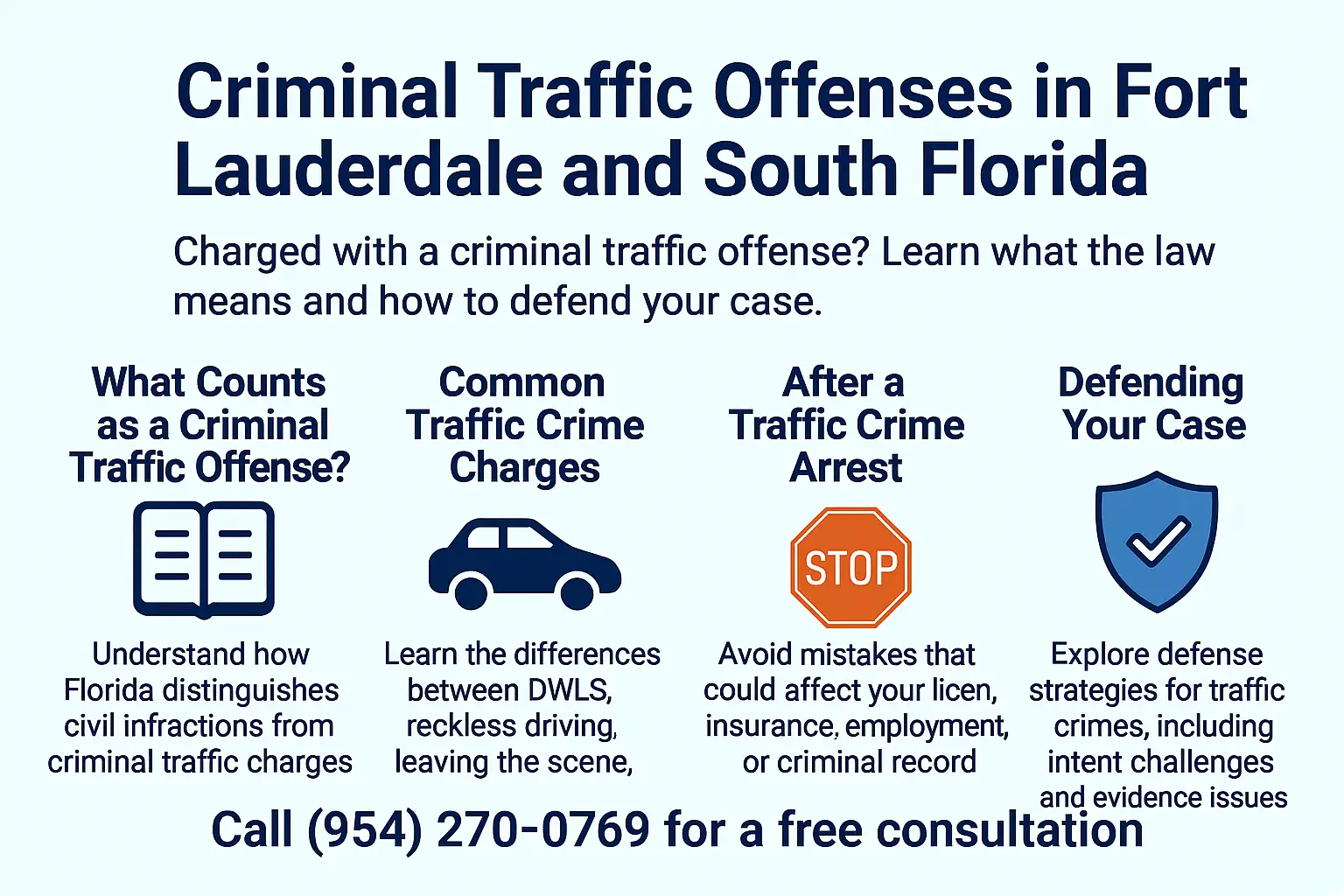
⚖️ What Is a Criminal Traffic Offense in Florida?
Unlike civil infractions (such as minor speeding or failure to signal), criminal traffic offenses carry misdemeanor or felony penalties under Florida law.
These cases typically involve:
- allegations of willful or reckless conduct
- driving without lawful authority
- failure to comply with statutory duties after an accident
- conduct that creates risk of injury or property damage
Penalties may include:
- jail or probation
- heavy fines and court costs
- suspension or revocation of your driver’s license
- vehicle impoundment or forfeiture
- a permanent criminal record
Even a first offense can affect employment, insurance, and professional licensing.
🧠 How Criminal Traffic Charges Are Actually Filed
In many cases, criminal traffic charges are not the result of obviously dangerous conduct — they arise from how law enforcement interprets a situation during a stop.
In South Florida, we frequently see charges filed when:
- minor violations are combined into more serious allegations
- administrative issues (like license or registration problems) are discovered during a stop
- officer observations are treated as proof of intent
- situations escalate quickly based on assumptions rather than evidence
This gap between what is alleged and what can be proven is where many cases are successfully challenged.
🧾 Real-World Example: How a Minor Stop Becomes a Criminal Case
In many cases, criminal traffic charges do not begin with obviously dangerous conduct — they begin with something routine.
For example, a driver may be stopped for a minor issue such as an expired tag or a broken tail light. During the stop, the officer runs the driver’s information and discovers:
- a suspended license
- prior traffic-related convictions
- or an administrative issue that has not been resolved
What started as a simple stop can quickly escalate into a criminal charge such as Driving With a Suspended License or even a Habitual Traffic Offender case.
In other situations, a driver may leave the scene of a minor accident without realizing the legal consequences — only to face felony charges later if injury is alleged.
These cases often turn not on what the driver intended — but on how the situation is interpreted and what the State can actually prove.
Understanding how these cases develop in real-world scenarios is often the first step in preventing them from escalating.
🚗 Major Criminal Traffic Offense Categories
Florida criminal traffic charges generally fall into several major categories. The guides below explain how each area is prosecuted — and how these cases are defended.
🔵 Driver’s License Offenses
Many criminal traffic cases involve driving without valid legal authority.
These charges often arise from:
- license suspensions
- unpaid tickets or court issues
- DUI-related revocations
- Habitual Traffic Offender (HTO) designations
- violations of hardship license restrictions
Because these cases often depend on DHSMV records and proof of knowledge, they involve both criminal defense and administrative strategy.
👉 Driver’s License Offenses in Florida
🔵 Reckless Driving
Reckless driving involves allegations of willful or wanton disregard for safety — a much higher standard than ordinary negligence.
These cases are frequently overcharged and often depend on subjective officer interpretation rather than objective evidence.
🔵 Racing on Highways
Racing cases require proof of competition or coordination between vehicles — not just speed.
These charges often arise from high-speed situations where officers assume competition, even when the evidence is unclear.
👉 Racing on Highways in Florida
🔵 Leaving the Scene of an Accident
Florida law imposes strict duties after any crash. Failing to stop, provide information, or render aid can lead to serious criminal charges — including felony exposure in injury or death cases.
👉 Leaving the Scene of an Accident in Florida
🔵 Fleeing and Eluding Law Enforcement
Fleeing cases escalate quickly and are often charged as felonies. These cases frequently turn on whether the driver knew they were being ordered to stop and whether the conduct was willful.
👉 Fleeing and Eluding in Florida
🔵 Vehicle Registration & Tag Crimes
Some registration and plate violations are treated as criminal offenses rather than simple tickets.
These cases often involve administrative issues — but can still result in criminal charges if mishandled.
👉 Vehicle Registration & Tag Crimes in Florida
📈 How Criminal Traffic Cases Escalate
One of the most important realities of criminal traffic law is escalation.
A case may begin as:
- a simple traffic stop
- an expired registration
- a speeding allegation
But can escalate into:
- reckless driving
- racing or fleeing charges
- Habitual Traffic Offender designation
- felony exposure
Understanding how and why cases escalate is critical to building an effective defense strategy.
🧾 What Determines the Outcome
In many cases, outcomes are determined by:
- whether the State can prove intent or knowledge
- whether the stop or detention was lawful
- whether evidence (video, witness statements) supports the charge
- whether administrative records are accurate
- how early the case is addressed
Early legal intervention often changes the trajectory of the case entirely.
🛡️ How We Defend Criminal Traffic Charges
Every case is fact-specific, but effective defense strategies often include:
- challenging the legality of the stop
- attacking proof of knowledge or intent
- identifying inconsistencies in officer testimony
- using video evidence to contradict allegations
- negotiating reductions or diversion
- coordinating administrative solutions through DHSMV
Many criminal traffic cases are far more defensible than they initially appear.
📍 Criminal Traffic Defense in Fort Lauderdale & South Florida
Criminal traffic cases can affect far more than your driver’s license — they can impact your record, employment, immigration status, and freedom.
Michael White, P.A. provides strategic, aggressive defense for misdemeanor and felony traffic offenses throughout Fort Lauderdale and South Florida.
📞 Call (954) 270-0769 or schedule a confidential consultation today.