
Last updated March 2026
With the rise of Tesla Autopilot, adaptive cruise control, and increasingly autonomous vehicles, many drivers ask:
If the car is driving itself, can I still get a DUI?
In Florida, the answer is usually yes.
The key issue is not whether the car is in autonomous mode.
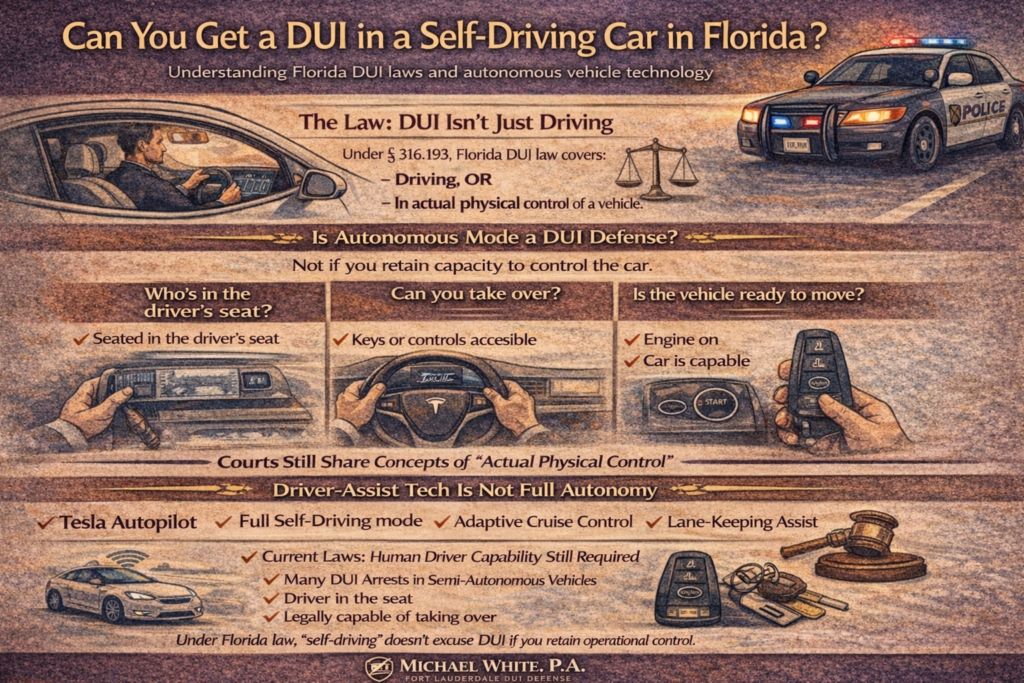
The legal issue is whether you were in “actual physical control” of the vehicle.
For a deeper discussion of actual physical control in Florida DUI cases, see our guide to DUI Actual Physical Control in Florida.
⚖️ Florida DUI Law Does Not Require Active Driving
Under Florida Statute § 316.193, a person commits DUI if they are:
Driving, or
In actual physical control of a vehicle
Florida courts have long interpreted “actual physical control” broadly. You do not have to be moving. You do not even have to be awake in some circumstances.
The legal question becomes:
Were you capable of exercising control over the vehicle?
That standard applies whether the vehicle is manually operated or using driver-assist technology.
🤖 What Counts as a “Self-Driving” Car in Florida?
Most vehicles on Florida roads today are not fully autonomous.
Systems like:
Tesla Autopilot
Full Self-Driving (FSD) beta
Adaptive cruise control
Lane-keeping assist
are classified as driver-assist systems, not true autonomous vehicles.
Under current law:
A human driver must remain seated in the driver’s seat.
The driver must be able to take over at any time.
The driver remains legally responsible for the vehicle.
Even if the vehicle is steering and accelerating itself, Florida law still treats the person in the driver’s seat as the operator.
🚔 Real-World Scenario: DUI in Autopilot Mode
Imagine this situation:
A driver activates Tesla Autopilot on I-95 in Broward County.
The vehicle remains in its lane and maintains speed.
The driver is intoxicated but not actively touching the wheel.
Police stop the vehicle.
Similar issues arise in cases involving DUI arrests in parked vehicles in Fort Lauderdale.
Can that driver be charged with DUI?
Most likely, yes.
Why?
Because:
The driver was seated in the driver’s seat.
The driver had the ability to intervene.
The vehicle was operating under the driver’s legal authority.
Autonomous mode does not eliminate control under Florida law.
🛑 What If the Vehicle Is Fully Self-Driving?
True Level 4 or Level 5 autonomous vehicles — where no human intervention is required — are not widely available for personal consumer use in Florida as of 2026.
If and when fully autonomous vehicles become common, courts may face new legal questions.
But under current law:
If you are in the driver’s seat of a vehicle capable of manual control, you are generally considered in actual physical control.
😴 What If You’re Sleeping While the Car Is in Self-Driving Mode?
Florida courts have upheld DUI charges in situations where a driver was:
Sleeping in a parked car — a situation we break down further in Sleeping in Your Car During a DUI Investigation
Sitting in the driver’s seat with the engine running
In possession of the keys
Capable of putting the vehicle into motion
If you are asleep while a semi-autonomous vehicle is operating, prosecutors may argue:
You retained the ability to control the vehicle.
You were responsible for supervision.
You created a public safety risk.
Self-driving mode does not automatically eliminate DUI exposure.
📱 What About Being in the Passenger Seat?
If an intoxicated person is in the passenger seat and a sober person or automated system is operating the vehicle, the legal analysis changes.
The State would need to prove:
The intoxicated person exercised control, or
The intoxicated person had the ability and intent to control the vehicle
If the intoxicated person is not in the driver’s seat and lacks control, DUI charges may be harder to sustain.
However, fact patterns vary widely.
⚖️ The Core Legal Question: “Actual Physical Control”
Florida courts typically evaluate actual physical control by asking:
Where was the person seated?
Were the keys or activation controls accessible?
Was the engine running? — an issue we analyze in detail in DUI Charges When the Engine is Off in Florida
Could the person immediately operate the vehicle?
Was the vehicle capable of movement?
Autonomous technology does not eliminate these questions.
In most current consumer vehicles, the human occupant remains legally responsible.
🚨 Can Autopilot Create a Defense?
Possibly — but not automatically.
Autonomous features may raise arguments about:
Lack of manual driving behavior
Absence of erratic steering
Limited control input by the driver
Whether the vehicle was truly under the driver’s control
However, these arguments depend on specific facts and how Florida courts interpret evolving technology.
They do not guarantee dismissal.
📍 DUI in a Self-Driving Car in Fort Lauderdale or Broward County
Law enforcement in Broward County treats driver-assist technology the same way it treats conventional vehicles.
If you are intoxicated and in control — or capable of control — of a vehicle on a public roadway, DUI charges may follow.
Self-driving mode does not override Florida’s DUI statute.
📞 Facing a DUI in an Autonomous or Driver-Assist Vehicle?
If your DUI arrest involved Autopilot, adaptive cruise control, or another driver-assist system, the legal analysis may differ from a traditional DUI case.
Call (954) 270-0769 or request a consultation to evaluate how Florida’s actual physical control doctrine applies to your situation.
Modern technology does not eliminate DUI law — but it can change how the case is litigated.