
Last updated April 2026
Traffic stops are one of the most common situations where obstruction charges arise in Florida.
But not every disagreement, refusal, or delay during a stop is a crime.
For a broader overview of how these situations lead to charges, see our guide to Resisting Arrest & Obstruction Charges in Florida.
Understanding what officers can legally require — and what they cannot — is critical.
The Legal Framework: § 843.02
Most obstruction charges during traffic stops are filed under § 843.02, Florida Statutes — Resisting an Officer Without Violence.
To convict someone under this statute, the State must prove:
-
The officer was lawfully executing a legal duty
-
The defendant knew the officer was performing that duty
-
The defendant’s conduct intentionally obstructed or opposed that duty
If the stop itself was unlawful, or if the conduct did not truly interfere with the officer’s duties, the charge may fail.
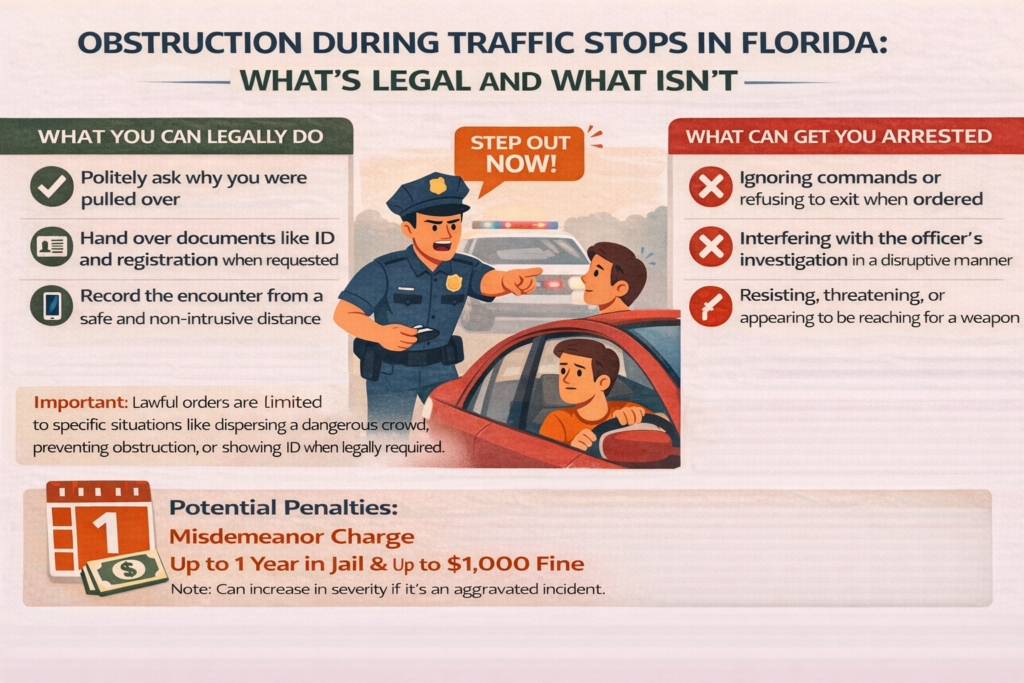
What Police Can Lawfully Require During a Traffic Stop
During a valid traffic stop, officers generally may:
Require a Driver to Provide:
-
Driver’s license
-
Vehicle registration
-
Proof of insurance
Order a Driver to Exit the Vehicle
Officers may direct a driver to step out of the vehicle during a lawful stop.
Control the Scene for Safety
This can include:
-
Directing passengers to remain in the vehicle
-
Ordering occupants to keep their hands visible
-
Conducting limited protective measures when justified
Failure to comply with lawful commands in these situations can support an obstruction charge.
What Police Cannot Automatically Require
There are limits.
You Are Not Required to Answer Investigative Questions
Beyond identifying yourself as the driver and providing required documentation, you generally have the right to remain silent.
Refusing to answer questions about where you are going or what you are doing is not automatically obstruction.
Passengers Have Different Obligations
Passengers are not required to produce identification unless there is independent legal justification. Learn more in Can Police Run Your Name If You’re a Passenger in Florida?
Consent to Search Is Not Mandatory
You may decline consent to search your vehicle. Exercising that right is not obstruction. These situations often overlap with broader identification issues. See Do You Have to Show ID in Florida If You’re Not Driving?.
When Conduct Becomes Obstruction
Obstruction charges often arise when conduct goes beyond verbal disagreement.
Examples may include:
-
Physically interfering with the officer’s investigation
-
Refusing repeated lawful commands that affect officer safety
-
Actively preventing an officer from completing required procedures
The State must prove actual interference — not merely non-cooperation. See how these charges are applied in Resisting Without Violence in Florida.
The Lawfulness of the Stop Matters
A traffic stop must be supported by at least reasonable suspicion of a traffic violation or criminal activity.
If the stop was unlawful, an obstruction charge based on that stop may be vulnerable to dismissal.
Courts analyze:
-
Whether the officer had a legal basis to initiate the stop
-
Whether the detention was extended without justification
-
Whether commands exceeded lawful authority
These issues frequently determine the outcome.
Common Defense Strategies
Challenging the Initial Stop
If the stop was unlawful, subsequent obstruction charges may collapse.
Lack of Interference
Not every delay or refusal constitutes obstruction.
Body and Dash Camera Review
Video evidence often reveals whether the commands were lawful and whether the conduct truly interfered.
Suppression Motions
If the stop or detention violated the Fourth Amendment, evidence may be excluded.
Potential Penalties
Resisting an officer without violence is a:
First-Degree Misdemeanor
Maximum penalties include:
-
Up to 1 year in jail
-
Up to $1,000 fine
-
Up to 12 months of probation
-
A permanent criminal record
Obstruction charges are sometimes added to traffic-related arrests to increase leverage during plea negotiations.
Arrested During a Traffic Stop in Broward County?
If you were arrested for obstruction during a traffic stop in Fort Lauderdale or anywhere in South Florida, the legality of the stop is often the most important issue.
At Michael White, P.A., we analyze:
-
Whether the stop was lawful
-
Whether commands were legally justified
-
Whether the conduct actually obstructed
-
Whether suppression or dismissal is available
Before resolving your case, make sure the stop itself withstands legal scrutiny.
📞 Confidential consultations available.