
Last updated April 2026
Facing a 5-Year License Revocation? Here’s What You Need to Know.
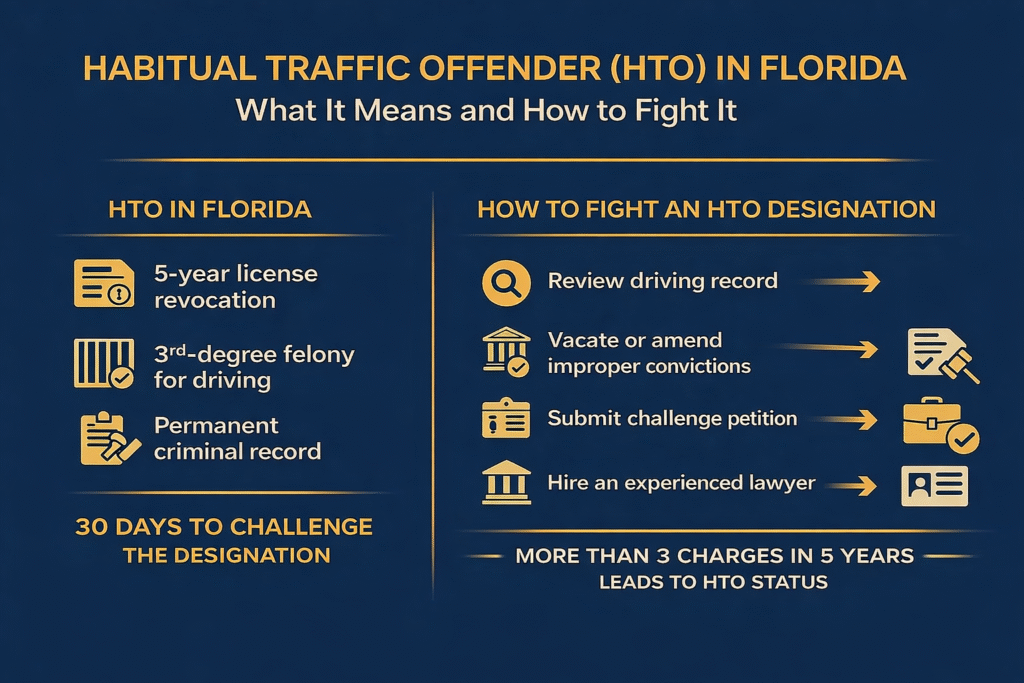
Being designated a Habitual Traffic Offender (HTO) in Florida is one of the most severe driver’s license penalties the state can impose. An HTO classification results in a mandatory five-year license revocation, and driving during that revocation is prosecuted as a third-degree felony.
Many drivers do not realize they are at risk until they receive formal notice from the Florida Department of Highway Safety and Motor Vehicles (DHSMV). By that point, the clock may already be running on your ability to challenge the designation.
If you have received notice — or believe you may qualify — you may still have options.
For a broader overview of license-related criminal charges, see our guide to Driver’s License Offenses in Florida.
⚖️ What Is a Habitual Traffic Offender in Florida?
Under Florida Statute § 322.264, a driver is designated a Habitual Traffic Offender if, within a five-year period, they accumulate:
1️⃣ Three or More Qualifying Serious Offenses
Common qualifying convictions include:
-
Driving With a Suspended or Revoked License (DWLS)
-
DUI
-
Leaving the scene of an injury accident
-
Fleeing or attempting to elude
-
Manslaughter involving a motor vehicle
-
Using a motor vehicle in the commission of a felony
-
Certain no-valid-license convictions
Many HTO designations are triggered by repeated convictions for Driving With a Suspended License, which is one of the most common qualifying offenses.
2️⃣ Fifteen or More Moving Violations Carrying Points
Fifteen separate point-based violations within five years may also trigger HTO status.
HTO designation is administrative and mandatory once the threshold is met.
🚫 What Happens After You Are Classified as HTO?
Once designated:
-
Your driver’s license is revoked for five years
-
Reinstatement is not automatic
-
Driving during revocation becomes a felony
-
Insurance premiums increase dramatically
-
Employment opportunities may be restricted
-
Future traffic charges escalate in severity
HTO status is not simply a traffic issue — it creates felony-level exposure.
🚨 Driving While Classified as HTO Is a Felony
If you drive during the HTO revocation period, you can be charged with a third-degree felony punishable by:
-
Up to 5 years in prison
-
5 years of probation
-
Felony fines
-
A permanent criminal record
This is substantially more serious than a standard misdemeanor DWLS charge. For how incarceration risk escalates in these cases, see Can You Go to Jail for DWLS in Florida?.
If you are facing new charges while classified as HTO, understand how HTO status affects new criminal traffic charges before taking action.
🧠 How to Fight a Habitual Traffic Offender Designation
HTO cases are record-driven. The strategy is rarely emotional — it is procedural.
The key question is: Were the qualifying convictions properly counted and legally valid?
1️⃣ Vacating a Prior Conviction
If one of the qualifying convictions was entered improperly — such as:
-
Lack of counsel
-
Defective plea colloquy
-
Failure to advise of rights
-
Invalid waiver
It may be possible to vacate that conviction.
If even one qualifying offense is removed, the HTO designation may collapse entirely.
This strategy is especially common in prior DWLS cases.
2️⃣ Reclassifying or Correcting Prior DWLS Convictions
Many HTO designations are built on stacked DWLS convictions.
In some cases, it may be possible to:
-
Amend a criminal DWLS to a civil infraction
-
Correct improperly coded offenses
-
Remove a predicate offense from eligibility
Because DWLS is the most common HTO trigger, correcting even one conviction can change everything.
3️⃣ Identifying Clerical or DHSMV Record Errors
HTO designations often rely on:
-
Duplicate entries
-
Misclassified charges
-
Offenses outside the five-year window
-
Improperly counted point violations
Comparing DHSMV driving history with court dockets frequently reveals errors.
Administrative mistakes are more common than many drivers realize.
⏳ The 30-Day Challenge Window
If you receive notice of HTO designation, you may have only 30 days to initiate a formal challenge.
Missing that window can:
-
Lock in the five-year revocation
-
Limit administrative remedies
-
Increase the risk of felony prosecution
Early intervention dramatically improves options.
⚠️ What Happens If You’re Arrested While HTO?
HTO status fundamentally changes how new traffic cases are charged.
A charge that might otherwise be a misdemeanor — especially DWLS — can be filed as a third-degree felony once HTO revocation is in place.
Consequences may include:
-
Formal felony filing
-
Reduced access to diversion
-
Higher bond conditions
-
Increased sentencing exposure
However, even after arrest, defenses may still apply.
Challenging the Underlying HTO After a New Arrest
Even after a felony filing, it may still be possible to:
-
Vacate a qualifying conviction
-
Correct improperly counted offenses
-
Remove a predicate DWLS conviction
-
Collapse the HTO designation
If the HTO status falls, the felony enhancement may fall with it.
This is often the most strategic path forward.
🔁 Can I Get a Hardship License After HTO?
Possibly — but not immediately.
In many cases, a driver may apply for a Business Purposes Only hardship license after 12 months of revocation, provided eligibility requirements are met.
A hardship license may allow limited driving for:
-
Employment
-
School
-
Medical appointments
-
Religious services
Eligibility is reviewed through the Bureau of Administrative Reviews and is highly fact-specific.
🧾 Why HTO Status Happens So Often
HTO designations commonly arise from:
-
Repeated DWLS pleas entered without counsel
-
Stacked minor violations over time
-
Overlapping DUI and license offenses
-
Unreviewed driving record errors
Many drivers resolve DWLS cases quickly — not realizing they are accumulating qualifying convictions toward HTO status.
Early record review can prevent long-term consequences.
👨⚖️ Fort Lauderdale Habitual Traffic Offender Defense Lawyer
HTO status does not have to define your future.
As a former prosecutor, Michael White understands how HTO designations are calculated, imposed, and challenged in Broward County and throughout South Florida.
Our firm works to:
-
Prevent HTO classifications before they become final
-
Challenge improper qualifying convictions
-
Reduce felony exposure
-
Pursue hardship eligibility when available
-
Protect clients from permanent criminal record damage
If you have received notice — or are facing new charges while classified as HTO — early legal review can make a significant difference.
📞 Call (954) 270-0769 or schedule a confidential consultation today.
❓ Habitual Traffic Offender (HTO) – FAQs
What qualifies someone as a Habitual Traffic Offender in Florida?
A driver may be labeled an HTO if they have three qualifying serious driving convictions or fifteen moving violations with points within five years.
How long is an HTO revocation?
The revocation period is five years. Limited driving privileges may be available after one year in some cases.
Can I get a hardship license after an HTO designation?
Possibly. Some drivers may apply for a Business Purposes Only license after 12 months, depending on eligibility and compliance.
Is there a way to fight an HTO designation?
Yes. You typically have 30 days to challenge the designation. A lawyer can review your record and contest improper qualifying convictions.
What happens if I drive while classified as an HTO?
Driving during an HTO revocation is a third-degree felony punishable by up to five years in prison.