
Last updated March 2026
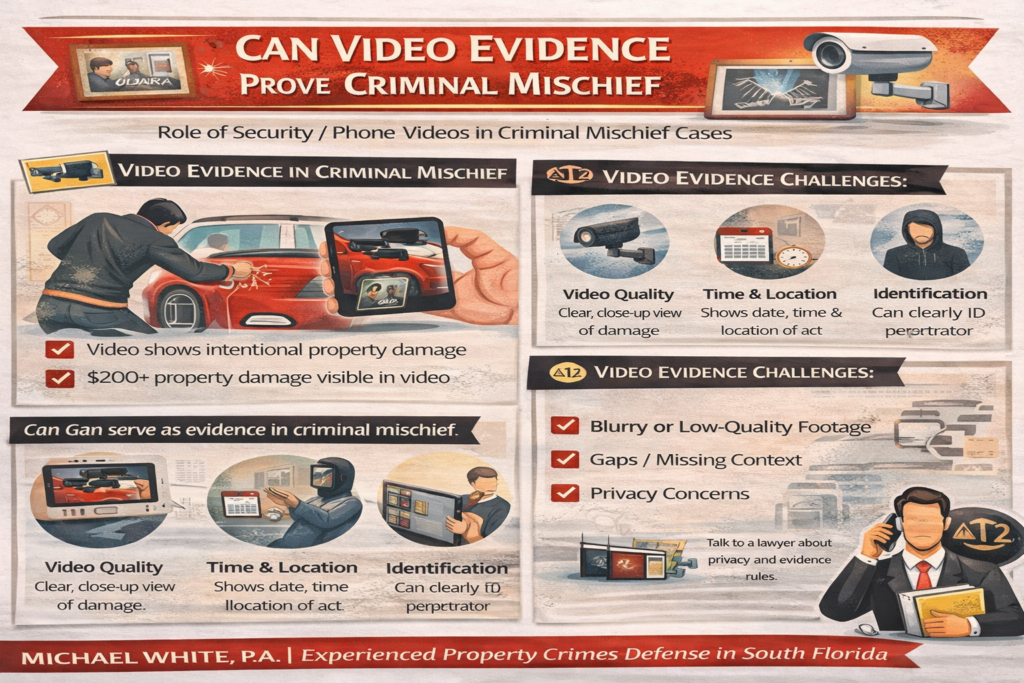
Video evidence is one of the most common forms of proof used in criminal mischief cases in Florida. Surveillance cameras, doorbell cameras, and cell phone recordings are often central to how these cases are investigated and prosecuted.
But video evidence is not always as clear or reliable as it seems.
For a general overview of the offense, see Criminal Mischief in Florida.
Is Video Evidence Enough to Prove a Case?
Not necessarily.
To prove criminal mischief, the State must show:
- intentional conduct
- damage to property
- that the property belonged to another person
Video may help establish these elements — but it must clearly show what happened and who did it.
If the footage does not establish identity or intent, it may not be enough to sustain a conviction.
Common Types of Video Evidence
In property damage cases, video evidence often comes from:
- home security systems
- doorbell cameras
- parking lot surveillance
- business cameras
- cell phone recordings
These sources can provide valuable evidence, but they also come with limitations.
Problems With Video Evidence
Poor Quality
Many recordings are grainy, distant, or taken at night. Facial features and identifying details may not be clear.
Lack of Context
Video may show part of an incident — but not what happened before or after. Without context, the footage can be misleading.
Unclear Intent
Even if a person is visible, the video may not show whether the conduct was intentional or accidental.
Misidentification
Assumptions are often made based on clothing, location, or timing. That does not always prove who committed the act.
Mistaken identity is a recurring issue in these cases.
How Video Evidence Is Used in Practice
Video is often combined with:
- witness statements
- physical evidence
- repair estimates
- police observations
However, these pieces do not always align. Inconsistencies between video and witness accounts can create reasonable doubt.
Video Evidence in Real-World Criminal Mischief Cases
Video frequently plays a role in cases involving:
- vehicle damage in parking lots
- graffiti or tagging incidents
- property damage during disputes
- vandalism at businesses or residences
For example:
- see Keying a Car in Florida for vehicle-related scenarios
- see Graffiti and Criminal Mischief in Florida for tagging cases
Can Video Evidence Be Challenged?
Yes — and it often is.
Defense strategies may include:
- challenging identification
- highlighting poor video quality
- exposing missing context
- questioning how the footage was obtained
- comparing video with conflicting evidence
Even when video exists, it does not automatically mean the State can prove its case beyond a reasonable doubt.
Why Video Evidence Does Not Always Tell the Full Story
Video can be persuasive — but it is not perfect.
It may:
- capture only part of an incident
- fail to show intent
- lead to incorrect assumptions
- be interpreted differently depending on context
A careful legal analysis is required to determine what the footage actually proves.
Fort Lauderdale Criminal Mischief Defense Attorney
Video evidence is powerful — but it is not definitive.
At Michael White, P.A., we analyze video evidence by focusing on:
- identification issues
- gaps in footage
- inconsistencies with other evidence
- whether intent is actually shown
In many cases, what video does not show becomes just as important as what it does.
FAQs
Is video evidence enough to convict someone in Florida?
Not always. The State must still prove every element of the charge, including intent and identity.
Can blurry video be used in court?
Yes, but its reliability can be challenged, especially if identification is unclear.
What if the video doesn’t clearly show my face?
That may weaken the State’s case. Identification must still be proven beyond a reasonable doubt.
Can video evidence be thrown out?
In some cases, yes — particularly if there are legal issues with how it was obtained or handled.