
Last updated March 2026
A juvenile’s phone can hold some of the most important evidence in a criminal case. Text messages, photos, videos, app data, location history, and social media content can all become targets in a police investigation. But that does not mean law enforcement has unlimited authority to search a minor’s device. In Florida, phone searches remain subject to constitutional limits, even in juvenile cases. For a broader overview of juvenile defense issues, see our guide to Juvenile Crimes.
Do Police Need a Warrant to Search a Juvenile’s Phone?
In many situations, yes.
Courts recognize that cell phones contain large amounts of personal data, and that gives them stronger privacy protection than many other items. Even if police lawfully take possession of a phone, that does not automatically allow them to search everything inside it.
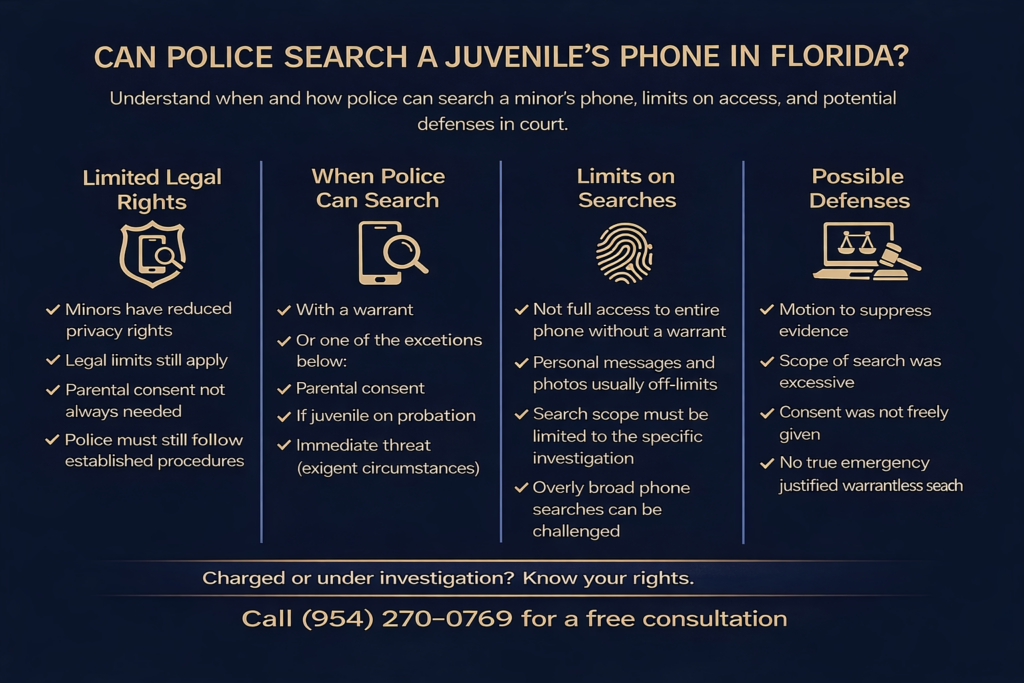
A warrant is often required unless an exception applies, such as:
- Valid consent
- Exigent circumstances
- Certain probation-related conditions
If none of those apply, a warrantless search may be subject to challenge.
Does It Matter That the Phone Belongs to a Minor?
It can.
Juveniles still have constitutional rights, but courts may evaluate situations differently depending on the child’s age, maturity, and understanding of what is happening.
This becomes especially important when police claim the juvenile “consented” to a search. A key issue is whether that consent was truly voluntary and informed.
If the issue is whether a minor could refuse a search in the first place, see our post Can a Juvenile Refuse a Search in Florida?.
What If the Phone Was Taken at School?
Many phone search cases begin in a school setting. A student may be asked to turn over a phone during an investigation, and that device can later end up in the hands of law enforcement.
That creates a layered legal issue:
- What were school officials allowed to do?
- When did police become involved?
- Did the legal standard change once law enforcement took over?
For more on how searches work in a school environment, see our post on School Searches & Student Rights in Florida.
Are There Limits on What Police Can Search?
Yes.
Even when police have legal authority to search a phone, the scope of that search is not always unlimited. A search tied to a specific investigation should generally stay within that scope.
For example:
- A search for messages related to a specific incident may not justify reviewing every app or photo
- Expanding beyond the original purpose may raise constitutional issues
If police go too far, the defense may be able to challenge parts of the evidence.
Can Phone Evidence Be Suppressed?
In some cases, yes.
Digital evidence may be challenged if:
- Police searched the phone without a valid warrant or exception
- Consent was not truly voluntary
- The search exceeded its lawful scope
- The phone was unlawfully seized in the first place
Because phone evidence can drive the entire case, these issues are often central to the defense strategy.
If the case also involves statements made during questioning, see our post that addresses Police Questioning of a Minor in Florida.
Why These Cases Require Early Attention
Phone evidence is often treated as highly persuasive, but how that evidence was obtained matters just as much as what it shows.
In juvenile cases, early legal review can identify whether the search was valid, whether rights were violated, and whether key evidence may be excluded. That analysis can significantly change how a case is defended moving forward.
FAQs
Can police search a juvenile’s phone in Florida without a warrant?
Sometimes, but only if a recognized exception applies, such as valid consent or exigent circumstances. In many cases, police still need a warrant to search the contents of the phone.
Can a juvenile give consent to search their phone?
Possibly, but courts will closely examine whether the consent was voluntary and whether the minor understood their rights. Age and maturity can play an important role in that analysis.
Can Phone Evidence Be Suppressed?
Sometimes, yes. Suppression may be possible if:
- Police searched without a valid warrant or exception
- Consent was not voluntary
- The search exceeded its lawful scope
- The seizure itself was unlawful
Because phone evidence can shape the entire direction of a case, challenging that evidence early may significantly improve the defense position.