
Last updated April 2026
Many people assume that once they have a lawyer, police are no longer allowed to question them.
That’s not always true.
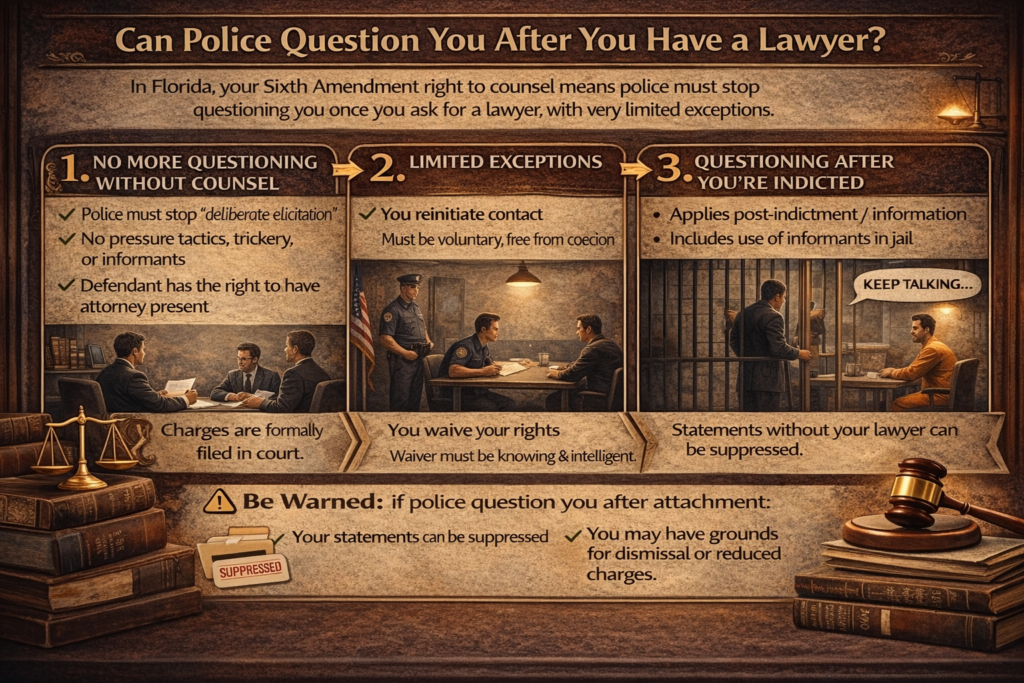
In Florida, whether police can question you depends on when your right to counsel attached and how the interaction occurs. In some situations, questioning is strictly prohibited. In others, statements may still be used.
For a broader explanation of how this protection works, see our guide to right to counsel in Florida.
⚖️ The General Rule After the Right Attaches
Once the Sixth Amendment right to counsel has attached:
- police cannot deliberately elicit statements about the charged offense
- questioning without your lawyer is heavily restricted
- attempts to bypass your attorney may violate the Constitution
But the analysis does not stop there.
🧠 Why This Issue Is Often More Complicated Than It Seems
The real question is not simply whether you have a lawyer — it’s:
- whether your right to counsel had attached
- who initiated the conversation
- whether any waiver was valid
Even small details can determine whether statements are admissible.
👉 Learn when this right begins in when the right to counsel attaches in Florida
🚨 When Police Questioning Is Not Allowed
After the right to counsel attaches, police generally cannot:
- initiate questioning about the charged offense
- use informants to obtain statements
- create situations designed to produce admissions
This applies even when questioning is indirect.
🕵️ Common Workarounds Police May Use
In real cases, officers may attempt to:
- place informants near a defendant
- record conversations in custody
- encourage casual discussion about the case
- reinitiate contact after silence
These tactics often become the focus of suppression litigation.
👉 Learn how courts analyze these situations in Massiah violations in Florida
⚠️ When Statements May Still Be Used
Statements may still be admissible if:
- you voluntarily reinitiate communication
- you clearly and knowingly waive your rights
- the questioning is unrelated to the charged offense
However, courts scrutinize these situations carefully.
🧠 Where These Cases Are Won or Lost
In many cases, the outcome depends on subtle facts, including:
- who initiated the conversation
- whether the defendant was pressured
- whether the waiver was truly voluntary
- whether officers deliberately created the situation
What looks like a casual conversation can become a constitutional violation depending on how it unfolds.
🔎 Real-World Examples
These issues frequently arise in:
- jailhouse conversations with other inmates
- recorded phone calls from custody
- follow-up questioning after charges
- situations where officers claim the defendant “wanted to talk”
Bodycam footage, recordings, and timing often determine the outcome.
⚖️ How These Violations Are Challenged
If police improperly question a defendant after the right to counsel attaches, the defense may seek to exclude those statements through a motion to suppress in Florida.
Courts will examine:
- whether the right had attached
- whether police deliberately elicited statements
- whether a valid waiver occurred
If the statements are excluded, the prosecution’s case may weaken significantly.
🛑 What Should You Do If Police Try to Question You?
If police attempt to question you after you have a lawyer:
- clearly state that you want your attorney present
- do not engage in conversation about the case
- avoid explaining or “clarifying” anything
Even informal statements can be used against you.
❓ Frequently Asked Questions
Can police talk to me after I have a lawyer?
Sometimes, but only under limited circumstances. Once the right attaches, police cannot deliberately elicit statements without counsel.
What if I start talking first?
If you voluntarily reinitiate communication, statements may be admissible — depending on the circumstances.
Can informants be used to question me?
In some cases, yes — but if used improperly after the right attaches, it may be a Massiah violation.
Can my statements be suppressed?
Yes. If police violated your right to counsel, your statements may be excluded.