
Last updated March 2026
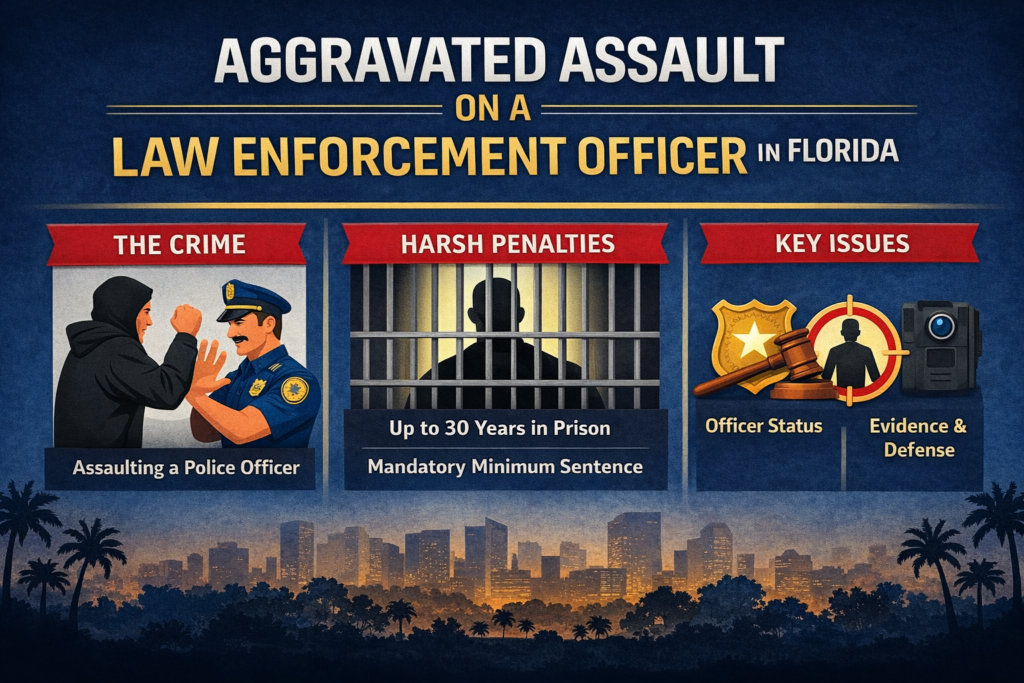
In Florida, aggravated assault charges become significantly more serious when the alleged victim is a law enforcement officer.
What might otherwise be charged as a third-degree felony can be enhanced — exposing a defendant to higher penalties, stricter prosecution, and reduced flexibility in resolving the case.
These cases are prosecuted aggressively, often with heightened scrutiny and limited tolerance for mitigation.
For a full overview of how aggravated assault charges are defined and prosecuted, see Aggravated Assault Charges in Florida.
⚖️ What Makes the Charge Different?
Under Florida law, aggravated assault on a law enforcement officer occurs when:
The defendant commits an aggravated assault
The alleged victim is a law enforcement officer
The officer was engaged in the lawful performance of their duties
The defendant knew (or should have known) the person was an officer
This enhancement changes both how the case is charged and how it is prosecuted.
🚨 Penalties and Enhancements
Aggravated assault on a law enforcement officer is typically charged as a second-degree felony, punishable by:
Up to 15 years in prison
15 years of probation
$10,000 in fines
If a firearm is involved, additional mandatory minimum sentencing laws — including Florida’s 10–20–Life statute — may apply.
For a deeper explanation of firearm-related enhancements, see Aggravated Assault with a Firearm in Florida: What You Need to Know.
🔍 The “Lawful Performance of Duties” Requirement
One of the most important issues in these cases is whether the officer was acting within the lawful scope of their duties.
If the officer was:
Acting outside their authority
Using unlawful force
Conducting an illegal detention or arrest
the enhancement may not apply.
These issues often arise in cases involving disputed police conduct, where the legality of the encounter becomes central to the defense.
🧠 Knowledge That the Person Was an Officer
The State must also prove that the defendant knew — or reasonably should have known — that the alleged victim was a law enforcement officer.
This can become an issue in situations involving:
Plainclothes officers
Undercover operations
Poor lighting or chaotic conditions
Rapid or confusing encounters
If this element is weak, the charge may be reduced.
🔫 Common Fact Patterns
These charges often arise from:
Traffic stops that escalate
Arrest situations involving resistance or confusion
Confrontations during investigations
High-stress encounters involving multiple officers
In some cases, the allegation involves a weapon being displayed or perceived during the encounter.
Whether that conduct meets the legal standard often depends on context, as discussed in Is Pointing a Gun Aggravated Assault in Florida.
🛡️ Defenses to Aggravated Assault on an Officer
These cases are serious — but they are still defensible.
Common defense strategies include:
Lack of Intent
The conduct did not constitute a true threat.
No Apparent Ability
The accused did not have the ability to carry out the alleged threat.
This element is critical in many cases and is explained in What Is “Apparent Ability” in Florida Aggravated Assault Cases.
Officer Not Acting Lawfully
If the officer was acting outside lawful authority, the enhancement may not apply.
Lack of Knowledge
The accused did not know the person was a law enforcement officer.
Self-Defense
In limited circumstances, self-defense may still apply — particularly if excessive force was used.
These principles are discussed in How Self-Defense Defeats Aggravated Assault Charges in Florida.
⚖️ Can These Charges Be Reduced?
Yes — but they are more difficult to resolve than standard aggravated assault cases.
Possible outcomes include:
Reduction to standard aggravated assault
Reduction to a lesser offense
Dismissal if key elements cannot be proven
A fuller discussion of how aggravated assault cases are resolved before trial appears in Can Aggravated Assault Be Dropped Before Trial in Florida.
📍 Why These Cases Are Prosecuted Aggressively
Cases involving law enforcement officers are often:
Filed quickly
Prosecuted aggressively
Given heightened priority
However, that does not mean the case is strong.
Many of these cases depend on:
Officer testimony
Body camera footage
Rapid, high-stress events
Those factors can create inconsistencies and opportunities for defense.
📞 Charged With Aggravated Assault on an Officer in Florida?
These are high-stakes felony charges — but they are not automatic convictions.
At Michael White, P.A., we bring former prosecutor insight to every case. We understand how these charges are evaluated — and how to challenge them effectively.
If you are facing aggravated assault charges in Fort Lauderdale or anywhere in South Florida, call (954) 270-0769 for a confidential consultation.
❓ FAQs
Is aggravated assault on a law enforcement officer a felony in Florida?
Yes. It is typically charged as a second-degree felony.
Do I have to know the person was an officer?
Yes. The State must prove you knew or should have known.
What if the officer was not acting lawfully?
The enhancement may not apply, and the charge could be reduced.
Can these charges be reduced or dismissed?
Yes, especially if key elements cannot be proven.
Are these charges more serious than regular aggravated assault?
Yes. They carry enhanced penalties and are prosecuted more aggressively.