
Last updated March 2026
How Evidence Handling Mistakes Can Undermine a Florida DUI Prosecution
In many Florida DUI cases, blood test results are presented as powerful scientific proof. But the strength of that evidence depends on something often overlooked: chain of custody.
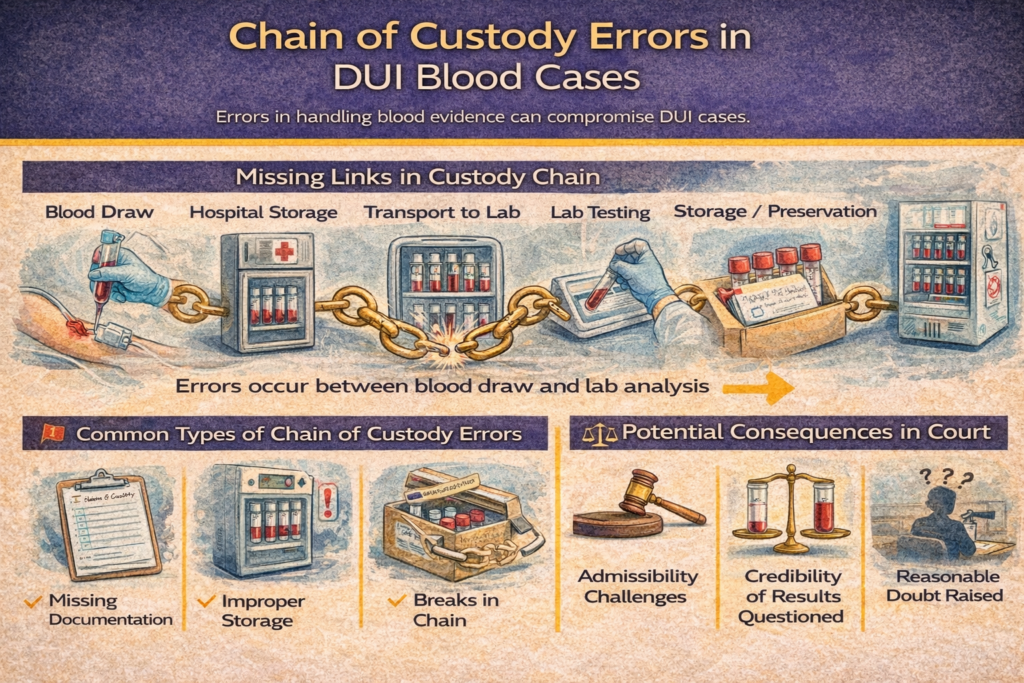
Chain of custody refers to the documented path a blood sample takes from the moment it is drawn until it is tested and introduced in court. If that chain is broken — even slightly — the reliability of the result can come into question.
This page explains what chain of custody means in DUI blood cases, common documentation errors, and how these issues are challenged in Florida courts.
For a broader explanation of how chemical evidence is collected, handled, and challenged, see our Florida DUI testing guide.
🔍 What Is Chain of Custody?
In a DUI blood case, chain of custody is the record showing:
Who collected the blood sample
When and where it was drawn
How it was labeled and sealed
Who transported it
Where it was stored
Who tested it
How it was preserved after testing
Each step must be documented. The purpose is to prove that the sample:
Was not tampered with
Was not contaminated
Belongs to the defendant
Was properly preserved
Chain of custody is one part of the broader framework that governs how chemical evidence is collected, preserved, and evaluated in Florida DUI cases. We explain how these issues arise in medical versus evidentiary testing in our guide to hospital blood draws vs. legal DUI blood tests in Florida.
Without a reliable chain of custody, the State may struggle to prove the blood result is trustworthy.
🩸 Why Chain of Custody Matters in DUI Cases
Blood evidence is often described as the “gold standard” of DUI testing. But even accurate lab equipment cannot fix poor handling or incomplete documentation.
Chain-of-custody issues matter because:
Blood samples are biological material that can degrade
Storage temperature affects alcohol concentration
Labeling errors can misidentify samples
Delays can alter chemical composition — including situations where medical treatment affects interpretation, as explained in our guide to how IV fluids affect blood alcohol results in Florida DUI cases
Missing signatures can raise tampering concerns
In court, the prosecution must show that the blood sample tested is the same sample taken from the defendant — and that it remained intact throughout the process.
🚨 Common Chain of Custody Errors in Florida DUI Cases
🏷️ Improper Labeling
Mistakes in labeling — including incorrect names, dates, times, or case numbers — can create doubt about the sample’s identity.
📄 Missing Documentation
Incomplete evidence logs, missing signatures, or gaps in transfer records may suggest that the chain was broken.
🌡️ Improper Storage
Blood samples must be stored under appropriate conditions. Temperature fluctuations or storage delays can affect reliability.
🚚 Transport Gaps
If there is no documentation showing how and when the sample was transported to the lab, the defense may argue contamination or mishandling.
🧪 Lab Handling Irregularities
Errors in lab intake procedures, testing logs, or analyst documentation can undermine admissibility.
⚖️ Legal Standards for Admitting Blood Evidence
Florida courts do not require perfection — but they do require reasonable assurance that the evidence is what the State claims it is.
If documentation gaps create substantial doubt about authenticity or integrity, defense counsel may:
Object to admissibility
Cross-examine witnesses about procedural failures
Argue that the evidence lacks sufficient foundation
Move to suppress the blood test result
The more serious the break in the chain, the stronger the challenge.
🛡️ How Defense Attorneys Challenge Chain of Custody
In DUI blood cases, effective defense often involves:
Requesting complete evidence logs
Reviewing lab intake and testing records
Comparing timestamps across documents
Examining storage procedures
Questioning technicians and law enforcement under oath
Even small discrepancies can grow under scrutiny.
For example:
A missing signature may indicate an undocumented transfer
A time gap may conflict with officer reports
A storage irregularity may affect BAC concentration
When the chain cannot be clearly traced, the credibility of the test result suffers.
🔬 Chain of Custody vs. Scientific Accuracy
It’s important to distinguish between:
Scientific validity (was the test performed correctly?)
andEvidence integrity (was the sample preserved and documented correctly?)
Timing also plays a critical role in reliability, as discussed in our guide to how long after driving police can test your BAC in Florida
A test may be scientifically accurate — but still inadmissible if the chain of custody is unreliable.
🚗 Blood Evidence Is Only as Strong as Its Paper Trail
Prosecutors often rely heavily on blood results in crash-related DUI cases. But those results are only as strong as the documentation supporting them.
Chain-of-custody problems can lead to:
Reduced credibility of the blood result
Exclusion of evidence
Negotiation leverage
In rare cases, dismissal
The outcome depends on how significant the break in the chain is and how it affects reliability.
📍 Charged With DUI Based on a Blood Test?
If your DUI case involves a blood draw, reviewing the chain of custody is critical. Evidence logs, lab reports, and transfer documentation may reveal weaknesses that are not obvious at first glance.
Blood test results are not automatic proof — they must be lawfully obtained, properly preserved, and reliably documented.
❓ Frequently Asked Questions
What is chain of custody in a DUI blood case?
It is the documented record showing how a blood sample was collected, handled, stored, transported, and tested.
Can a DUI blood test be thrown out because of paperwork errors?
Possibly. Significant documentation gaps or handling irregularities may affect admissibility or credibility.
Does a missing signature invalidate a blood test?
Not automatically, but it can raise questions about who handled the sample and whether procedures were followed.
Is blood evidence automatically stronger than breath testing?
Not necessarily. Blood evidence must still meet legal and procedural standards.
Can chain of custody issues help reduce charges?
Yes. Weak or questionable blood evidence can create leverage in plea negotiations or pretrial litigation.