
Last updated February 2026
Most people think a Florida criminal case is only about the sentence — jail, probation, fines, or court costs.
But for many people, the biggest damage comes outside the courtroom.
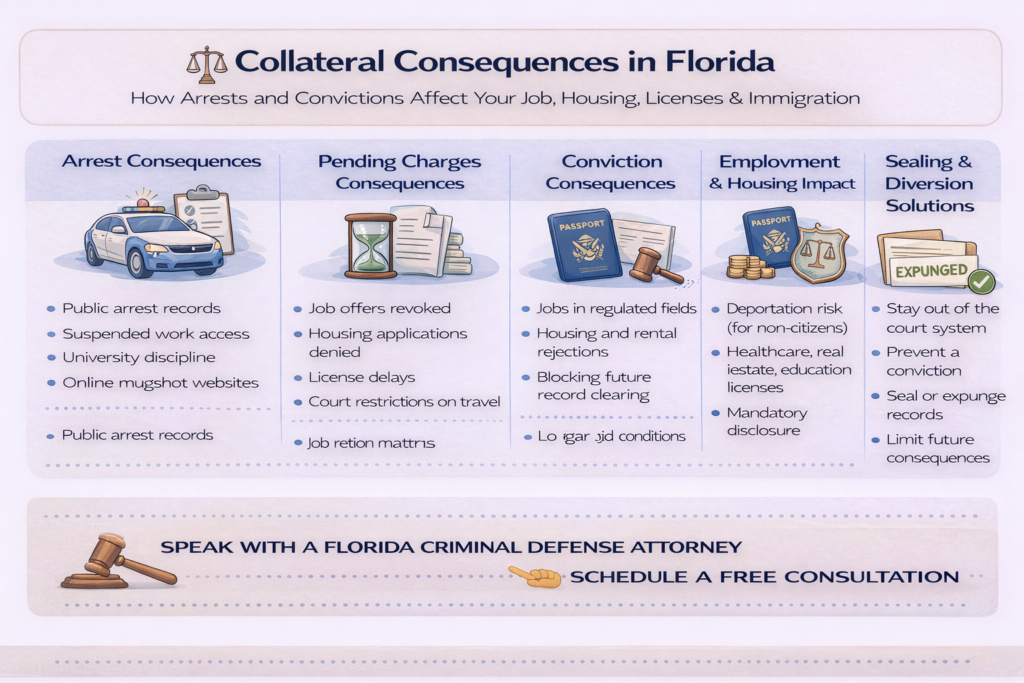
An arrest, pending charge, or conviction can affect your job, housing, professional license, immigration status, and reputation long after the case ends. These “extra” penalties are known as collateral consequences — and they often hit harder than the punishment itself.
If you were arrested in Fort Lauderdale or anywhere in South Florida, understanding these consequences early can help you make better decisions about pleas, diversion options, and record clearing
Collateral consequences are just one part of the larger system explained in our guide to Fort Lauderdale criminal defense.
✅ What Are “Collateral Consequences”?
Collateral consequences are the real-world penalties that follow a criminal accusation or outcome, even when they are not part of the formal sentence.
They can include:
Job loss or hiring denials
Apartment and housing denials
Professional discipline or license restrictions
Immigration problems (including removal risk)
Firearm restrictions
Loss of school or university opportunities
Reputational damage from public records and online search results
The key point is this: you can suffer collateral consequences even if the charges are dismissed — and the risk increases with pending charges and convictions.
🚔 Consequences of Being Arrested in Florida (Even Without a Conviction)
In Florida, arrests and case filings can become public record quickly. Even if you are not convicted, an arrest can trigger:
Background check flags
Employer “leave pending investigation” decisions
Suspended work access (security badges, credentials, driving privileges)
University or professional program discipline
Reputation harm from mugshot sites and online court records
If your case is still early, defense strategy matters because the best way to reduce collateral consequences is often to prevent formal filing, avoid conviction, or resolve the case cleanly.
⏳ Consequences of Pending Criminal Charges
Pending cases create their own set of problems because they signal “unresolved risk” to employers, landlords, and licensing boards.
Pending charges may lead to:
Job termination or suspension
Lost job offers during background screening
Housing denials, especially for drug, violence, and theft allegations
Delays in professional credentialing or renewal
Bond/pretrial conditions interfering with work schedules (court dates, testing, travel restrictions)
If you are worried about job loss while your case is pending, start here: Can You Be Fired While Criminal Charges Are Pending in Florida?
🧾 Consequences of a Criminal Conviction in Florida
A conviction can create long-term barriers that follow you for years — sometimes permanently.
Convictions can affect:
Employment in regulated fields (healthcare, education, finance, government)
Professional licensing applications and renewals
Housing approvals, especially with property management screening systems
Immigration status for non-citizens
Your ability to seal or expunge records
Your credibility in future cases, including prior record consequences
Even a “small” conviction can create outsized consequences depending on your career, immigration status, or licensing requirements.
👔 Employment Consequences
Florida is an at-will employment state. That means many private employers can terminate employment based on:
Arrests or pending charges
Perceived reputation risk
Missed work due to court or custody
Trust concerns, especially in theft, fraud, violence, or DUI cases
Some employees have protections (public employment, unions, written contracts), but many do not.
🏠 Housing and Background Check Consequences
Housing denials are one of the most common collateral consequences — especially in South Florida, where many apartment complexes use automated screening.
Background checks may show:
Pending charges
Arrest history (if not sealed)
Convictions and dispositions
Landlords commonly deny applications based on drug, violence, theft, or fraud allegations — and some deny based on any record at all.
For a deeper breakdown of how records affect jobs and housing (and what solutions may exist), see: How Does a Florida Conviction Impact Job and Housing Opportunities?
📋 Professional Licensing Consequences
For licensed professionals, a criminal case can trigger more than a court problem — it can become a career problem.
Many licensing boards require disclosure of:
Arrests
Pending charges
Pleas (even with withheld adjudication)
Convictions
Potential outcomes include:
Board investigations
Probationary licenses
Suspensions or revocations
Denials for new applicants
Healthcare professionals, teachers, real estate agents, contractors, and financial professionals are especially vulnerable to licensing collateral consequences.
🛂 Immigration Consequences and “Crimes of Moral Turpitude”
For non-citizens, the “collateral consequences” of a criminal case can be life-changing.
Certain offenses may trigger:
Inadmissibility
Denial of immigration benefits
Removal proceedings
Visa revocation or travel restrictions
One major risk category is crimes of moral turpitude (CIMTs) — a classification that often involves theft, fraud, deceit, or certain violent offenses.
If immigration or licensing is a concern, read this next: What is a Crime of Moral Turpitude in Florida?
🧠 Why Early Defense Strategy Matters
Collateral consequences are not an afterthought — they should shape the defense plan from day one.
The wrong plea can:
destroy sealing/expungement eligibility
trigger licensing discipline
create immigration consequences
make housing and employment denials far more likely
The right strategy can often:
reduce charges early
resolve a case before it becomes a permanent record
protect employment and licensing where possible
preserve future record-clearing options
🛡️ Talk to a Fort Lauderdale Criminal Defense Lawyer
At Michael White, P.A., we defend clients in Fort Lauderdale and throughout South Florida with one goal: protect your freedom now — and your future later.
If you’ve been arrested, charged, or are under investigation, we can help you fight the case and reduce the collateral damage that often follows.
📲 Call (954) 270-0769 to schedule a consultation.